Why it is written this way
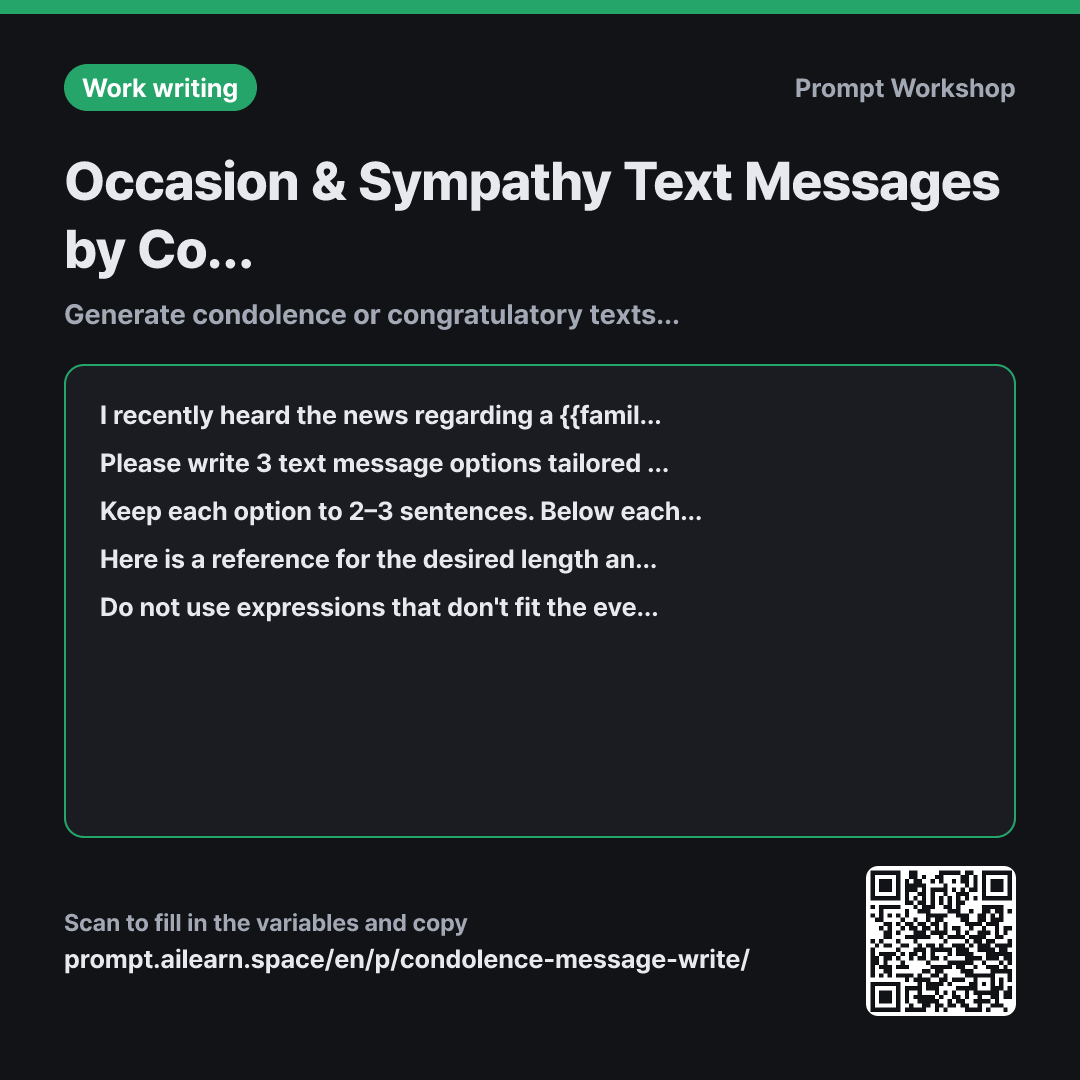
The most common mistake when drafting an occasion text message is providing only the event name, such as "Write a wedding text." When you do this, AI produces a generic template suitable for anyone, which is precisely why it feels unnatural. A message for a direct supervisor requires an entirely different tone and phrasing compared to one for an old friend, but an AI lacking relationship context cannot bridge this gap.
This is why the first paragraph establishes the Context by combining the relationship, event type, and attendance status. Attendance is especially crucial—the closing sentence changes completely depending on whether you can be there in person. Communicating your inability to attend politely makes up half the substance of the text.
Providing an Example in the fourth paragraph sets clear benchmarks for length and emotional tone. Typical search results for sympathy messages often lean either overly stiff or uncomfortably casual. Showing a single concrete sample aligns the AI's tone far more effectively than abstract descriptions.
Demanding 3 variations in the Format recognizes that managing these messages is more about selecting than composing. Having a "When to choose this" note attached to each draft allows you to pick the best fit and send it immediately. Finally, the negative constraints prevent critical blunders, such as accidental exclamation marks in condolence texts or hallucinated names.
Unfamiliar terms? See Aha AI: few-shot, output-format
Compared with a bad example
Write a condolence text message.
Without context about the relationship, AI defaults to maximum formal safety. The output ends up resembling a stiff corporate notice fit for an executive, making it awkward and distant if sent to a teammate. Without knowing your attendance status, it might include phrases like "I will see you at the service soon," rendering it unusable if you cannot attend.
Variations
For Celebrations Like Weddings and New Babies
I recently heard the news regarding a {{family event type}} for my {{interpersonal relationship}}. Regarding attendance, my status is: {{attendance confirmation status}}.
Please write 3 congratulatory text message options. Instead of repeating generic clichés, include an encouraging sentence wishing them the best moving forward in one of the options. Keep each option to 2–3 sentences and include a one-line "When to choose this" guide beneath each. Do not invent any names, dates, or locations not provided.
The negative constraints change for celebratory events. Restrictions on solemnity are replaced with instructions to avoid hollow, boilerplate greetings.
When Acknowledging News Late
I only recently learned about the {{family event type}} for my {{interpersonal relationship}}. Regarding attendance, my status is: {{attendance confirmation status}}.
Please write 2 text message options that briefly apologize for the delayed outreach in the opening sentence without making long excuses. Keep each option within 3 sentences and include a one-line "When to choose this" note below each.
When reaching out late, long excuses make it awkward for the recipient to reply. The prompt firmly restricts unnecessary explanations.
Model notes
Text messages with multiple line breaks might be split into several SMS segments depending on the carrier. If the result is too long, simply request: "Please rewrite this as a single paragraph without line breaks."
Related prompts
Last updated 2026-09-02 · Found a mistake? Let us know