Why it is written this way
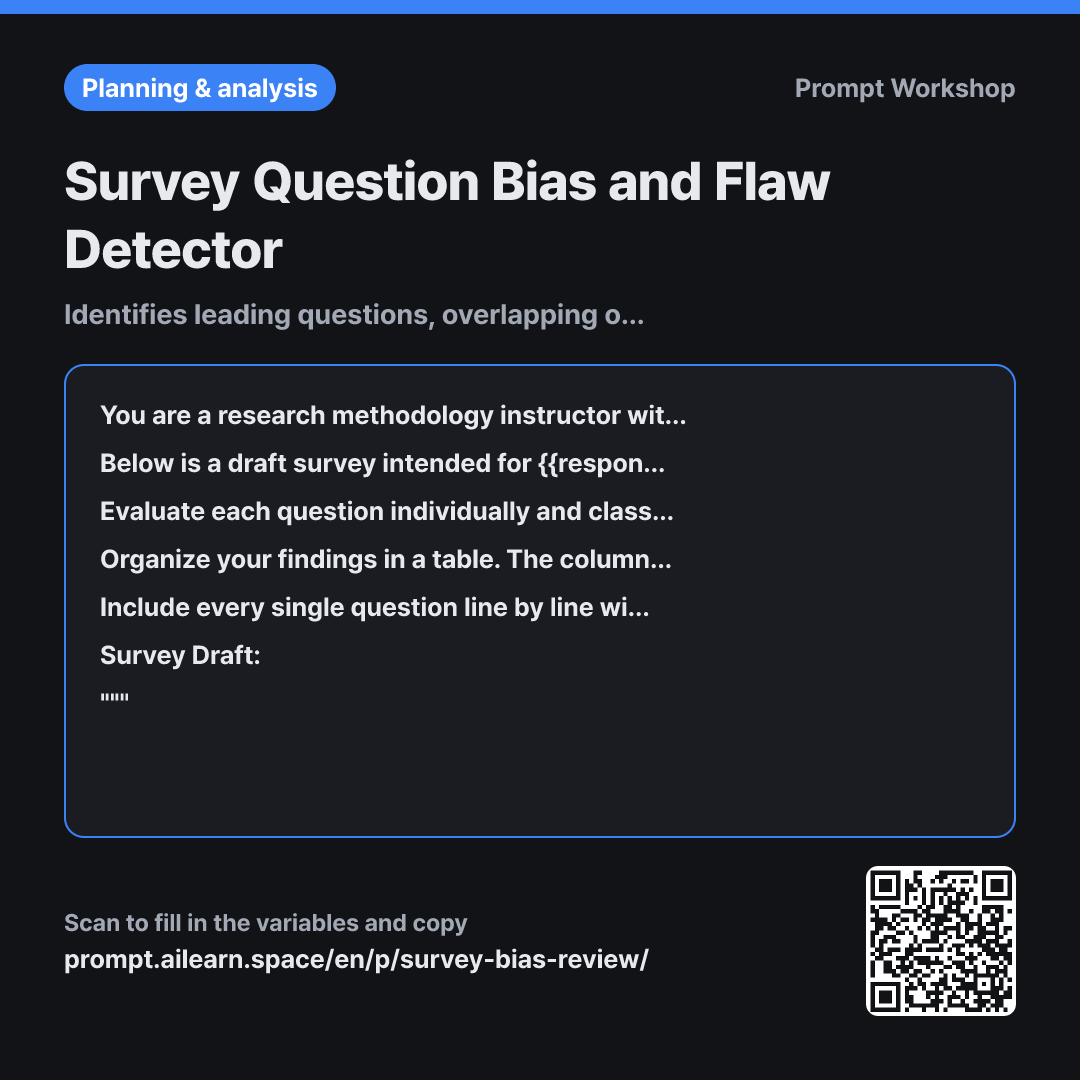
If you ask a simple review question like "How is this survey?", you will almost always get a polite response: "Overall, it looks well structured. Here are just a few minor suggestions." By default, AI tries to be encouraging. Without strict evaluation criteria, it writes vague impressions instead of spotting critical flaws, leaving biased or leading questions intact.
This is why the Role paragraph explicitly states, "Your job is not to praise well-written parts, but to pinpoint flaws that must be fixed." A job title alone is not enough; stating what the AI should not do shifts its tone. The category list in the third paragraph gives it a clear ruler for measurement. When categories are predetermined, you get precise diagnoses like "Question 4 is a leading question" instead of vague comments like "This feels a bit awkward."
Formatting the output as a table (Format) forces a row for every question. With a loose list, the AI often reviews just two or three obvious items. A structured table ensures it examines every item, even ones it might have skimmed past. The "Revised Version" column ensures you get immediately actionable copy rather than abstract critique.
Wrapping the survey draft in """ prevents instructional text inside the survey from being parsed as system commands. Surveys often contain prompts like "Please rate the following item," which can confuse the AI into answering the survey instead of reviewing it. Finally, asking for "missing questions" uncovers blind spots in survey scope beyond mere question phrasing.
Unfamiliar terms? See Aha AI: prompt-injection, output-format
Compared with a bad example
I made a survey. Please look it over and let me know if anything looks weird.
(Paste survey questions)
You will get a generic evaluation starting with "This is a great survey!" Even if it finds issues, the feedback will be vague (e.g., "Make Question 3 more specific"), leaving the rewriting work entirely to you. Furthermore, it often skips later questions entirely or starts answering the survey directly.
Variations
When you only want quick revisions
This is a survey intended for {{respondent target}}. Without any explanations or general overview, list only the questions that need fixing in the format: "Original → Revised". Do not list questions that require no changes.
""" {{survey draft}} """
Use this when you already know the issues and just want polished copy. Omitting explanations produces a concise result ready for copy-pasting.
To test through the respondent's eyes
You are a representative member of {{respondent target}}. Imagine taking this survey in real life, and note any friction points as you answer each question. Point out anywhere you found it hard to choose an option, wanted clarification on what something meant, or felt like guessing just to finish.
""" {{survey draft}} """
Forces the AI to adopt the respondent's perspective rather than an auditor's. This reveals questions that may be methodologically sound but frustrating to answer in practice.
Related prompts
Last updated 2026-09-02 · Found a mistake? Let us know