Finding Art Style Keywords in English

Translate vague aesthetic ideas into precise English art style terms

Prompt · 2 variables

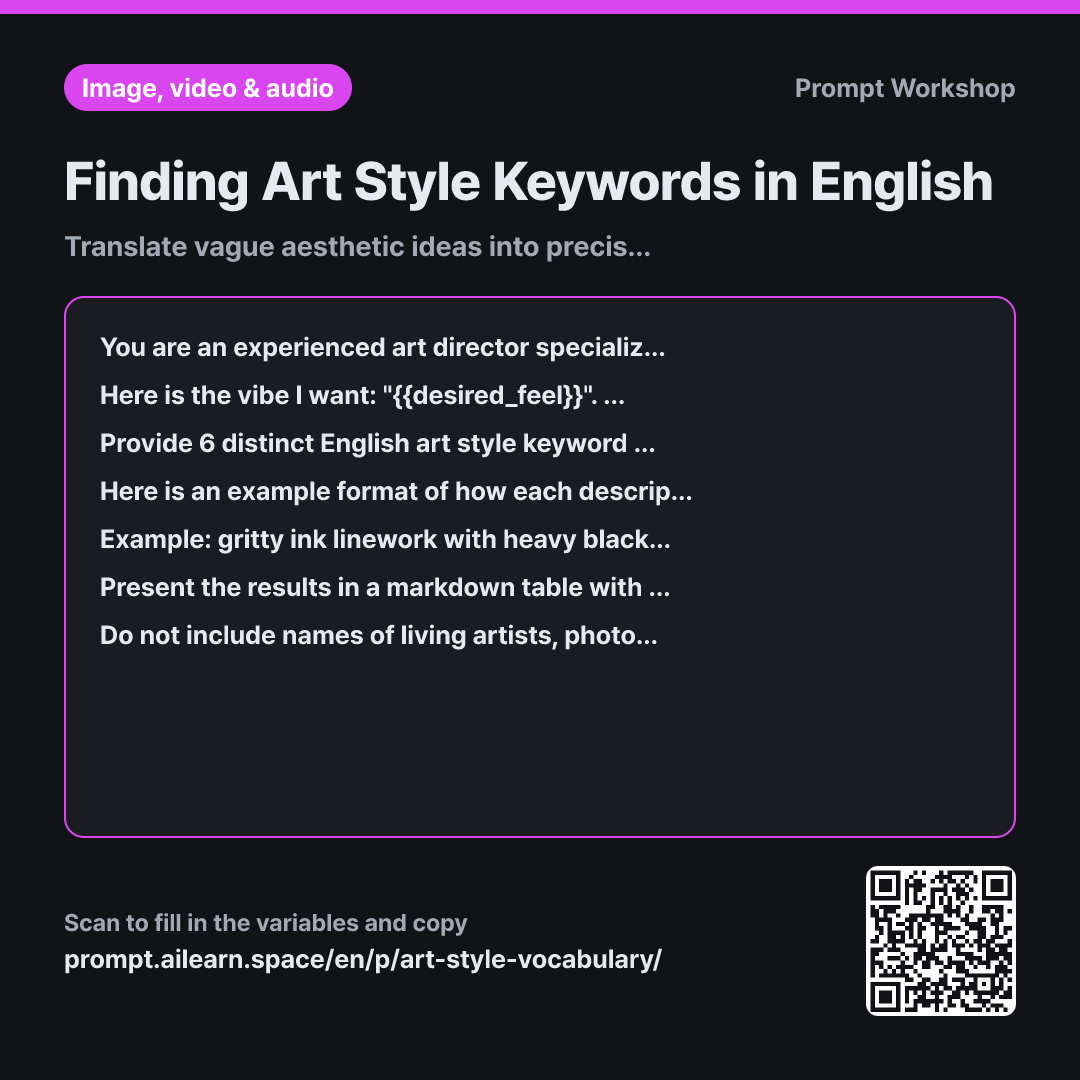
You are an experienced art director specialized in crafting prompts for image-generation AI tools. Your job is to translate conceptual visual ideas into precise English art style descriptors that AI models reliably understand.

Here is the vibe I want: "{{desired_feel}}". The reference or similar impression I have in mind is: "{{reference_elements}}".

Provide 6 distinct English art style keyword combinations that match this visual feel. Do not just name broad genres; combine specific attributes such as linework type, coloring method, texture, and color palette into a coherent descriptor bundle. Ensure the 6 options are not merely slight variations of each other—include at least two candidates from slightly different artistic branches.

Here is an example format of how each descriptor bundle should look. The subject and tone are different, so do not copy the exact words, just the formatting structure: Example: gritty ink linework with heavy black fills, limited two-color risograph palette, visible paper grain

Present the results in a markdown table with the following columns: English Descriptor Bundle · Plain-English Meaning & Feel · Key Strengths/Visual Impact · Trade-offs/What You Lose. Below the table, pick the two candidates closest to my original request and explain the reasons for your choice in two sentences.

Do not include names of living artists, photographers, studios, or specific copyrighted titles. Instead, deconstruct their visual characteristics into descriptive terminology. If a suggested descriptor might be less consistently recognized across different AI models, flag it as "obscure term" in the table.

Copy, then paste here · ChatGPT and Claude open with the prompt filled in Open in ChatGPT ↗Open in Claude ↗Open in Gemini ↗ Edit in builder Download classroom card

Why it is written this way

Role
You are an experienced art director specialized in crafting prompts for image-generation AI tools. Your job is to translate conceptual visual ideas into precise English art style descriptors that AI models reliably understand.
Context
Here is the vibe I want: "{{desired_feel}}". The reference or similar impression I have in mind is: "{{reference_elements}}".
Task
Provide 6 distinct English art style keyword combinations that match this visual feel. Do not just name broad genres; combine specific attributes such as linework type, coloring method, texture, and color palette into a coherent descriptor bundle. Ensure the 6 options are not merely slight variations of each other—include at least two candidates from slightly different artistic branches.
Example
Here is an example format of how each descriptor bundle should look. The subject and tone are different, so do not copy the exact words, just the formatting structure: Example: gritty ink linework with heavy black fills, limited two-color risograph palette, visible paper grain
Format
Present the results in a markdown table with the following columns: English Descriptor Bundle · Plain-English Meaning & Feel · Key Strengths/Visual Impact · Trade-offs/What You Lose. Below the table, pick the two candidates closest to my original request and explain the reasons for your choice in two sentences.
Constraints
Do not include names of living artists, photographers, studios, or specific copyrighted titles. Instead, deconstruct their visual characteristics into descriptive terminology. If a suggested descriptor might be less consistently recognized across different AI models, flag it as "obscure term" in the table.

When searching for style keywords for image generation, people often get stuck on vague phrases like "soft aesthetic" or "warm drawing vibe." While humans understand this intent, AI models need specific visual cues. Art styles already have standardized descriptive vocabularies, and knowing these exact terms makes or breaks the output quality. This prompt focuses solely on translating conceptual vibes into actionable terminology.

Setting the Role upfront shapes the nature of the response. Asking a generic query yields art history lectures, but setting the persona as an experienced prompt engineer produces terms that consistently trigger the intended look in AI models.

In the Task paragraph, broad genre words are explicitly disallowed. A single word like "watercolor" is too broad, leading to wildly different outputs every generation. Bundling line quality, rendering style, texture, and palette anchors the visual aesthetic. Requiring two distinct variations prevents six nearly identical suggestions.

Because describing the structure of visual keywords in plain instructions is difficult, an Example is provided. A contrasting genre is deliberately used in the example to prevent the AI from borrowing its exact keywords. The "Trade-offs" column in the Format paragraph is the core feature: every stylistic choice involves a compromise. Choosing pixel art reduces subtle facial expressions, while photorealistic textures reduce stylized cuteness. Knowing these trade-offs upfront saves trial-and-error iterations.

Unfamiliar terms? See Aha AI: few-shot, prompt

Compared with a bad example

Common bad example

I want to make an image that feels like a storybook. What English art style should I use?

A prompt like this typically returns generic keywords like "storybook illustration, whimsical, soft colors." All three are too broad, causing the AI tool to generate wildly inconsistent styles each time. Even if you get a good result, you won't know which keyword produced it because foundational details like line weight, color saturation, and paper texture remain completely undefined.

Variations

A/B Testing Candidates Side-by-Side

A/B Testing Candidates Side-by-Side

I want to compare two art style candidate bundles for the following desired feel: "{{desired_feel}}". Create two English generation prompts depicting the exact same scene using the two different styles. The subject, composition, and lighting sections must be identical word-for-word, changing only the style descriptor block. Below the two prompts, provide two sentences explaining what specific visual differences to look for when judging the outputs.

When multiple prompt variables change at once, it is impossible to isolate which element caused a stylistic shift. Keeping non-style parameters fixed ensures a clean comparison.

Targeting a Specific Audience (e.g., Children)

Targeting a Specific Audience (e.g., Children)

I need to generate illustrations for children's educational material based on the following style: "{{desired_feel}}". Please provide 4 English art style descriptor bundles that maintain an approachable, non-scary, and moderately stylized look suitable for young kids. Beneath each bundle, add a one-sentence tip on what to watch out for when applying that style to children's content.

The same general aesthetic can vary widely in emotional tone. Specifying the target audience narrows the style candidates to appropriate, safe parameters.

Model notes

Different AI models interpret style keywords differently. Rather than stacking multiple candidates together in a single prompt, test them one by one to see which specific descriptor produces the desired visual effect.

Related prompts

Last updated 2026-09-02 · Found a mistake? Let us know