Why it is written this way
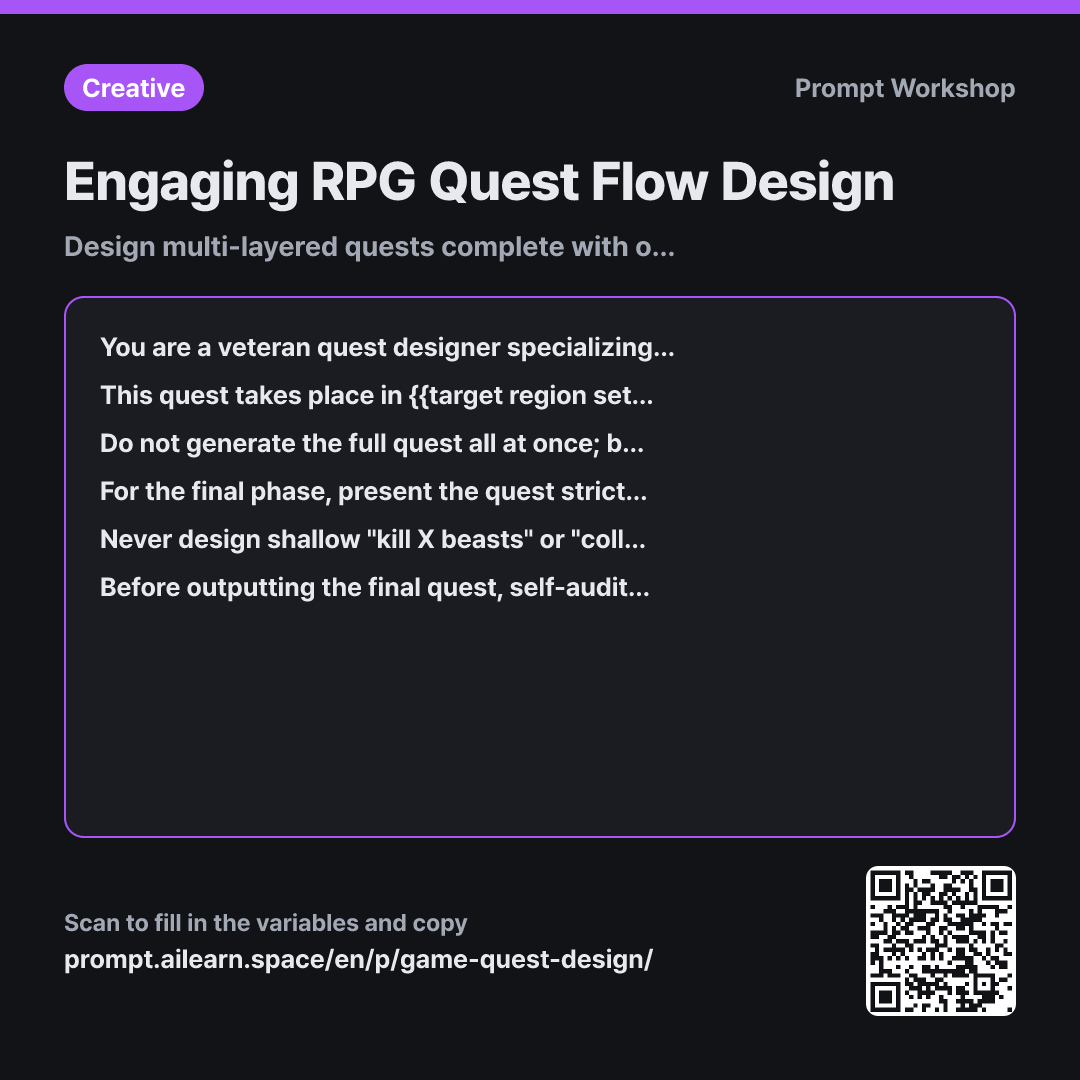
When asking an AI to design game quests without strict constraints, it almost always generates generic fetch quests—gathering five herbs or slaying ten wolves. The reason is simple: you only asked for an objective. When given solely a goal, the shortest path to that goal becomes the quest design.
Injecting the Role with a specific distaste ("despises mindless fetch quests") gives the AI an artistic preference. Providing just a job title makes the AI generate average industry clichés; specifying what it dislikes nudges it away from that baseline.
Quest design is inherently iterative, so splitting the task into three Phases is crucial. Starting with three local problems anchors the quest naturally in the world instead of forcing the setting to bend to an arbitrary quest mechanic. If the direction feels off, you can course-correct right at the one-line pitch phase.
The structured Format requirements are what truly eliminate fetch quest tropes. Demanding "hidden motives" and "consequences of failure" forces the model to construct contextual narrative layers. Dividing rewards into items, intel, and faction shifts stops the RPG quest AI from defaulting to just gold and generic loot. Finally, the Self-Audit step catches omitted sections across the eight mandatory criteria. Without explicit verification parameters, AI audits usually degenerate into empty self-praise.
Unfamiliar terms? See Aha AI: role-prompting, chain-of-thought
Compared with a bad example
Make a side quest for an RPG game set in a riverside village.
This produces a barebones fetch quest with a single objective. The village elder complains about the dried-up river, sends the player upstream, and the quest ends after killing a few monsters. The quest giver is completely honest, failure doesn't exist, and the reward is just gold. Without a defined duration, it might take 3 minutes or drag on for 2 hours.
Variations
Refining an Existing Quest Draft
You are a veteran quest designer specializing in {{game genre}}. Below is my initial quest draft. Do not rewrite it; simply diagnose it across three criteria: ① Segments lacking player agency or choices ② Stages where obstacles rely solely on combat ③ Missing failure states. Afterward, provide a revised version that fixes only the single weakest point, along with a one-line note on how this edit affects the {{gameplay play time}}.
Asking the AI to fix a quest outright often replaces your core vision with generic ideas. Requesting a diagnosis first and limiting revisions to one key flaw keeps your original concept intact.
Designing Interconnected Hub Quests
Design 3 interconnected quests set in {{target region setting}}. Each quest should be independently accepted by a player at the {{player level tier}} stage, but completing one must alter the conditions or narrative state of the other two. First, present a table showing only the one-line summary of each quest and how they influence one another. Format the table with columns: Quest Name · Quest Giver · Impact on Other Quests Upon Completion.
Ideal for populating an entire hub zone. Mapping interdependencies before detailing individual quests prevents narrative plot holes.
Model notes
Even when instructed to follow a multi-step process, some models may try to output everything at once. If this happens, add "Stop after listing the 3 problems" to your initial prompt, and send your chosen option in a separate follow-up message.
Related prompts
Last updated 2026-09-02 · Found a mistake? Let us know