Why it is written this way
When you ask for an entire fantasy world in a single prompt, you usually end up with a list of flashy names. You get twenty kingdoms and races, but the magic system in item 3 directly contradicts the warfare description in item 7—like claiming healing magic is trivial while also stating a plague wiped out half the population. These plotholes inevitably stall your drafting later.
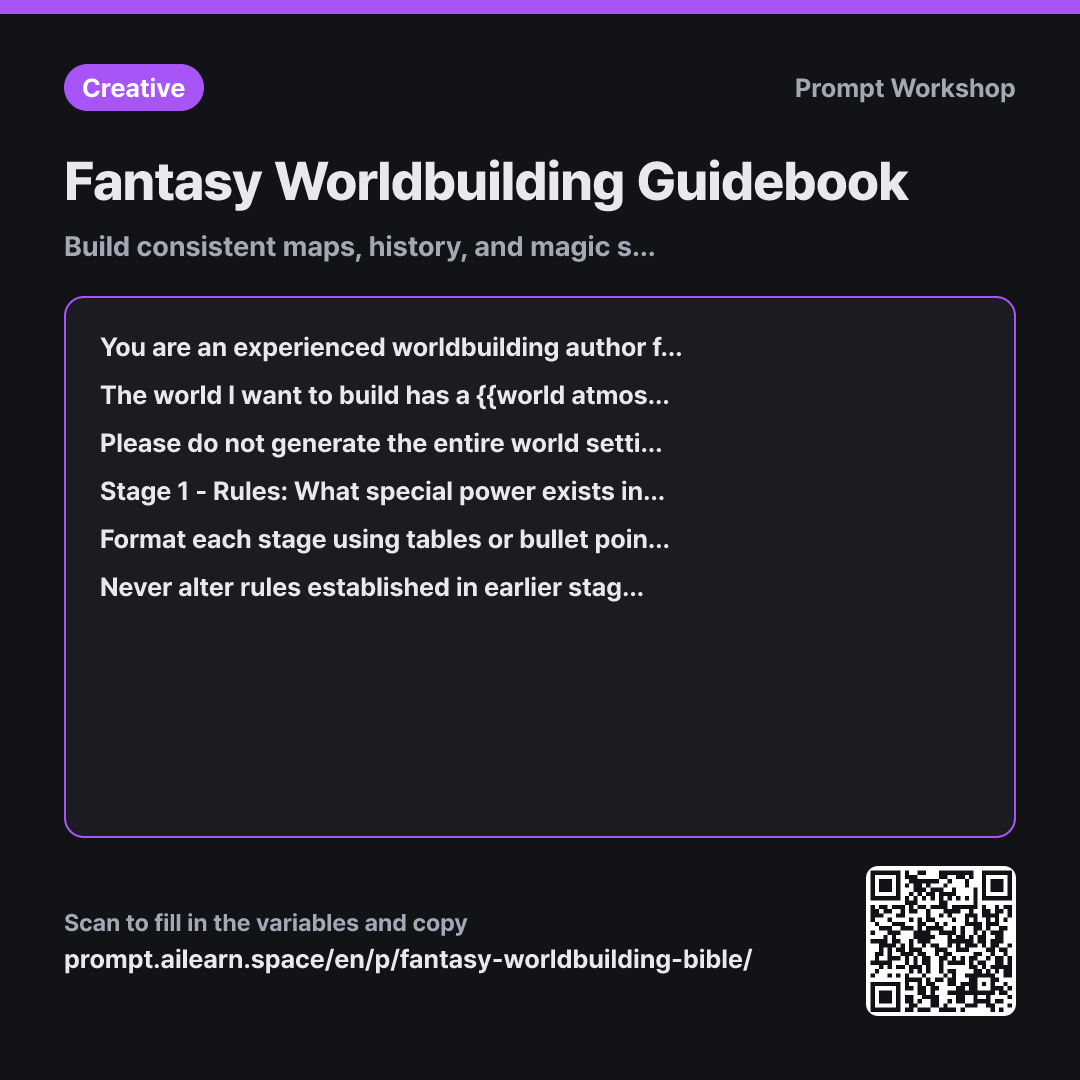
This prompt breaks the process into five distinct chunks to build the setting progressively. Starting with the core power rules is crucial. Defining what is possible and what is forbidden establishes why cities exist where they do and why certain factions hold power. In contrast, drawing the map first forces you to contrive unnatural rules to justify arbitrary geography.
Requiring an "Elements Used from Previous Stages" recap at the end of each step creates a memory anchor. As conversations grow longer, models tend to lose context; forcing the model to explicitly restate previous decisions keeps them active. The final 5th step acts as a dedicated consistency audit, compelling the AI to catch the typical contradictions seen in fantasy worldbuilding generation.
Defining the role as a "rule-keeper" rather than a "name-inventor" establishes the proper priority. Limiting the format to 8 bullet points and 3 proper nouns per stage is designed for informational density rather than mere length—excessive names only dilute logical consistency.
Unfamiliar terms? See Aha AI: chain-of-thought, context-window
Compared with a bad example
Make me a dark, rainy fantasy world setting. Include magic systems, maps, and history too.
Requesting everything all at once produces superficially plausible paragraphs that completely fail to cross-reference each other. It might state magic demands a severe toll, yet later describe entire cities relocated effortlessly with no sacrifice. Because resolving these tangled contradictions is so tedious, writers usually abandon the generated lore entirely.
Variations
Finding Contradictions in Existing Lore
Below is my world setting with a {{world atmosphere}} atmosphere. Please do not introduce any new lore or additions.
Audit the setting exclusively for internal contradictions: 1) Conflicts between magic/power rules and historical events, 2) Items or travel speeds inconsistent with the {{technical skill level}}, 3) World elements that inadvertently resolve the {{core story conflict}}. For each issue, pinpoint exactly which sections clash and provide a one-line recommendation on which element should be discarded to best serve the story.
Existing Lore: """ [Paste your current worldbuilding notes here] """
Use this when you already have extensive lore notes. Without the explicit instruction "do not introduce any new lore," the AI often fabricates more details to gloss over contradictions instead of flagging them.
Minimal Worldbuilding for a Single Scene
I am writing a single scene set in a world with a {{world atmosphere}} atmosphere. The technology level is {{technical skill level}}.
Do not generate an entire world bible. Establish only the essentials strictly required to write this scene: 1 location, 2 local rules, and 3 common-sense assumptions the characters take for granted. Below your list, provide a three-line summary of "Elements that do NOT need to be decided for this scene."
Trying to build an entire universe before writing often delays your first chapter for weeks. This approach scopes the lore down to what is immediately required for a single scene.
Model notes
When carrying five stages across a single chat thread, the AI may start dropping Stage 1 rules toward the end. Around Stage 3, prompt: "Summarize all currently established rules into a bulleted list," then copy and paste that summary at the start of your subsequent stage requests.
Related prompts
Last updated 2026-09-02 · Found a mistake? Let us know