Why it is written this way
When asking AI to "create an appealing character," the results are almost always predictable: a stoic yet secretly warm person who carries past trauma but remains resilient. A character profile full of glorified strengths cannot drive a scene. Characters move a story not through what they excel at, but through the flaws that cause them to fail.
Establishing the role as "a fiction editor who evaluates whether a character can drive dynamic scenes rather than writing flattering copy" is the primary mechanism. When assigned the role of a novelist, the AI tries to make the character look appealing; an editor asks whether this character will generate compelling narrative friction.
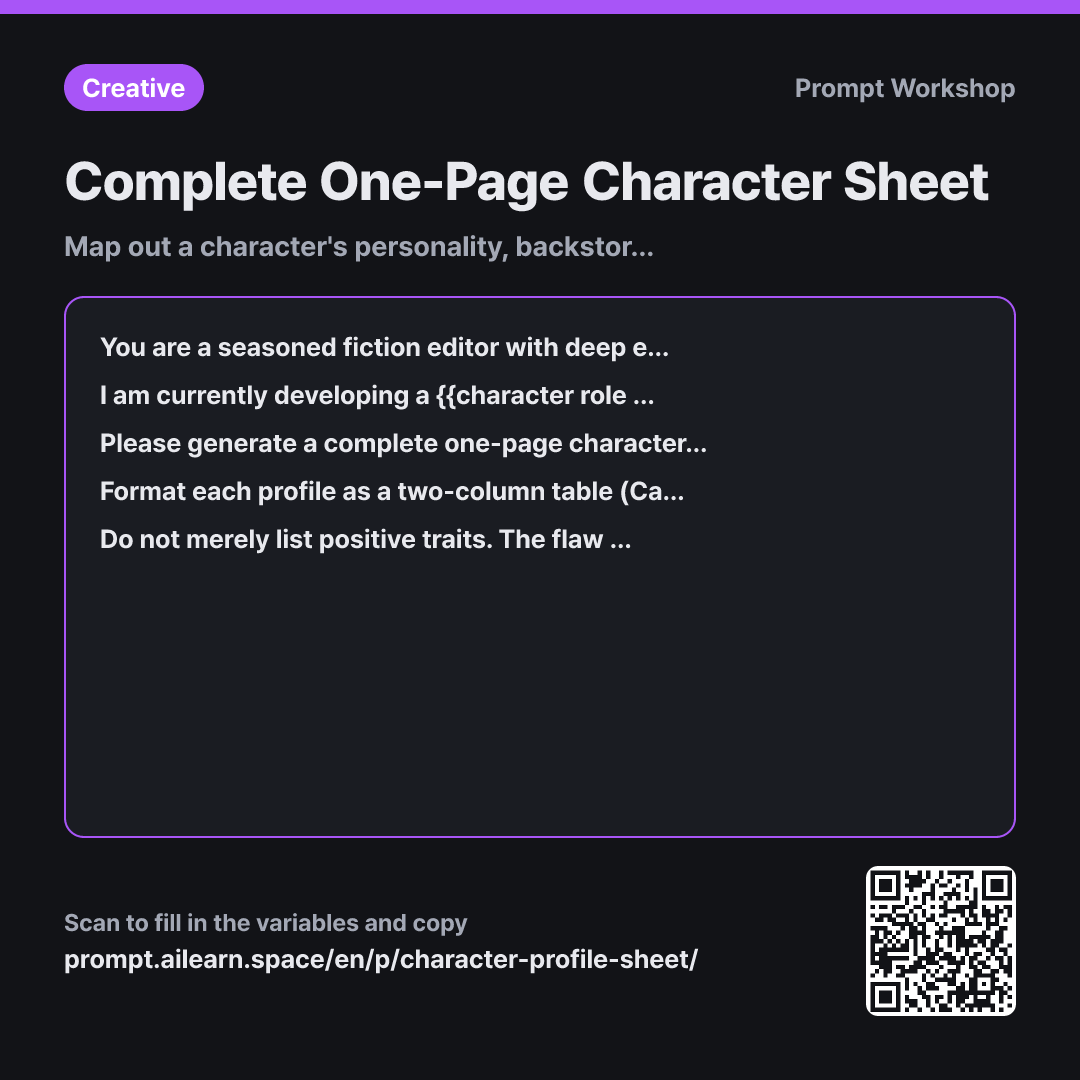
The item list in the format section forms the backbone of this prompt. Placing "How Others Perceive Them" and "True Inner Personality" side by side creates immediate tension within the character. Items like "One Habit Contradicting Words and Actions" and "One Thing They Would Never Do" are often missing from standard character sheets, yet they are precisely what generate realistic dialogue and scenes. Capping each cell at two sentences prevents the AI from stalling with bloated descriptions.
The constraints section forces the AI to frame flaws as actionable catalysts rather than personality adjectives. "Being stubborn" is not a functional narrative flaw; "acting without verifying facts and wrecking someone else's schedule" is. Requesting two candidates allows you to contrast options side by side and immediately spot which one fits your narrative better.
Unfamiliar terms? See Aha AI: persona, output-format
Compared with a bad example
Create an appealing villain character for my novel.
Without a specific genre or narrative role, the model produces a generic, cliché villain: tragic childhood, warped sense of justice, and a pre-packaged bond with the hero. Because the structural fields are not specified, actionable items like speech quirks or absolute boundaries are omitted, forcing you to rebuild the profile from scratch.
Variations
Filling gaps in an existing character
I have already outlined a {{character role description}} character for a {{creative work genre}} project. Here is what I have established so far:
Do not create an entirely new character. Instead, identify the missing elements and fill in the blanks. First, list the missing categories, then suggest 2 options for each category that stay consistent with the existing details. Add an asterisk (*) next to any suggestion that intentionally challenges or conflicts with the existing profile.
Character Information: [Insert name, age, personality traits, and backstory developed so far here].
Regenerating a profile from scratch often breaks continuity with scenes you have already drafted. Focusing exclusively on empty fields lets you flesh out the character without having to rewrite existing drafts.
Defining dynamic relationships between two characters
I want to create dynamic conflict between a {{character role description}} character and the protagonist in a {{creative work genre}} project.
Please propose 3 distinct dynamic relationship setups under the following premises: 1) They want the same goal through conflicting methods, 2) They want different goals but compete for the same limited resource, and 3) They are driven by a critical mutual misunderstanding. For each option, include a one-sentence summary of their first encounter scene and specify what distinct flaw each person must possess to sustain that dynamic.
Developing characters in isolation often leads to scenes where they fail to generate organic friction. Establishing the relationship dynamic first and reverse-engineering the necessary character flaws is much faster.
Model notes
When a character sheet has too many fields, the model's responses tend to become shorter and more generic toward the bottom. If the central flaw and defining backstory event are crucial, ask for those two first, finalize them, and then prompt the model in a follow-up turn to fill in the remaining categories for better depth.
Related prompts
Last updated 2026-09-02 · Found a mistake? Let us know