Why it is written this way
The most common prompt for AI character dialogue is something like: "Write this in a blunt yet caring tone." However, tone cannot be captured by adjectives alone. The AI's generic concept of "blunt" differs from what you envision, leading to clichéd soap-opera lines.
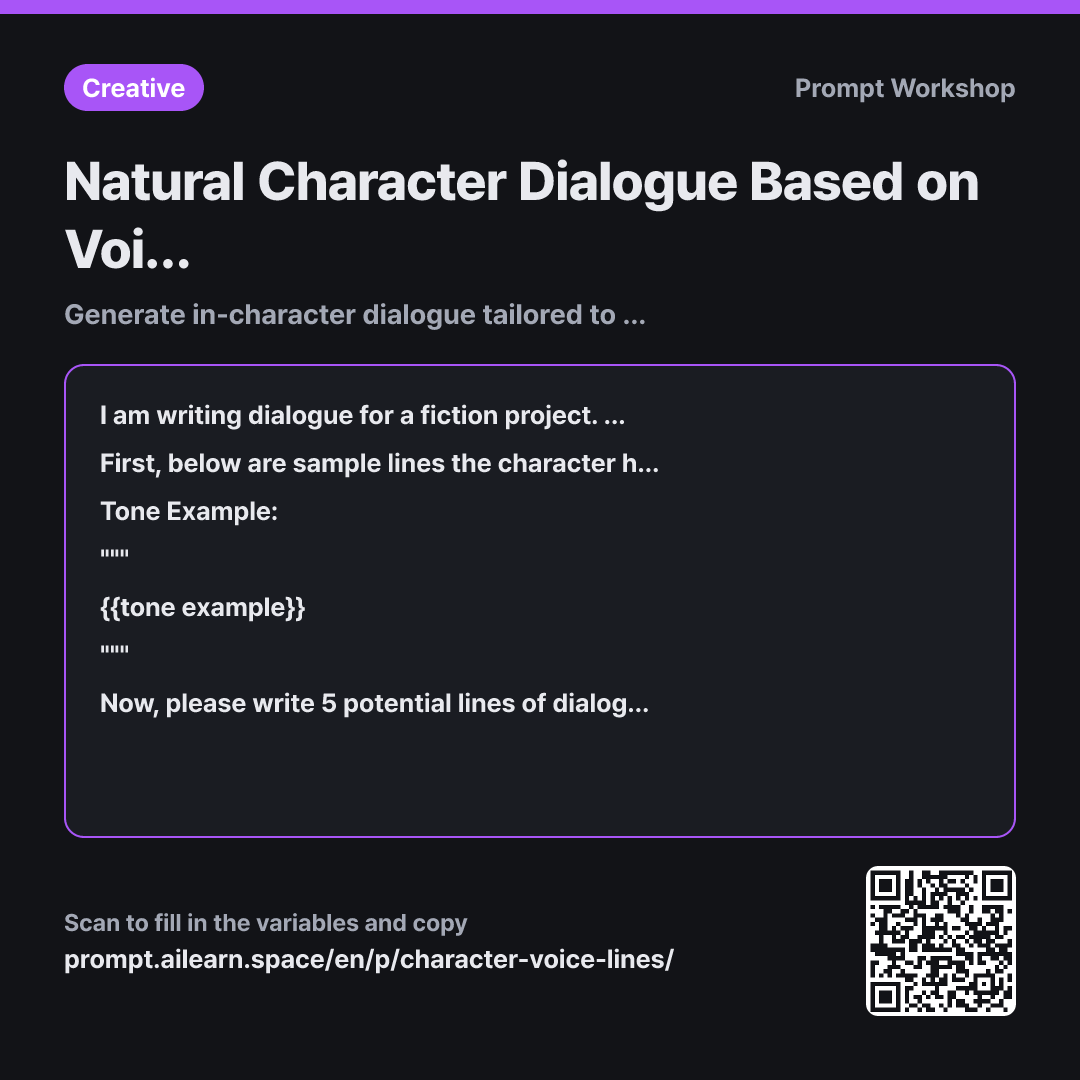
That is why the second paragraph establishes examples before instructions. With just two or three lines of actual dialogue, the AI captures sentence length, cadence, punctuation rhythm, and speech hesitations. Three actual lines beat ten abstract adjectives. If you don't have existing lines yet, even temporary draft sentences will yield better results.
Wrapping the profile and situation in """ serves two purposes. First, it prevents phrases like "covers it with dry jokes" from being treated as direct instructions to generate non-stop punchlines. Second, it clearly separates the voice reference material from background context.
The format requirement—adding a one-line rationale for each option—serves as a verification mechanism. If the AI cannot justify a line against the provided sample, it relied on generic intuition rather than the character's voice. Finally, the constraint paragraph prevents the classic pitfall of characters over-explaining their psychology. Listing "2 lines they would never say" draws clear boundaries for character consistency across future scenes.
Compared with a bad example
Write dialogue for a scared nurse character acting tough after getting caught making a mistake.
Without sample lines, the AI generates a generic "tough-acting persona." Several options will unnaturally state raw emotions like "I know I'm a coward." Running this prompt again in the next scene will yield a different tone, breaking consistency across your draft.
Variations
Rewriting Drafted Dialogue into the Character's Voice
Using the tone examples below as a baseline, rewrite my pre-written draft dialogue to match this character's voice. Do not change the core meaning; adjust only the phrasing and delivery. Show the rewritten line first, followed by the original line directly underneath. For lines that need no adjustment, keep them as-is and label them "Retained."
Tone Example: """ {{tone example}} """ Draft dialogue to revise in the {{dialogue situation}} scene: """ [Paste your draft dialogue here] """
Ideal for polishing an entire draft pass character by character. Keeping original lines side by side makes it easy to revert over-edited lines.
Two-Character Dialogue Exchange
Write an exchange between two characters in the situation below, keeping it under 12 lines total. The first character's voice must match the tone examples below. The second character speaks in short, concise sentences and rarely asks questions.
Ensure neither character repeats the same points, and make the situation worse by the end of the dialogue than it was at the beginning. Do not include stage directions.
Character Profile Setting: """ {{character profile setting}} """ Tone Example: """ {{tone example}} """
Generating a back-and-forth exchange is different from drafting standalone lines. Adding the constraint "make the situation worse by the end" avoids flat, instantly agreeable resolutions.
Model notes
As conversations grow longer, the AI gradually loses track of earlier tone examples. Repaste the tone example block whenever starting a new scene. When expanding your voice samples, pulling from finalized manuscript lines is the safest approach.
Related prompts
Last updated 2026-09-02 · Found a mistake? Let us know