Why it is written this way
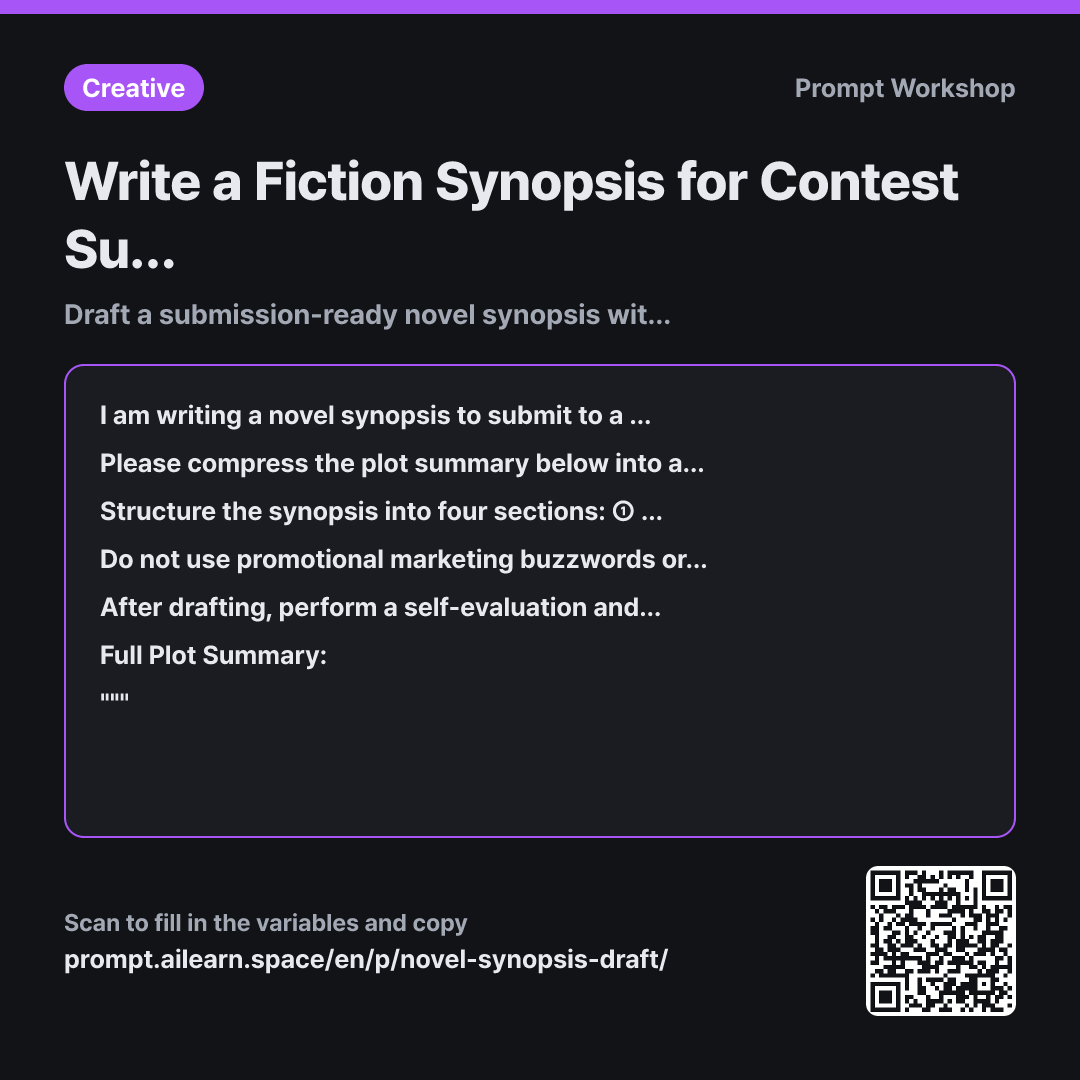
When using AI to write a novel synopsis, submissions often lose points during judging for one primary reason: AI tends to mistake a synopsis for back-cover blurb copy, ending crucial moments with teasers like "Will they ever uncover the truth?" Judges read a synopsis to verify that the ending and narrative structure hold up; if the ending is missing, the submission cannot be evaluated.
The Context established in the first paragraph prevents this misunderstanding. Clarifying that judges evaluate the submission based on this document forces the AI to adopt a formal, evaluation-ready tone rather than promotional copy. The subsequent Task section reinforces this by mandating full disclosure of the ending, explicitly naming the elements to reveal—such as the true culprit, major twists, and final character choices.
The third paragraph defines a structured four-part format and target length. Because general synopsis templates vary widely, AI outputs can be inconsistent without explicit constraints. Fixing the structure to logline, characters, plot progression, and resolution ensures a universally accepted contest format.
The fourth Constraint paragraph directly bans cliffhanger questions and excessive adjectives—the two biggest culprits making synopses sound like marketing blurbs. Finally, the Verification step directs the AI to self-audit length, ending clarity, and fabricated details, curbing its tendency to invent filler characters.
Unfamiliar terms? See Aha AI: output-format, hallucination
Compared with a bad example
Write a contest synopsis based on this plot.
(Pasted plot summary)
Without length specifications, the output might turn into 200 words or run over 1,500 words. The ending is often glossed over with vague lines like "The protagonist's choice changes everything," omitting the exact resolution judges need to see. The AI will also frequently hallucinate extra supporting characters.
Variations
Submitting to multiple contests with different limits
Below is the full plot summary of my {{creative work genre}} novel. Please write two synopses of the same story with different lengths: one fitting {{required length}}, and another condensed one-paragraph version (under 100 words).
The condensed version must retain only the core logline and the definitive ending. Verify at the end that both versions describe the exact same sequence of events.
""" {{entire plot summary}} """
Since different competitions have varying length requirements, generating a full-length draft alongside an ultra-short version saves time.
Reviewing an existing synopsis draft
Below is an existing synopsis I wrote for my {{creative work genre}} novel. Please review it from the perspective of a contest judge without rewriting it yet.
Provide a 2-line evaluation for each of the following three points: ① Is the ending clearly stated in complete sentences? ② Does the resolution feel unearned or rely on unestablished elements? ③ Are there any points where character names or motivations become confusing? Afterward, rewrite only the single most problematic sentence to show how it should be fixed.
""" {{entire plot summary}} """
Use this when you need editorial feedback on an existing draft rather than a complete rewrite, preventing the AI from overwriting your personal writing style.
Model notes
No AI model counts exact words or characters with 100% precision internally. After receiving the final draft, verify the word count in a text editor. If it exceeds your limit, prompt the AI with a specific reduction instruction, such as: "Shorten the character descriptions by two lines to keep the total under 500 words."
Related prompts
Last updated 2026-09-02 · Found a mistake? Let us know