Why it is written this way
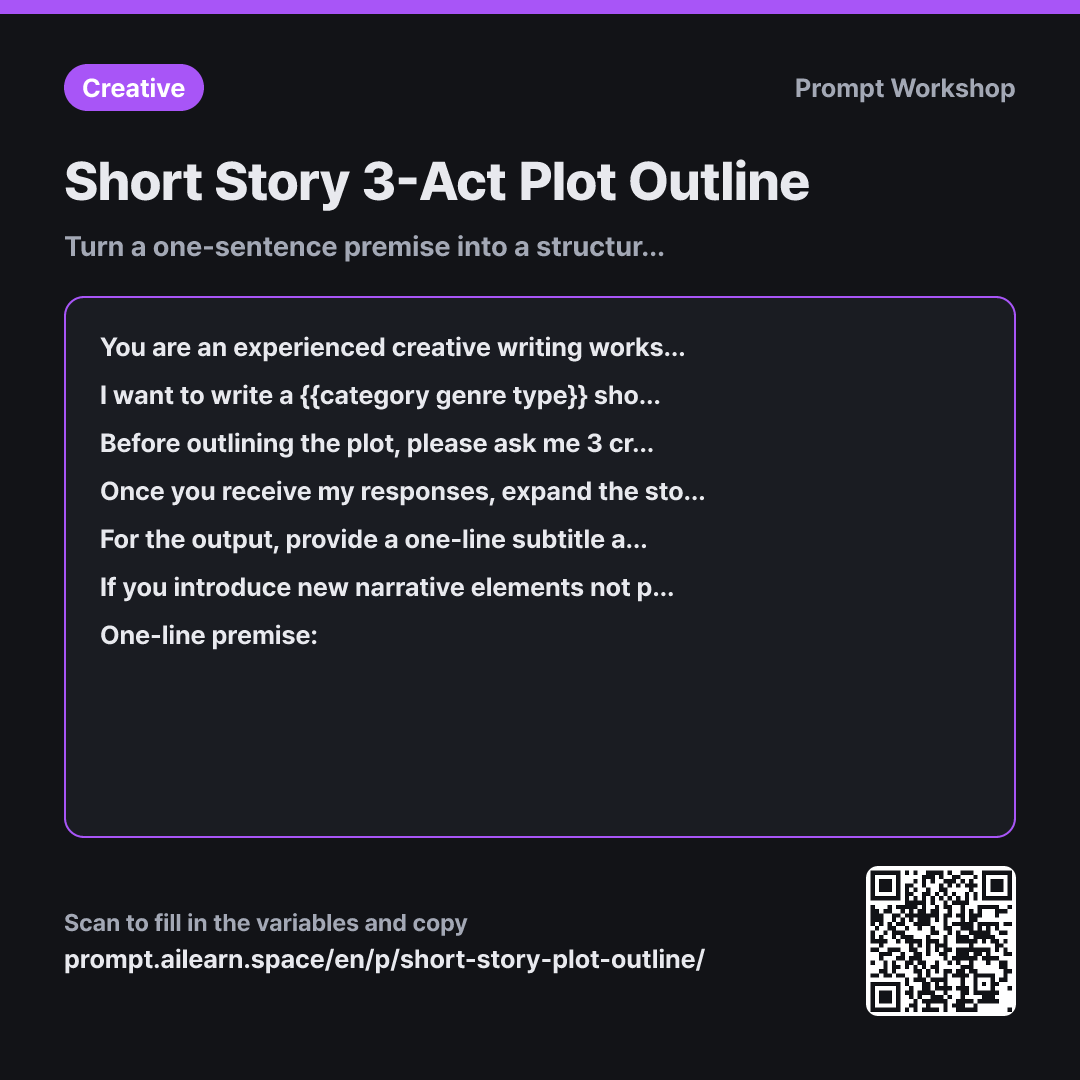
The most common failure in plot brainstorming prompts is giving a single-line idea and immediately asking, "Write me a plot." Lacking sufficient context, AI defaults to predictable clichés: the protagonist lost their family in a tragic accident, a dark secret is revealed midway, and everyone reconciles at the end. This prompt raises a stop sign before that auto-complete kicks in.
The third paragraph acts as that stop sign. By forcing the AI to ask clarifying questions rather than generating immediately, it pushes you to define key story choices yourself. These 3 questions typically target core motivations—such as "Why must the protagonist act now?"—effectively solving half the plot. Setting the role as a workshop instructor serves the same purpose: an AI assigned an author persona immediately tries to write prose, whereas a critiquer looks for plot holes first.
The fourth paragraph breaks the workflow into three steps. It locks down the desire and obstacle in single sentences, arranges beats chronologically, and only then maps them into acts. When asked to produce a plot all at once, AI creates acts first and forces events to fit; this structured order ensures events come first and structure follows.
In the format section, limiting scenes to single sentences prevents early drafts from getting bogged down in descriptive filler. Polished prose can easily hide structural flaws. Finally, the constraint tag [Added Detail] helps you distinguish your core ideas from AI suggestions, and banning overused tropes ensures the brainstorming starts in fresh territory.
Unfamiliar terms? See Aha AI: role-prompting, chain-of-thought
Compared with a bad example
Make a short story plot outline with this idea:
A winter coat has been hanging in the dry cleaner unclaimed for 20 years.
With a prompt this vague, the AI decides who owns the coat and why it was never picked up on its own. It will likely default to a deceased family member or a missing lover, resolving the mystery with an emotional letter. Because it veers far from what you intended without clear turning points, you end up having to discard the entire output and start over.
Variations
Reviewing the Structure of an Existing Draft
I have written a draft for a {{category genre type}} short story of around {{content amount}}. The protagonist is {{main character protagonist}}.
Please read the synopsis below and do not rewrite the story. Instead, pinpoint only three things: ① which sentence reveals what the protagonist wants, ② where the pacing lags in the middle, and ③ whether the ending feels earned based on earlier setups. Then, suggest two ways to fix the most urgent issue.
""" {{one line idea}} """
When you already have a draft, diagnosing where the structure falters is much faster than rebuilding from scratch. Explicitly instructing "do not rewrite the story" prevents the AI from jumping straight into generating a revised draft.
Brainstorming Multiple Ending Options
Please provide 5 alternative ending scenes for a {{category genre type}} short story. The protagonist is {{main character protagonist}}, and the story seed is provided below.
Write each option in a single paragraph (no more than 3 sentences), followed by a one-line note on what narrative seeds must be planted earlier for this ending to work. The five options should evoke distinct emotional tones.
""" {{one line idea}} """
Use this variation when you are stuck on the climax or resolution. Asking what narrative seeds must be planted earlier ensures you get actionable insights on how to adjust the setup leading into the ending.
Model notes
Some models may skip the interactive step and generate the outline immediately despite the prompt instructions. If that happens, send only the instruction "Please ask 3 clarifying questions first and wait for my response" on your first turn, then provide your answers along with the rest of the prompt.
Related prompts
Last updated 2026-09-02 · Found a mistake? Let us know