Why it is written this way
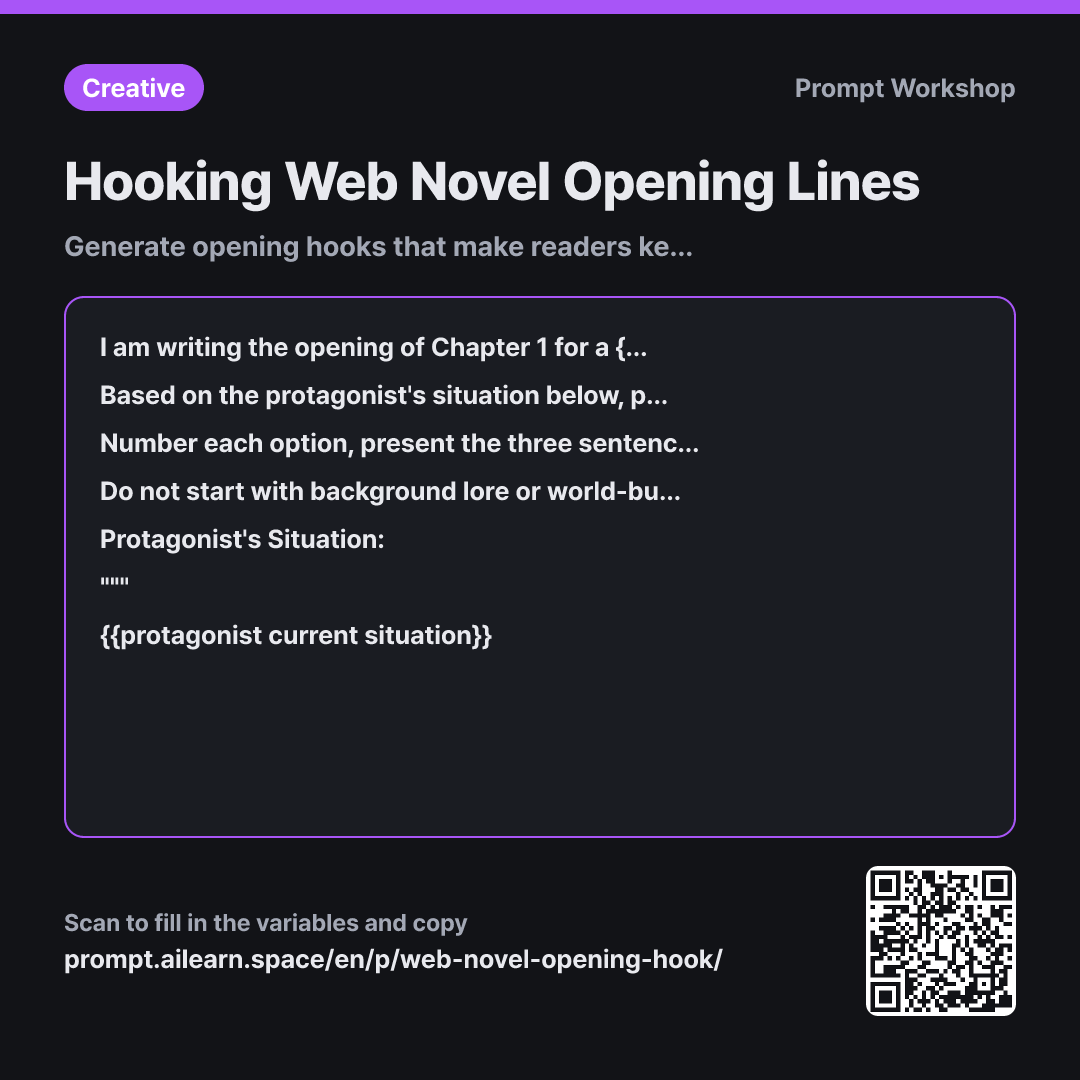
The biggest mistake when prompting for web novel openings is treating the hook as "the start of a story." When asked to write Chapter 1, AI typically opens with the weather, describes the protagonist's age and profession, and only introduces the inciting incident around the third paragraph. That pacing might work for print novels, but digital web novel readers drop out immediately at the preview screen.
That is why the prompt establishes the context in the first paragraph: "readers decide within the first few lines of the free preview." Setting the reading format shifts how the AI structures sentence priority. The following Task section asks for 7 distinct candidates rather than a full chapter. Evaluating a single output provides no comparative baseline, but viewing seven options side by side makes the most engaging hook immediately obvious.
Labeling each hook technique in the third paragraph is a strategic tool for pacing future chapters. If you select a "Loss" hook for Chapter 1, you can intentionally open Chapter 2 with a different angle to keep the narrative rhythm fresh. Instead of relying blindly on AI suggestions, cataloging these techniques helps you actively direct your story's momentum.
Finally, the Constraints in the fourth paragraph do the heaviest lifting. Weather intros, alarm clocks, and mirror reflections are the most common opening clichés; banning them forces the model into creative territory from the start. The 15-word cap on the first sentence and the strict limit on proper nouns prevent the hook from getting bogged down with unfamiliar lore. Once you pick your favorite, you can simply ask the model to "expand this specific hook with three more sentences" to continue drafting.
Unfamiliar terms? See Aha AI: self-consistency, output-format
Compared with a bad example
Write the opening of Chapter 1 for an urban fantasy web novel. The protagonist is an office worker who just got laid off.
Requesting only one draft provides zero comparative options. The AI will almost certainly open with descriptions of the evening subway ride home and a lengthy monologue on the protagonist's past ten years, delaying the actual incident by ten lines. Prompting "try again" repeatedly yields similar structural variations rather than distinct creative angles.
Variations
Diagnosing and Polishing an Existing Opening
Below is the opening paragraph of Chapter 1 for my {{category genre type}} web novel. Please diagnose it instead of rewriting from scratch.
1. Identify which sentence carries the highest risk of making the reader drop off. 2. Pinpoint any expository sentences that can be safely postponed. 3. Highlight the single strongest sentence in the paragraph.
After answering these three points, provide one revised version that moves the third highlighted sentence to the very beginning.
""" {{protagonist current situation}} """
Often, the real hook is already buried deeper in your draft. Rearranging the sentence order preserves your authentic authorial voice while instantly improving pacing.
Matching the Opening with a Title and Blurb
I have selected the following three sentences as the opening hook for Chapter 1 of my {{category genre type}} web novel.
Based strictly on this opening, generate a book blurb (under 100 words) and 5 title candidates. The blurb should rely only on details already revealed in this opening, hinting at future plot developments in no more than one sentence. For each title candidate, add a one-line note specifying its target reader demographic.
""" {{protagonist current situation}} """
A tonal mismatch between the blurb and the opening chapter leads to immediate reader drop-off. Finalizing your hook first and aligning the synopsis afterward ensures consistency.
Model notes
When asking for 7 candidates, the last two or three often become slight variations of the earlier ones. An effective alternative is to request 5 options first, then follow up with: "Give me 3 more options using completely different opening techniques from the first five."
Related prompts
Last updated 2026-09-02 · Found a mistake? Let us know