Why it is written this way
If you simply feed a topic to ChatGPT for a poem, the results are shockingly predictable. Starlight streams, time flows like a river, and the final line wraps everything up with "yet we must carry on." Models default to high-frequency clichés first, but restricting those worn-out expressions upfront changes everything.
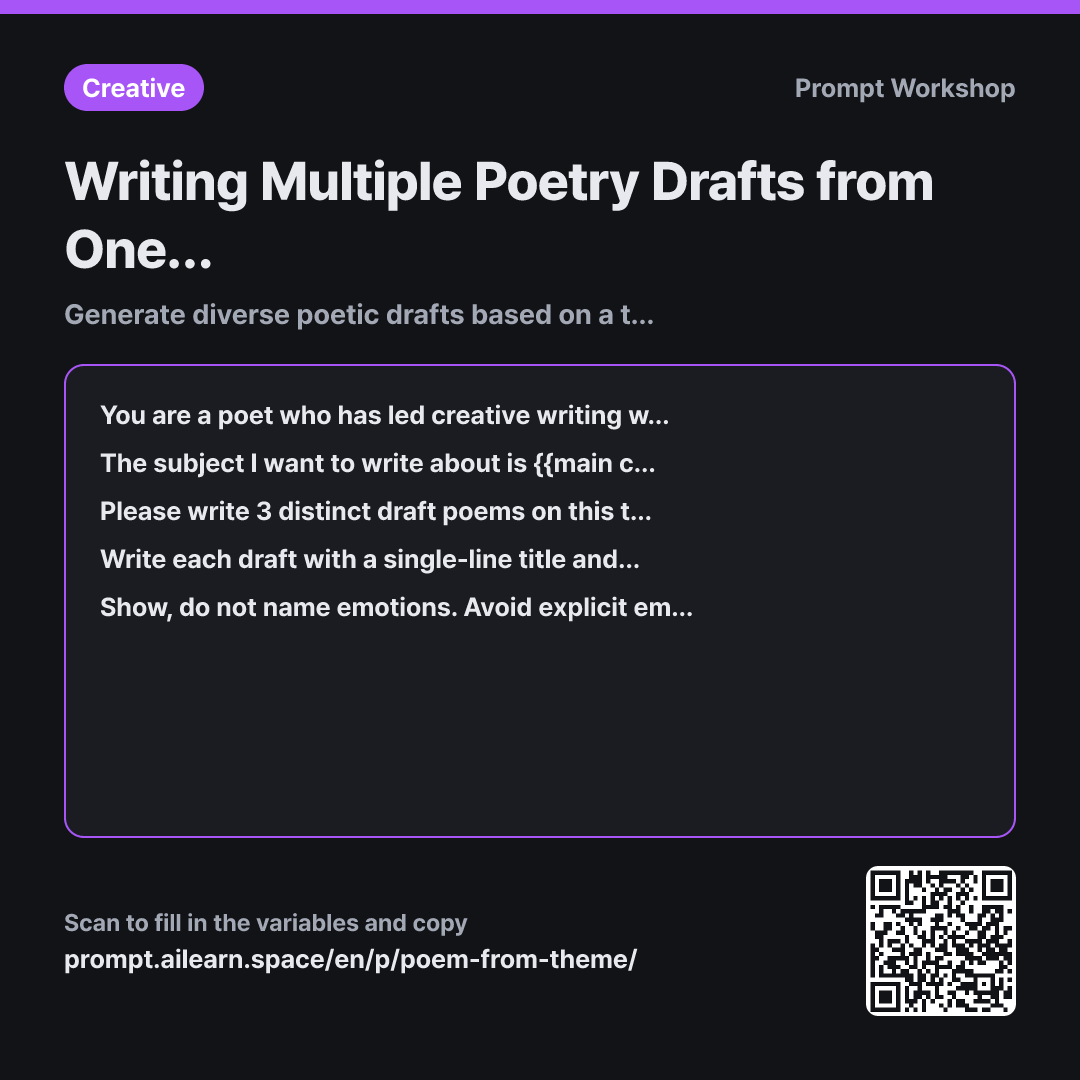
The final constraints paragraph does this heavy lifting. Listing specific banned words is essential. Vague instructions like "avoid clichés" have almost no effect, but explicitly naming forbidden words forces the AI to reach for alternative imagery. Directives like "Show, do not name emotions" work the same way—ban the word "sadness," and the model reaches for empty hangers or scuffed floorboards instead.
Assigning the role of "someone who strips away clichés" rather than "a judge picking pretty phrases" pushes the writing in the right direction. If you treat AI like a polite judge, it writes bland verse; if you instruct it to edit out fluff, it produces lines with distinct character even if they feel unpolished. Drafts are meant to be revised anyway, so three rough, distinct drafts are far more useful than one safe, predictable piece.
Generating three drafts at once facilitates comparison. Getting just one draft makes it feel like the only way to treat the topic, but laying three variations with different perspectives side-by-side reveals where your own voice truly belongs. Asking for the most striking line from each serves the next step: you can keep those anchor lines and build forward without starting from scratch.
Unfamiliar terms? See Aha AI: temperature, self-consistency
Compared with a bad example
Write an emotional poem about moving out.
Saying "emotional" signals the AI to pull from the most generic pool of sentimental tropes. Instead of an empty room, you get abstract "memories," and the final line closes with a promise of new beginnings. With only one draft to review, there is nothing to compare; asking for a rewrite often yields five nearly identical variations. The biggest loss is never discovering which perspective truly suits your intent.
Variations
Polishing around selected favorite lines
I am writing a poem about {{main central topic}}. Below are lines I want to keep. Do not change a single word in these lines.
Please complete a single poem of around 10 lines by adding lines before, between, or after these anchors so they flow naturally. Maintain an {{overall atmosphere}} mood throughout, and mark any newly added lines with a symbol at the start so I can see what was filled in.
Lines to keep: """ Paste the lines you want to preserve here """
This approach uses two or three standout lines from a previous draft as seeds. Without the strict rule "Do not change a single word," the AI tends to smooth over and rewrite your original lines.
Writing ultra-short verse
Please write a short poem of no more than 3 lines about {{main central topic}}. The tone should feel {{overall atmosphere}}.
Provide 5 distinct variations, with each line containing only 4 to 8 words. Do not include any explanatory phrases, and ensure the final line twists or subverts the meaning established in the first two lines.
Shortening the line count leaves no room for clichés. When longer poems feel stuck, this exercise quickly clarifies the core imagery.
Model notes
Running the same prompt again will generate entirely different options. If you find lines you like, save them separately and include them in your next request.
Related prompts
Last updated 2026-09-02 · Found a mistake? Let us know