Why it is written this way
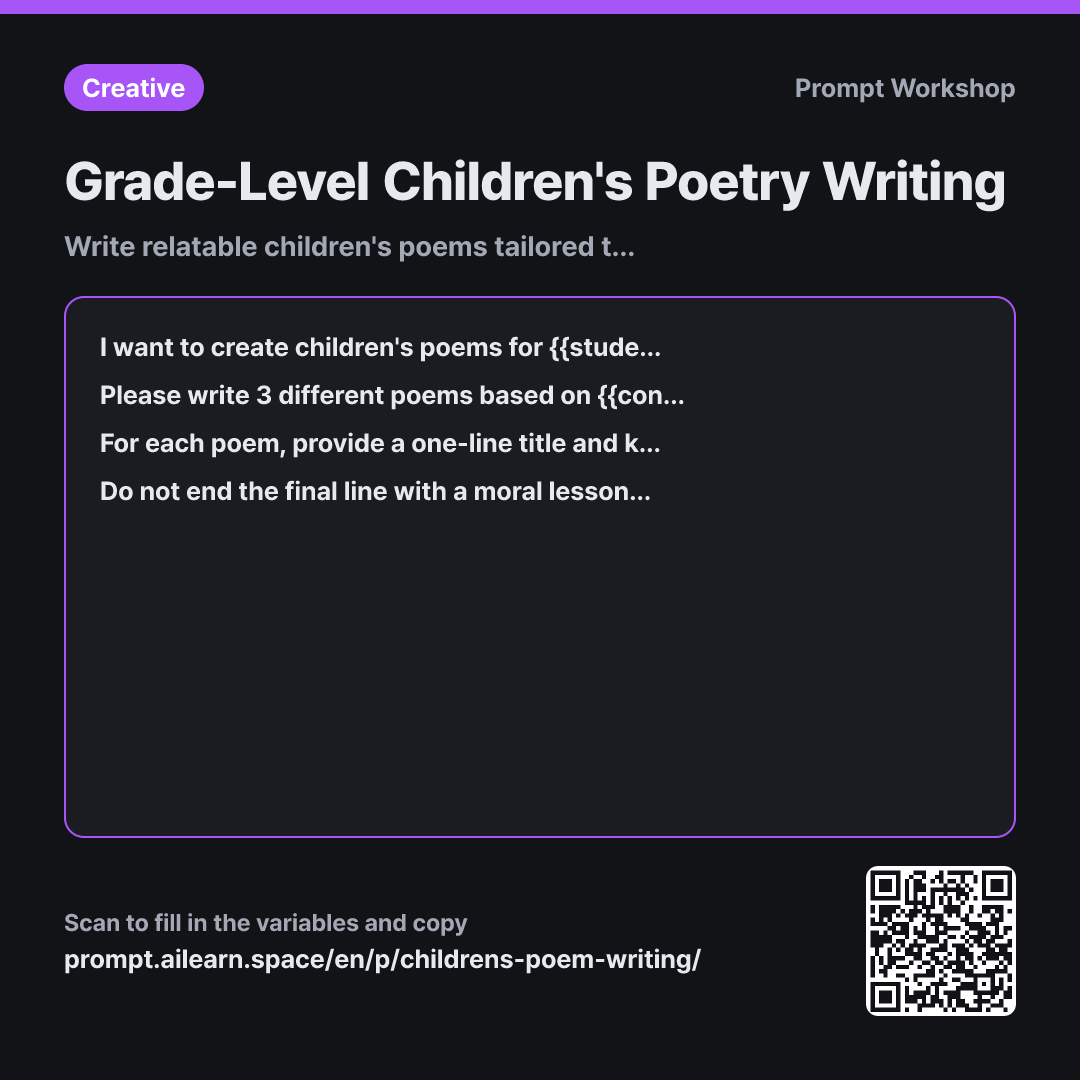
If you simply ask an AI to "write a children's poem," it produces adult poetry cut into shorter lines. Even if the lines are brief and the vocabulary seems simple, the moment it ends with a lesson like "Every little thing matters," it ceases to be a children's poem and becomes an adult's lecture. Children feel instructed on what to feel rather than experiencing the poem naturally.
The context in the first paragraph makes all the difference. Specifying the grade level alone is not enough; describing what children at this developmental stage perceive well and what they struggle with guides the model. Adding the practical purpose—"to be included in a class anthology and read out loud"—prompts the AI to craft rhythmic lines meant for the ear rather than passive reading.
The format instructions in the third paragraph set strict numerical constraints. Without concrete limits like 8 lines and short line lengths, AI outputs quickly drift into lengthy prose poems. Requiring a repeated phrase ensures musicality when read aloud, and the vocabulary alternative table allows teachers or parents to use the output directly in class.
The final constraints eliminate three common pitfalls: moralizing conclusions, an adult narrator's perspective, and abstract vocabulary. All three frequently turn children's poems into adult monologues. Instead, specifying sensory details—what kids see, touch, and hear—gives the AI clear direction to include vivid, relatable imagery, like teeth marks left on an opened milk carton.
Unfamiliar terms? See Aha AI: output-format, prompt
Compared with a bad example
Write a children's poem for an elementary student. Topic: milk carton.
Without a specific grade level, the vocabulary is inconsistent, and without line constraints, it easily exceeds ten lines. It usually personifies the milk carton ("I am a little milk carton") and ends with a moral lesson urging the child to finish their drink. Getting only one poem also leaves no room to offer choices to students.
Variations
Feedback on Student's Draft
This is a poem written by a {{student grade level}} student. Please do not rewrite it using adult phrasing.
First, identify two expressive, vivid lines in this draft and explain why they work well, using language the child can easily understand. Then, highlight only two areas for improvement; instead of rewriting the lines, guide the student with reflective questions such as, "Could you add one more line describing what you saw right here?"
Student's poem: """ [Paste the student's draft here] """
If AI rewrites a child's poem, it loses the child's genuine voice. The key is to highlight strengths first and provide improvement suggestions strictly as exploratory questions.
Classroom Activity Brainstorming
I am planning a poetry writing activity about {{content material}} for {{student grade level}} students.
Instead of providing finished poems, please create teaching materials for the lesson: 1) 5 sensory-focused questions to ask the students (all asking about what they see and touch), 2) 8 examples of expressions or phrases kids of this age might naturally say, and 3) 3 starter opening lines that give only the first line for students to continue. Write all items in language that students can easily read.
Showing finished poems leads students to copy them. Providing guiding questions and starter lines helps turn the children's own words into original poetry.
Model notes
LLMs occasionally struggle to strictly count words per line and may generate lines that run slightly long. Review the generated text and provide targeted feedback such as: "Line 3 is too long; please split it into two shorter lines."
Related prompts
Last updated 2026-09-02 · Found a mistake? Let us know