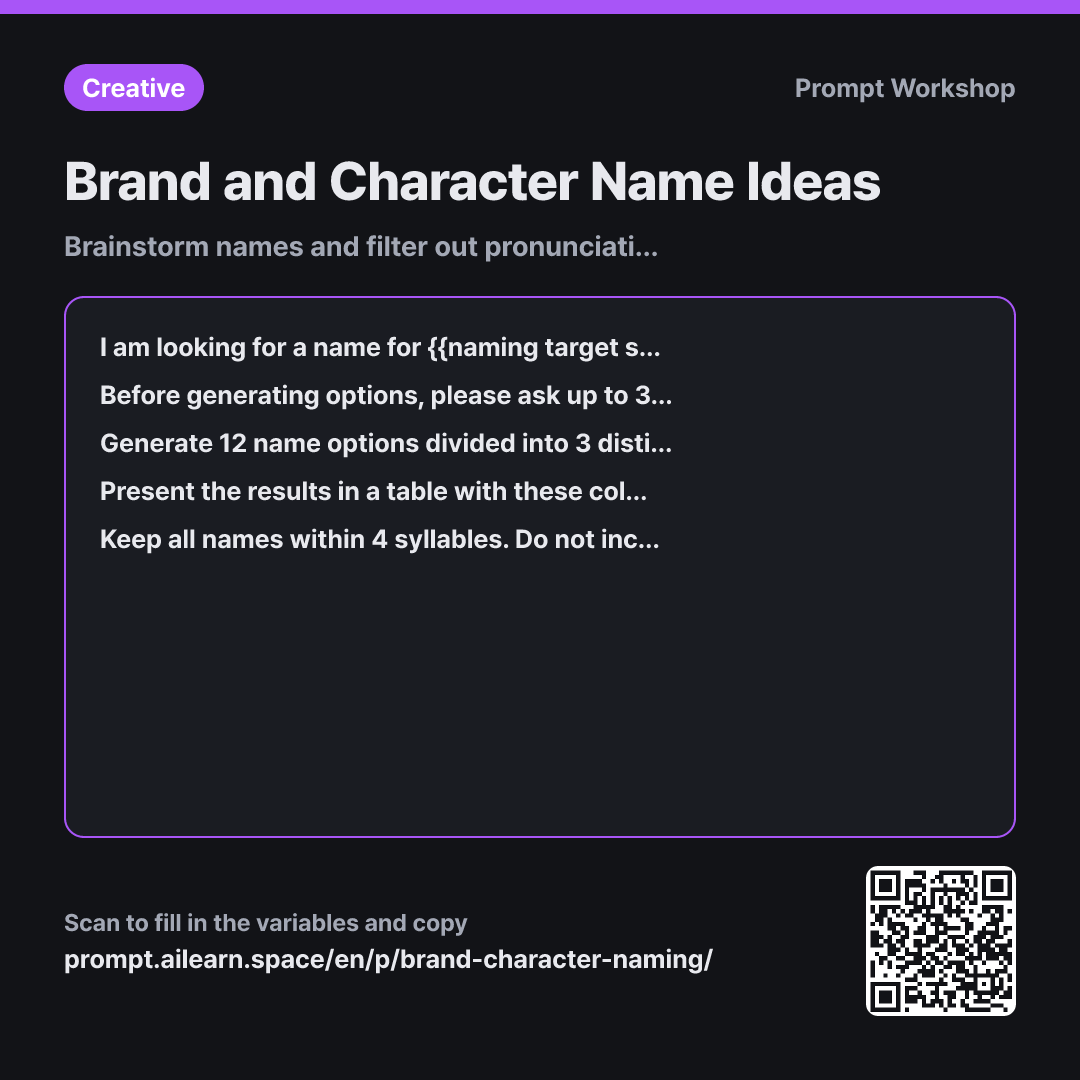
Why it is written this way
When you ask AI for names, you usually get one of two things: awkward, unpronounceable compound words, or generic words that already belong to a dozen existing businesses. Without clear constraints, the model defaults to safe, bland suggestions.
That is why the second paragraph prompts the AI to ask clarifying questions before brainstorming. A name depends heavily on who will use it and how it will be perceived—details usually missing from the initial prompt. Capping the questions at three prevents endless back-and-forth; if you prefer to skip them, simply reply with "Please proceed."
In the format, the "Pronunciation" and "Potential Red Flags" columns do the heavy lifting. Names that are clumsy to say out loud or easy to misunderstand get filtered out right here. Asking the AI to list three rejected candidates serves the same purpose: seeing why options were discarded reveals the model's evaluation criteria so you can correct its course if needed.
Under constraints, limiting syllable count ensures the final names remain catchy and easy to speak. The final rule is especially crucial: AI models cannot verify active trademarks or real-world domain usage, yet they often hallucinate that a name is completely original. Strictly instruct it not to make claims about availability, and verify final candidates yourself.
Unfamiliar terms? See Aha AI: hallucination, output-format
Compared with a bad example
Give me some names for my workspace. Make it aesthetic.
"Aesthetic" means different things to different people, so the model defaults to the most generic interpretation. The result is a list of ten nearly identical buzzwords without any rationale, leaving you with zero basis for selection. No one highlights pronunciation pitfalls or duplication risks, meaning you will likely have to rename it later.
Variations
When Naming Fictional Characters
Please provide 10 character name options fitting {{naming target subject}}. The impression this character should give off is {{desired impression vibe}}. Present the names in a table with the following columns: "Name | First Impression | Fit for Age and Setting | Risk of Confusion with Other Names". Do not use names of real famous figures or well-known fictional characters. Ensure no more than two names share the same starting letter.
For character names, avoiding reader confusion is top priority. Restricting duplicate initial letters significantly reduces reading fatigue.
When Choosing Among 3 Final Candidates
I am trying to pick the best name for {{naming target subject}} from the three options below. Evaluate each name based on three criteria: ① How it sounds when spoken aloud ② Whether a first-time audience can intuit its meaning ③ Whether it will still hold up in 5 years. At the end, recommend one final option and explain why the other two were not selected. Do not generate any new name suggestions.
Candidates: """ (Insert your three candidate names here, one per line) """
Do not mix idea generation with decision-making. Explicitly telling the model not to create new options forces it to focus entirely on comparative critique.
Model notes
AI models cannot check trademark registries. Once you narrow down your finalists, verify availability via your local patent and trademark office database.
If you re-run the same naming prompt, the model will often repeat similar word combinations. On subsequent attempts, paste the previous results and add a constraint such as: "Do not share initial letters or similar roots with this list."
Related prompts
Last updated 2026-09-02 · Found a mistake? Let us know