Why it is written this way
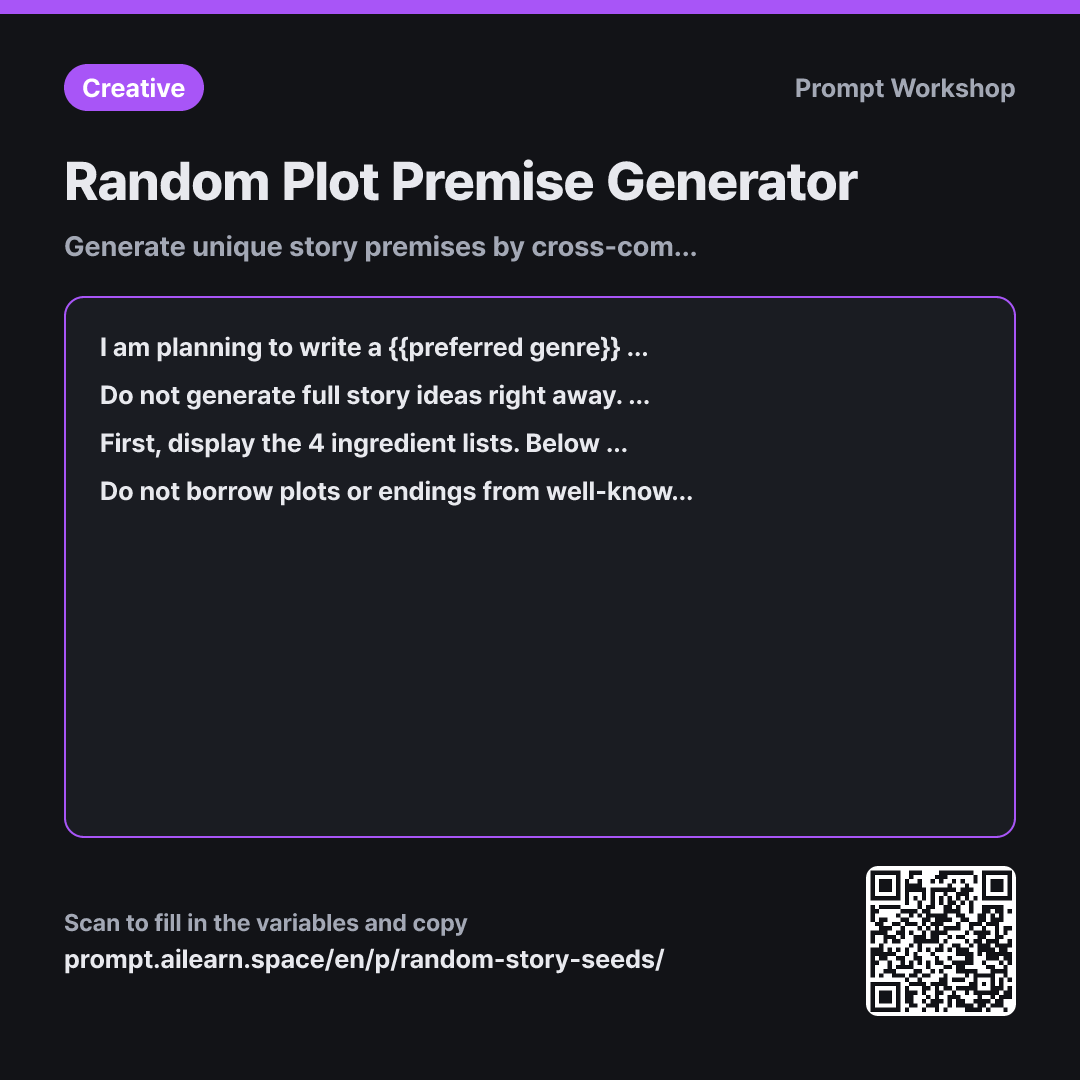
When you simply ask an AI for story ideas, you usually get generic clichés you have seen countless times: an amnesiac protagonist, a terminal illness diagnosis, or a contractual marriage with a billionaire. This happens because the model defaults to the most statistically common tropes associated with the genre. This prompt blocks that shortcut by forcing the model to lay out the raw ingredients first before assembling the final ideas.
The Task paragraph enforces a strict step-by-step order. By requiring eight distinct items across four categories—character situation, secret, setting, and inciting incident—common tropes are diluted across thirty-two discrete elements. Cross-combining these elements forces unexpected pairings that wouldn't normally appear together, resulting in fresh premises. In creative brainstorming, it is this combinatorial step, not sheer volume, that sparks original thinking.
The three-line Format ensures each premise is actionable rather than a vague list of world-building lore. A defined conflict line helps you instantly evaluate whether the idea has narrative tension, while an opening scene line gives you an immediate entry point to start writing. Single-line summaries often sound plausible at a glance, but leave you stuck when you actually try to write.
The Constraints prevent overlap and excessive cliches. Capping familiar narrative devices prevents the output from veering into pure absurdity or lazy repetition. Banning ideas that share two or more ingredients ensures you get truly diverse concepts rather than a long list of minor variations. Once you find a premise you like, follow up with: "Keep ingredient #3 fixed and generate eight alternative inciting incidents for it."
Unfamiliar terms? See Aha AI: temperature, prompt
Compared with a bad example
Recommend 10 novel story ideas.
Without genre details or structural constraints, the model defaults to the most predictable tropes. Half of the ten will feel derivative, and the rest will be vague one-liners with no clear direction for development. Because the ideas overlap heavily, there is little practical variety to choose from.
Variations
Adding Inciting Incidents to an Existing Setup
I am writing a {{preferred genre}} story, and my character and setting are already established. Keeping the setup below unchanged, generate {{selection count}} distinct inciting incidents that disrupt this character's daily life. For each incident, provide: "One-line incident · Why this hurts the character specifically · The character's immediate first choice." The incidents must not overlap in tone or nature.
Setup: """ (Paste your character and setting background here) """
This approach swaps out only the inciting incident rather than the entire premise. It is much faster when working on an existing manuscript than starting over from scratch.
Brainstorming for a Short Story
Please generate {{selection count}} story premises suited for a {{preferred genre}} short story. To ensure the story can be completed within a tight word count, limit the scope to a maximum of two characters, a single location, and a timeframe of under 24 hours. For each premise, include: "One-line premise · The final twist or turn."
When writing with length constraints, you must constrain the number of characters and locations upfront. Short stories require a fundamentally different scope than long-form fiction.
Model notes
When asked to generate eight items per list, some models begin repeating patterns toward the end of the lists. If the items start to feel repetitive, simply prompt: "Discard the last three items and regenerate them with completely different tones and archetypes."
Related prompts
Last updated 2026-09-02 · Found a mistake? Let us know