Why it is written this way
When asking AI for novel titles, requesting 10 candidates often results in 10 variations of the exact same phrasing with word orders slightly shuffled. When you ask again, it produces the same flavor because the model remains anchored to its initial direction.
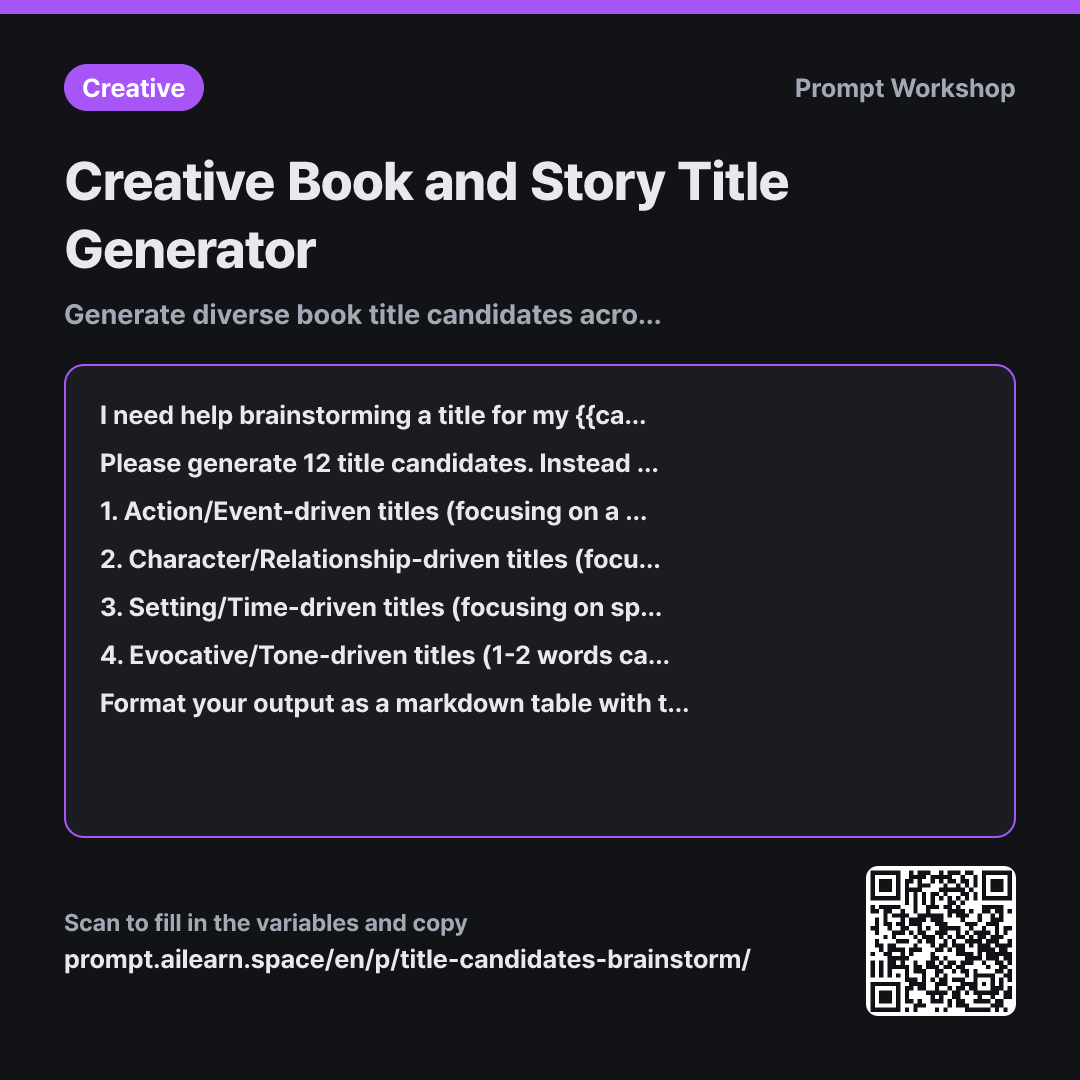
This prompt's Task section prevents this by specifying distinct stylistic categories rather than a simple total count. Action, character, setting, and mood each establish a different contract with the reader. Requiring 3 per angle forces the model out of repetitive loops and yields truly distinct, comparable choices.
In the Format section, the "What It Promises" column gives you objective criteria for selection. Instead of picking solely based on vague vibes, you immediately see whether a title sets expectations that align with your actual story. The "Potential Drawbacks" column flags pronunciation hurdles, unintended double meanings, or cliché risks early.
The length and originality rules in the Constraints prevent common publication pitfalls. Once you receive the table, select 2-3 favorites and follow up with "Generate 8 more purely in the direction of Title #2" to quickly zero in on a winner rather than starting from scratch each time.
Unfamiliar terms? See Aha AI: output-format, temperature
Compared with a bad example
Recommend 10 titles for my novel about a guy who inherits an old bathhouse.
You will get 10 repetitive titles endlessly recycling "Bathhouse" and "Winter." Without explanations of what each title conveys, you have no framework to evaluate them or spot overlaps with existing works. You end up re-prompting repeatedly, stuck in the model's initial rut.
Variations
When narrowing down a shortlist
Below are title candidates for my {{category genre type}} project: "{{one line logline}}".
Evaluate each title across three criteria: 1) The immediate visual image it evokes, 2) The story genre/tone a reader would expect, and 3) Potential discrepancies with the actual premise. Finally, rank them from best fit to weakest fit. Do not generate new titles.
Candidate Titles: """ [Paste your title candidates here, one per line] """
Generating options and shortlisting them require different modes of thinking. Explicitly forbidding new suggestions ensures the model focuses entirely on critical evaluation.
For serialized web fiction / web novels
Please generate 10 title candidates for a serialized web novel in the {{category genre type}} genre based on this logline: "{{one line logline}}".
Ensure titles are punchy and readable at a glance within feed lists (under 8 words). The core hook or premise keyword must appear within the first 3-4 words so it remains visible even if truncated on mobile screens. Present the results in a table: Title | First 4 Words | Target Reader Hook. Avoid misleading clickbait.
Serialized fiction platforms cut off long titles on mobile screens. Examining the opening words separately ensures the hook survives truncation in feed browsers.
Model notes
When generating title batches across multiple prompts, the AI often repeats earlier suggestions. From the second iteration onward, paste your previous candidates and add: "Do not duplicate or closely mirror any titles from this previous list: [list]".
Related prompts
Last updated 2026-09-02 · Found a mistake? Let us know