Why it is written this way
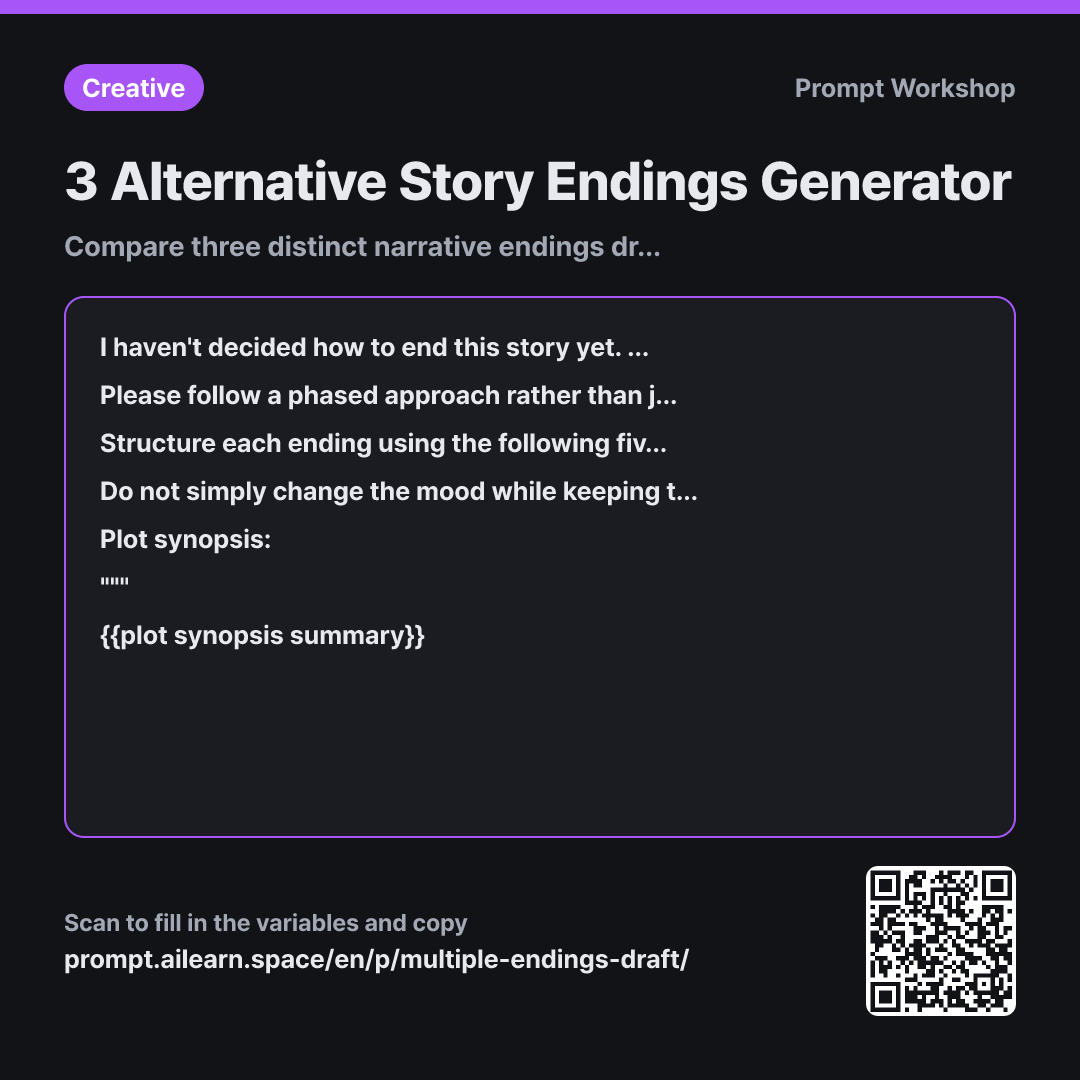
Asking for story ending ideas usually yields a single generic resolution. If you don't like it, you have nothing to contrast it against, and re-prompting usually returns the same core direction wrapped in slightly different prose. Endings are less about "good versus bad" and more about which thematic path you choose—so generating split branches from the start is essential for making a deliberate choice.
Breaking the process into steps is the core mechanism of this prompt. Forcing the AI to list unanswered questions first guarantees that it actually parses the plot and identifies loose threads. Anchoring the three branches around the character's core desire ensures the endings diverge meaningfully rather than by random chance. Asking for "three endings" without these steps skips this structural logic and generates superficial variations.
Centering the task on character desire works because compelling stories conclude on character arcs, not mere plot mechanics. Do they get what they wanted, fail to get it, or transform what they care about? The third branch almost always produces the most nuanced literary candidate.
Setting a concrete format with "cost" and "foreshadowing" makes the endings actionable. An ending without a cost feels hollow, and an ending without plant-and-payoff notes leaves you stuck when revising earlier chapters. The concluding comparison table allows you to weigh the trade-offs of each option side by side, minimizing second-guessing later on.
Unfamiliar terms? See Aha AI: chain-of-thought, output-format
Compared with a bad example
How should I end this story?
(Pastes plot synopsis)
A vague request like this leads the model to default to the safest, most cliché resolution: the protagonist grows, saves the shop, and reconciles with everyone. It gives no sense of alternative directions and provides no structural setup notes for earlier chapters, making it unusable for serious revision.
Variations
When exploring multiple versions of the final scene only
Please write four distinct variations of just the final closing scene based on the plot below. Set each in a different location (inside a home, out on the road, in a crowded public space, in total isolation), keeping each scene under eight lines. For each variation, include a dedicated single line with the closing sentence, followed by one line explaining what this specific scene conveys about {{protagonist main desire}}.
Plot synopsis: """ {{plot synopsis summary}} """
Use this when the thematic direction of the ending is already settled, but you are struggling to visualize the exact final scene. Shifting physical locations drastically alters the emotional resonance of the climax.
When an existing ending feels flat or unearned
Please review the plot synopsis and my draft ending below, and provide a diagnostic critique without rewriting it. Assess these four specific dimensions: ① Does this ending meaningfully resolve {{protagonist main desire}}? ② What planted setup elements or motifs remain unaddressed? ③ Where might the reader feel cheated or dissatisfied? ④ What critical cost or consequence is this ending currently avoiding? Conclude with two concise single-paragraph recommendations: one for refining this current ending, and one for completely overhauling it.
Plot synopsis: """ {{plot synopsis summary}} """
Diagnose why a draft ending feels weak before asking for a replacement. Generating new endings without understanding the underlying flaw usually replicates the exact same storytelling blind spots.
Model notes
Requesting three detailed endings in a single output can cause later sections to truncate or skimp on the foreshadowing points. If the third branch appears rushed, ask the model to expand that specific branch separately in a follow-up turn.
Related prompts
Last updated 2026-09-02 · Found a mistake? Let us know