Why it is written this way
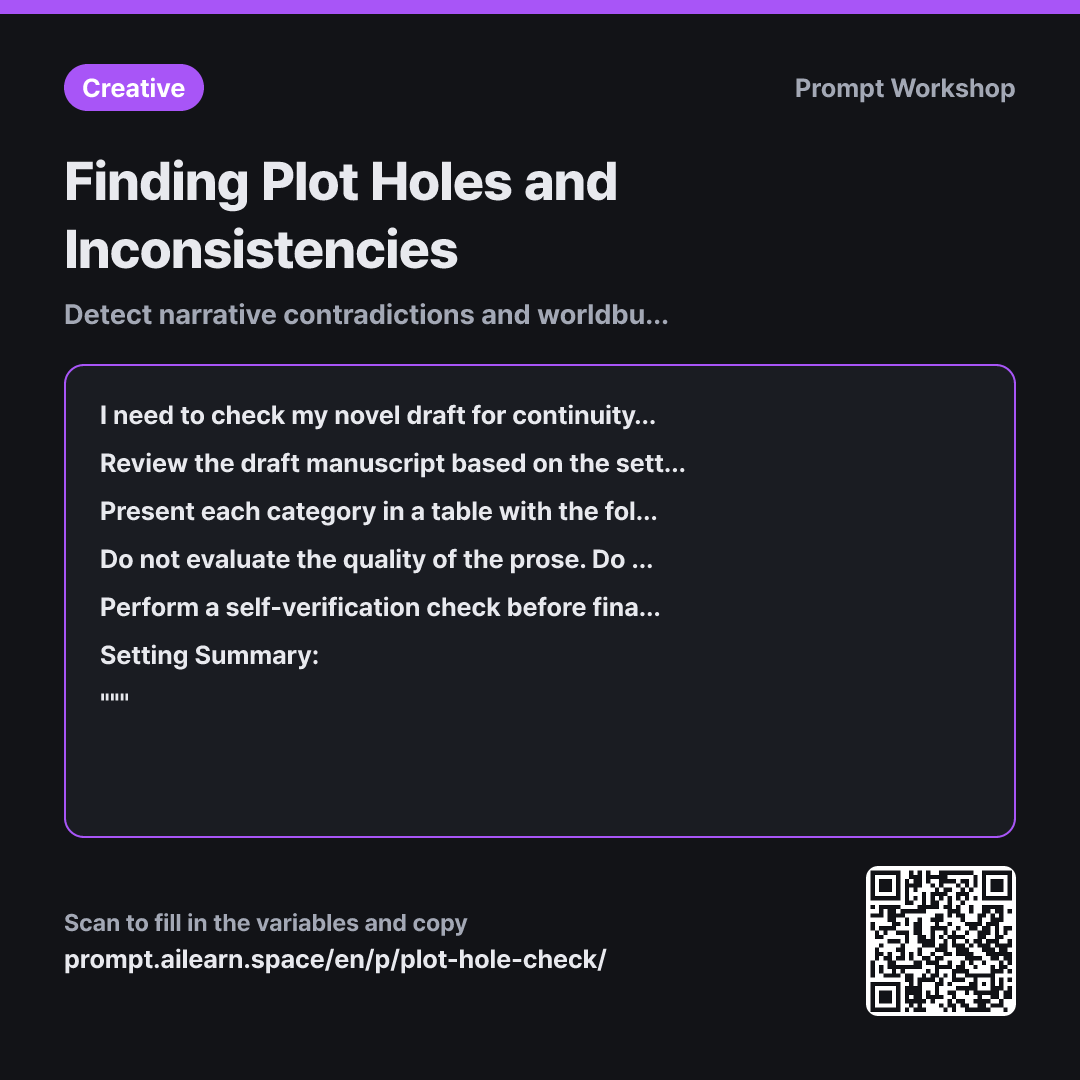
When asking an AI to spot plot holes, it often returns general reader reactions instead. Feedback like "The tension is great, though the character's emotions could be clearer" does not help identify continuity errors. This prompt sets clear boundaries from the first paragraph: strict verification, not subjective feedback.
Dividing the Task into four distinct categories prevents the model from stopping after pointing out just one obvious mistake. Setting conflicts, internal timeline errors, and unearned abilities are distinct issues that need individual scanning. Category four is crucial: without a dedicated place for unconfirmed details, the model will either invent errors or ignore missing rules entirely.
In the Format, the "Evidence (Quote)" column acts as a safety guard. Requiring exact quotes drastically reduces AI hallucinations. The Self-Verification step cleans up any remaining errors by having the model cross-check quotes against the manuscript, significantly boosting the reliability of the continuity check.
Wrapping both the setting summary and the draft manuscript in """ delimiters prevents context bleeding. If the reference data mixes with the story text, the AI might treat the manuscript as the established canon and miss contradictions. Instructing it not to rewrite the draft keeps the focus intact—you decide how to fix the story.
Unfamiliar terms? See Aha AI: hallucination, prompt-injection
Compared with a bad example
Can you check if anything seems off in this novel?
(Paste manuscript)
Without a setting summary, the AI has no baseline rules and will default to generic feedback on prose style. It won't detect violations of custom lore, such as a curfew rule. Furthermore, without requiring exact quotes, you'll have to manually search the text to verify its vague claims, some of which may be completely hallucinated.
Variations
Tracking Character Knowledge
Track only what each character knows based on the setting summary and manuscript below. Create a table for each character with the columns: "Information · When/How Learned (Quote) · Plausible at This Point?". List only instances where a character mentions or acts upon information they shouldn't know. Do not include other feedback.
Setting Summary: """ {{setting summary}} """
Draft Manuscript: """ {{draft manuscript}} """
Tracking who knows what and when is the most common failure point in mysteries. Isolating this single variable produces a much tighter audit.
Syncing Lore from an Ongoing Draft
Compare the setting summary with the draft manuscript below and extract all newly introduced facts in the manuscript that are missing from the setting summary. Organize them into a table: "New Fact · Manuscript Quote · Conflicts with Existing Lore?". For non-conflicting entries, format them into concise notes ready to add to the setting summary. For conflicting entries, display both sides side-by-side so I can choose which to keep.
Setting Summary: """ {{setting summary}} """
Draft Manuscript: """ {{draft manuscript}} """
As a story progresses, new details in the manuscript often outpace the original lore bible. Use this to reverse-extract worldbuilding updates back into your master reference.
Model notes
For long manuscripts, split the draft by chapter, but always include the full setting summary each time to keep the evaluation criteria consistent.
Specifying an exact number of plot holes often causes the model to hallucinate issues just to meet the quota. Instead of "Find 5 issues," add "If none are found, state that there are none."
Related prompts
Last updated 2026-09-02 · Found a mistake? Let us know