Why it is written this way
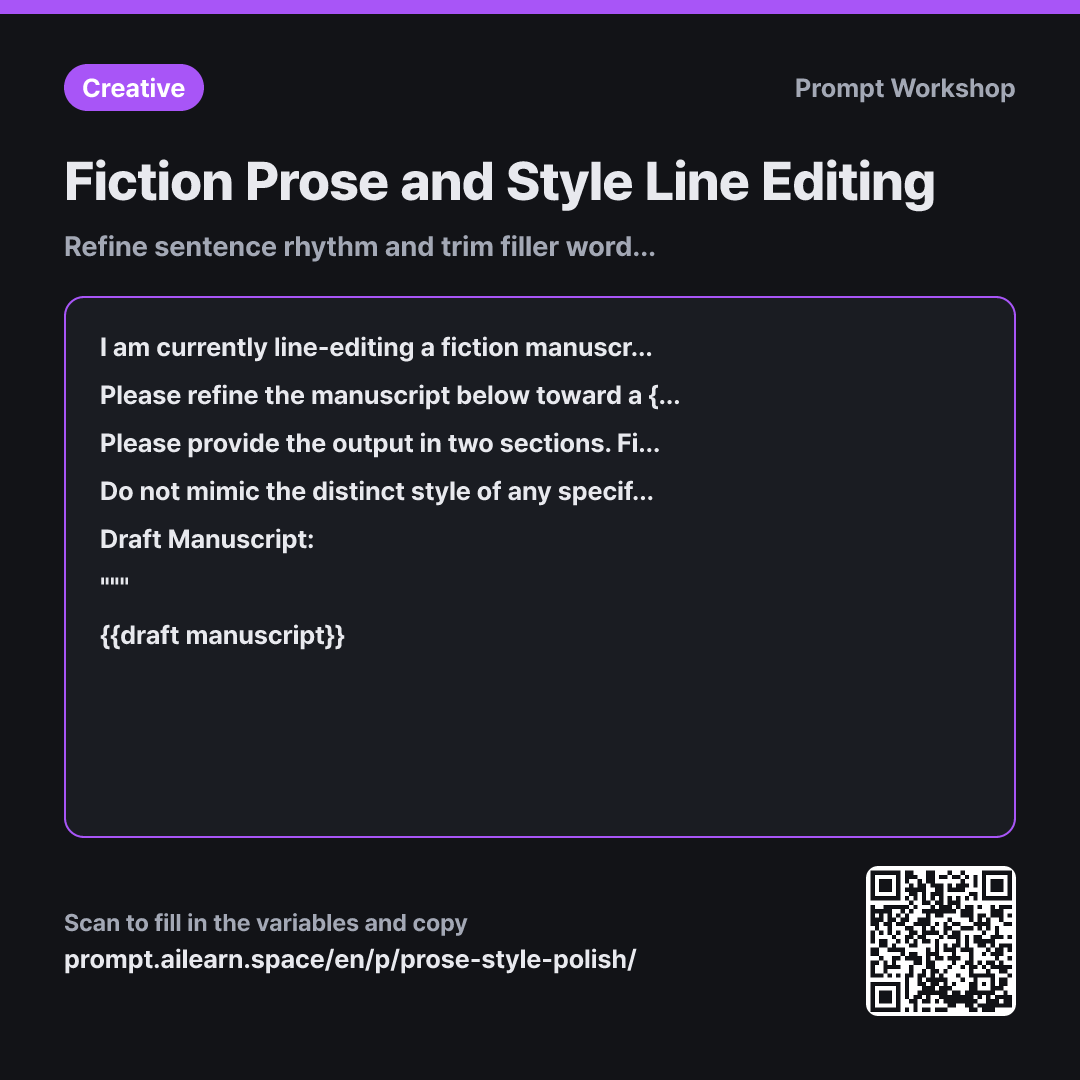
When asking an AI to polish fiction prose, the most common pitfall is receiving rewritten content rather than refined phrasing. Simply saying "make this better" often results in character dialogue disappearing, whole paragraphs of unrequested description being added, or the voice turning into someone else's entirely. This prompt firmly restricts the scope to sentence-level phrasing and makes every single edit transparent.
The Constraints paragraph is the core of this prompt. Prohibiting the imitation of specific authors prevents the output from sounding like generic fan-fiction tropes. Restricting paragraph merging or splitting prevents line editing from morphing into developmental restructuring. Providing the "Needs Author Review" escape route ensures the AI doesn't force unnecessary changes on ambiguous lines, but instead hands them back for your judgment. When given only negative constraints, models still try to alter text; giving them a designated place to leave things alone makes them comply.
Separating the output into the full manuscript and a "Revision Log" table allows for easy rollback. Without a table, you are forced to accept or reject the edited draft as an all-or-nothing package. With the table, you can pinpoint specific edits you dislike and revert only those sentences. Line editing is, after all, a sentence-by-sentence decision process.
Wrapping the text in """ prevents dialogue or in-line notes from being misread as instructions. Even if working notes like "delete this part later" are scattered inside the draft, the model treats them purely as raw material. Once you receive the table, you can follow up with prompts like "Keep edits #3 and #7 as the original, but apply the rest," ensuring total creative control remains in your hands.
Unfamiliar terms? See Aha AI: prompt-injection, output-format
Compared with a bad example
Polish this fiction prose for me.
(paste manuscript)
With a vague request like this, the model attempts to "improve" the entire story rather than just the prose. It alters dialogue it finds plain and inserts unprompted descriptions wherever it deems context lacking. Furthermore, because there is no changelog, you are forced to place the original and the new version side by side to manually compare them line by line.
Variations
Proofreading Grammar and Syntax Only
Please proofread the manuscript below, correcting only spelling, punctuation, grammatical errors, and awkward subject-verb agreements. Do not alter the writing style or tone. Present all changes in a table with columns: "Original Sentence | Revised Sentence | Reason".
Draft Manuscript: """ {{draft manuscript}} """
Mixing stylistic editing and mechanical proofreading in one go makes it difficult to distinguish actual errors from stylistic preferences. Proofread first, then polish the style in a second pass.
Polishing Dialogue Only for Character Voice
Please refine only the dialogue inside quotation marks in the manuscript below to match a {{desired writing style}}. Do not change a single word of the narrative description. Keep the substance and information in the dialogue identical, modifying only the cadence, tone, and phrasing. Provide a summary table showing how distinct character voices were maintained.
Draft Manuscript: """ {{draft manuscript}} """
Dialogue and narrative exposition follow different polishing criteria. Narrowing the scope strictly to dialogue makes individual speech patterns much clearer and easier to tune.
Model notes
For long manuscripts, split the text into chunks of roughly 1,000–1,500 words and add: "Please maintain the exact revision rules established in previous sections."
When submitting a long manuscript, the detail in the "Revision Log" table tends to degrade toward the end. If the table becomes overly brief, re-run just that specific section separately.
Related prompts
Last updated 2026-09-02 · Found a mistake? Let us know