Why it is written this way
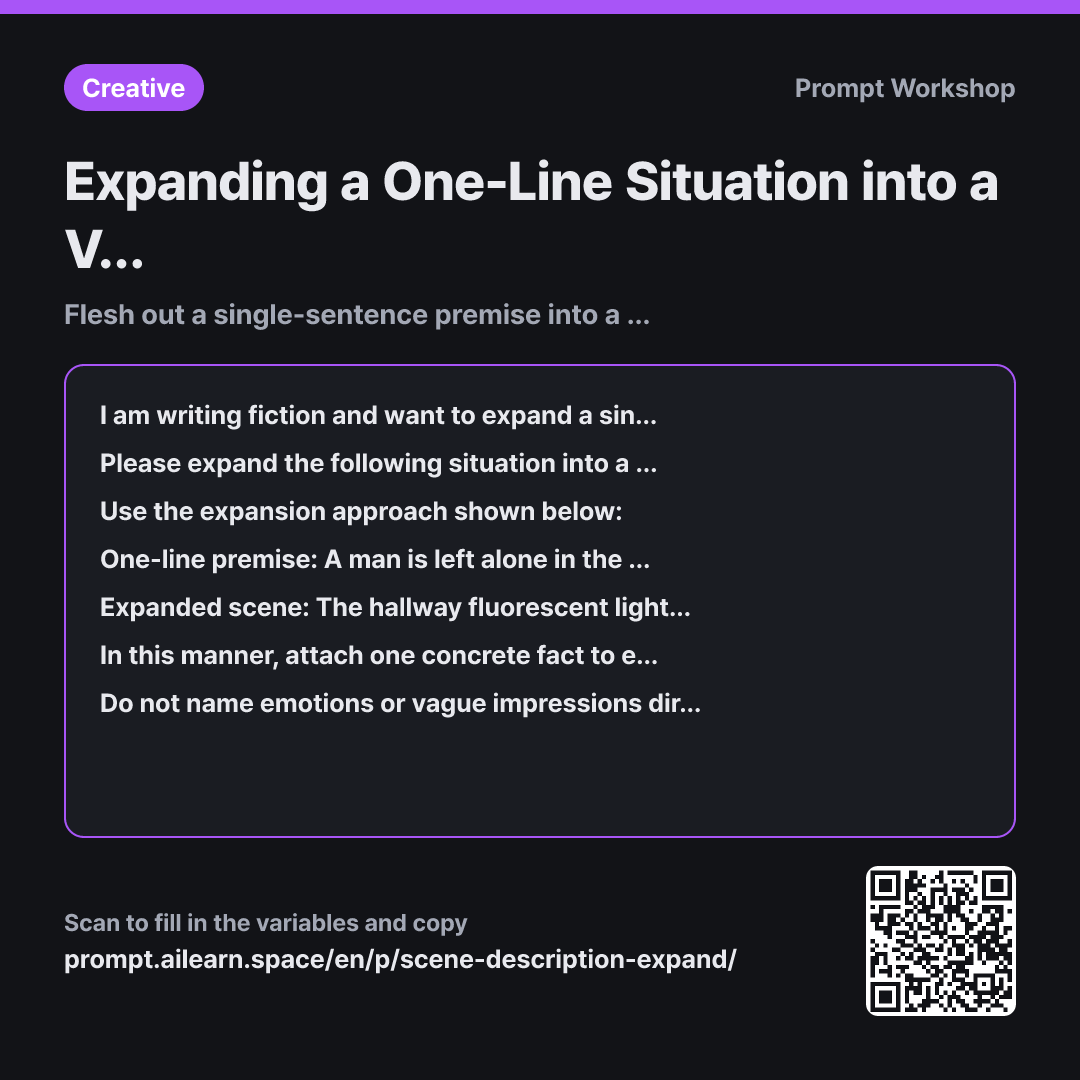
When asked to expand a scene, AI usually just applies cosmetic edits to the existing premise. "The woman ate dinner in the room" becomes "The woman ate dinner loneliness in the empty room." The word count increases, but the reader learns nothing new. Good description provides additional information rather than decorative filler.
That is why the Task paragraph specifies both the types and minimum count of senses, requiring a concrete fact for every sensory element. A lukewarm mouse reveals he had been working until just moments ago; a reclined chair next door reveals a colleague departed in a rush. This single rule transforms mere decoration into storytelling data. Defining the POV serves the same purpose: without a fixed perspective, details the character could not possibly observe begin creeping into the text.
The third paragraph directly presents the desired output format as an Example. Asking for "three sensory details" can be interpreted in countless ways, but providing a short four-sentence model instantly communicates length, density, and pacing. A concrete four-sentence example works better than three extra paragraphs of instruction.
Stating the intent in the Context paragraph ("feel as if they are right there") establishes the scene's emotional anchor. If you are honing your descriptive craft, this prompt serves as an excellent writing exercise. The constraint against directly naming emotions will quickly highlight how often one falls back on telling rather than showing.
Compared with a bad example
Make this sentence more descriptive and detailed: On moving day, a woman eats dinner alone in a room full of unpacked boxes.
If you only ask for "more detail," the model assumes you want more adjectives. The result is typically a bland paragraph repeating how lonely, unfamiliar, and quiet the room feels, often drifting between perspectives. Crucial concrete information—such as how many boxes there are or what she is actually eating—remains entirely absent.
Variations
Comparing Multiple POVs for the Same Scene
Write three separate one-paragraph versions of the following situation: "{{one line situation}}". ① First-person protagonist POV ② Third-person limited POV ③ The POV of another person present in the scene. Below the three paragraphs, add a one-line note for each POV explaining what it reveals and what it is forced to conceal. Do not name emotions directly.
A perspective's strengths and weaknesses are hard to evaluate until you see them in action. Placing the same scene side by side makes the optimal POV immediately apparent.
Altering Season and Time of Day
Expand the situation "{{one line situation}}" using the {{time point}} perspective, producing two distinct variations of the scene: ① Midday in peak summer ② Predawn in deep winter. Focus heavily on how sounds, smells, and tactile sensations change with the time and season. Do not reuse sentences between the two versions. The character's core actions must remain identical in both.
Changing the setting naturally alters the sensory palette. Prohibiting sentence reuse forces the model to move past generic descriptions and find fresh details.
Model notes
When an example is included in the prompt, models often mimic its exact sentence length and rhythm. If the provided sample clashes with your story's pacing, replace it with four lines from your own manuscript.
Related prompts
Last updated 2026-09-02 · Found a mistake? Let us know