Why it is written this way
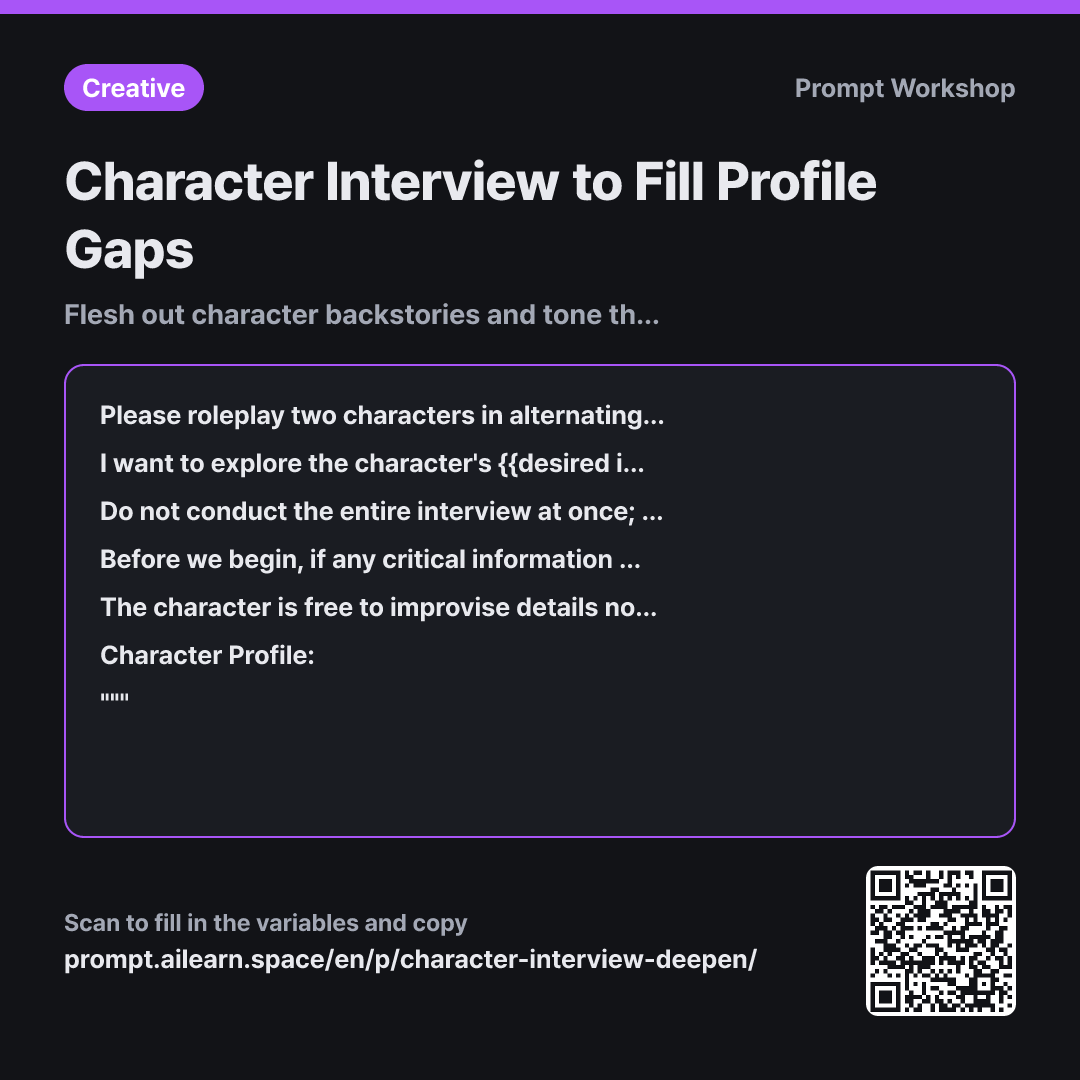
If you simply ask an AI to "flesh out this character profile," you will receive a table cluttered with superficial trivia: favorite foods, blood type, MBTI. You never get to see how the character deflects difficult questions, and such lists rarely help the actual manuscript. A character is revealed through how they speak and respond, not through a catalog of static traits.
Splitting the roles between the Character and the Journalist is the core foundation. If the AI only plays the character, you have to constantly invent sharp questions yourself and quickly tire out; by having the AI also play the journalist, questions come from unexpected angles. Enforcing explicit speaker prefixes prevents the two distinct voices from blurring together.
Staging the interview into three distinct rounds is equally deliberate. Poking at vulnerable wounds from the start causes the character to tense up defensively and produce generic answers. Establishing their speech patterns and daily rhythm in Round 1 builds texture before diving into direct confrontations in Round 2. Round 3, which revisits contradictions, is the secret to building genuine depth: where contradictions appear is precisely where the character is hiding something.
Requiring the AI to ask clarifying questions upfront ensures the character's tone doesn't waver due to undefined era or background constraints. The "Newly Established Canon" list captures improvisations so they don't get lost; once the interview concludes, you can easily copy-paste these into your master character document. Wrapping the profile in """ prevents drafting notes from bleeding into character dialogue.
Unfamiliar terms? See Aha AI: persona, role-prompting, context-window
Compared with a bad example
Make this character profile more detailed
(Paste character profile)
You will get back a generic list padded with arbitrary hobbies and favorite colors. The list grows longer, but what happened five years ago remains completely empty, and there is no guarantee the new traits are internally consistent. If you paste this directly into your manuscript, you will later spend hours resolving plot holes.
Variations
When exploring dynamic conflict between two characters
Please roleplay the character in the profile below. I will roleplay the opposing character in a dialogue. We have conflicting memories regarding {{desired inquiry part}}. Speak strictly from your character's memory, and if my statements contradict your recollection, do not back down easily—defend your perspective with your own rationale. Exchange 10 turns of dialogue, then stop and provide a bulleted list highlighting where our two characters' accounts diverge.
Character Profile: """ {{character profile setting}} """
When two characters remember the exact same event differently, their relationship gains dimensional depth. Roleplaying the counterpart yourself makes the conversation unfold unpredictably.
When generating an interrogation question list first
Read the character profile below and generate 20 probing interview questions designed to uncover details about {{desired inquiry part}}. Do not write answers. Divide them into four distinct categories with 5 questions each: ① Factual verification questions, ② Questions probing past choices made at that moment, ③ Uncomfortable questions the character would hate answering, and ④ Questions about how others might have perceived them.
Character Profile: """ {{character profile setting}} """
Getting just the questionnaire allows you to step into the character's shoes and answer in writing yourself. Writing the answers by hand is often the fastest way to master a character's authentic voice.
Model notes
As the conversation deepens, models may begin forgetting earlier rounds. Before starting Round 3, ask: "Please summarize everything newly decided so far into a consolidated list."
As the rounds progress, AI characters tend to become overly cooperative and confess everything easily. If the character starts opening up too smoothly, prompt them once with: "Make the character avoid answering this question."
Related prompts
Last updated 2026-09-02 · Found a mistake? Let us know