Why it is written this way
When asking an AI to add tension, users often receive the exact same scene padded with excessive adjectives. Hearts pound, hands tremble, and the air grows heavy, but the stakes remain unclear. Genuine tension comes not from heightened language, but from the concrete risk of loss.
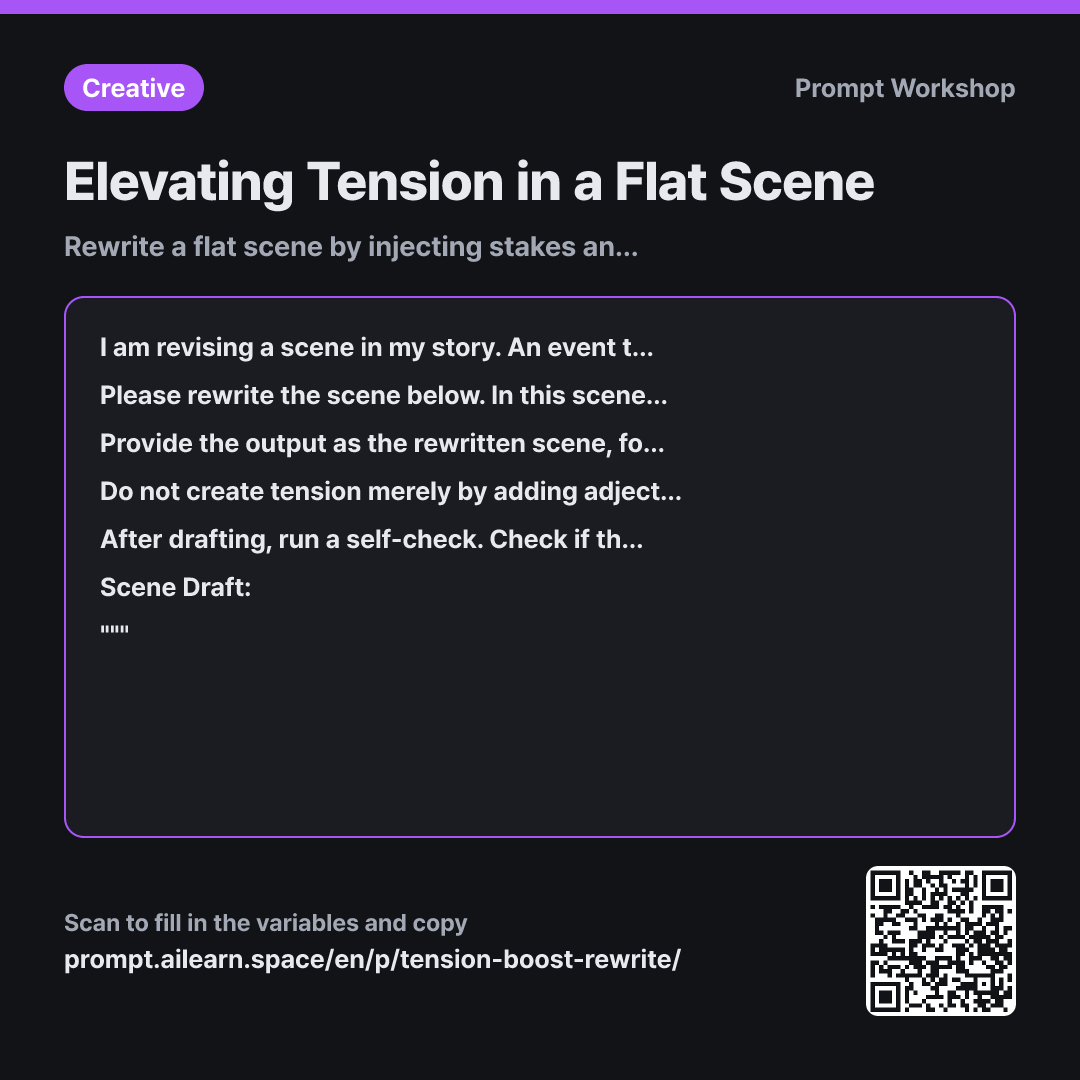
This is why the task paragraph explicitly establishes what the character stands to lose upfront. Once the stakes are clear, the model arranges actions and dialogue to threaten those stakes. Adding the constraint to "show through action rather than explain" eliminates summary lines like "She thought to herself that she could not afford to lose this chance." Forcing the desire and obstacle to clash within the same paragraph gives the scene immediate momentum.
Finally, the self-check paragraph acts as a built-in filter. Even with strict instructions, models often slip in one or two named emotions; asking it to actively scan and replace them before outputting catches most of these slips. Requesting only the final draft prevents the review process from cluttering the response.
Length limits and locked POVs stop a tension-enhancement request from turning into an unrecognizable rewrite. Enclosing the draft in """ delimiters serves the same purpose: it distinguishes reference material from instructions and prevents in-scene dialogue from being parsed as commands.
Unfamiliar terms? See Aha AI: prompt-injection, self-consistency
Compared with a bad example
Make this scene more tense and rewrite it.
(paste scene here)
You will get the exact same events buried under twice as many modifiers. The character's heart rate and cold sweats will increase, but the actual stakes remain unchanged, leaving the scene just as skippable. The point of view often drifts, or an unintroduced character abruptly bursts through the door.
Variations
Heightening Tension in Dialogue
Below is a dialogue scene between two characters. One character has {{character potential loss}} on the line and must not let the other person realize it. Keep the spoken dialogue seemingly normal, but make the unspoken tension felt through silences, topic changes, and evasive answers. Do not use sentences that explicitly name emotions.
Scene Draft: """ {{scene manuscript draft}} """
Dialogue scenes generate tension through subtext and evasion rather than physical description. Defining what is hidden makes the exchange naturally taut.
Diagnosing Weaknesses Before Rewriting
Please diagnose the scene below rather than rewriting it immediately. Identify: 1) What the character seems to risk losing based on the text, 2) Three specific sentences where tension drops and why, and 3) Any sections where the story momentum stalls. Afterward, provide a revised example for only the single most critical section that needs fixing.
Scene Draft: """ {{scene manuscript draft}} """
Asking for an immediate full rewrite risks losing your own voice. Getting a diagnosis first allows you to choose exactly where and how to intervene.
Model notes
Running multiple full-scene rewrites in succession tends to produce increasingly flowery prose while keeping the underlying plot static. From the second iteration onward, input the previous output instead of the raw draft and narrow your instruction, such as: "Keep the stakes, but strip out the extra adjectives."
Related prompts
Last updated 2026-09-02 · Found a mistake? Let us know