Why it is written this way
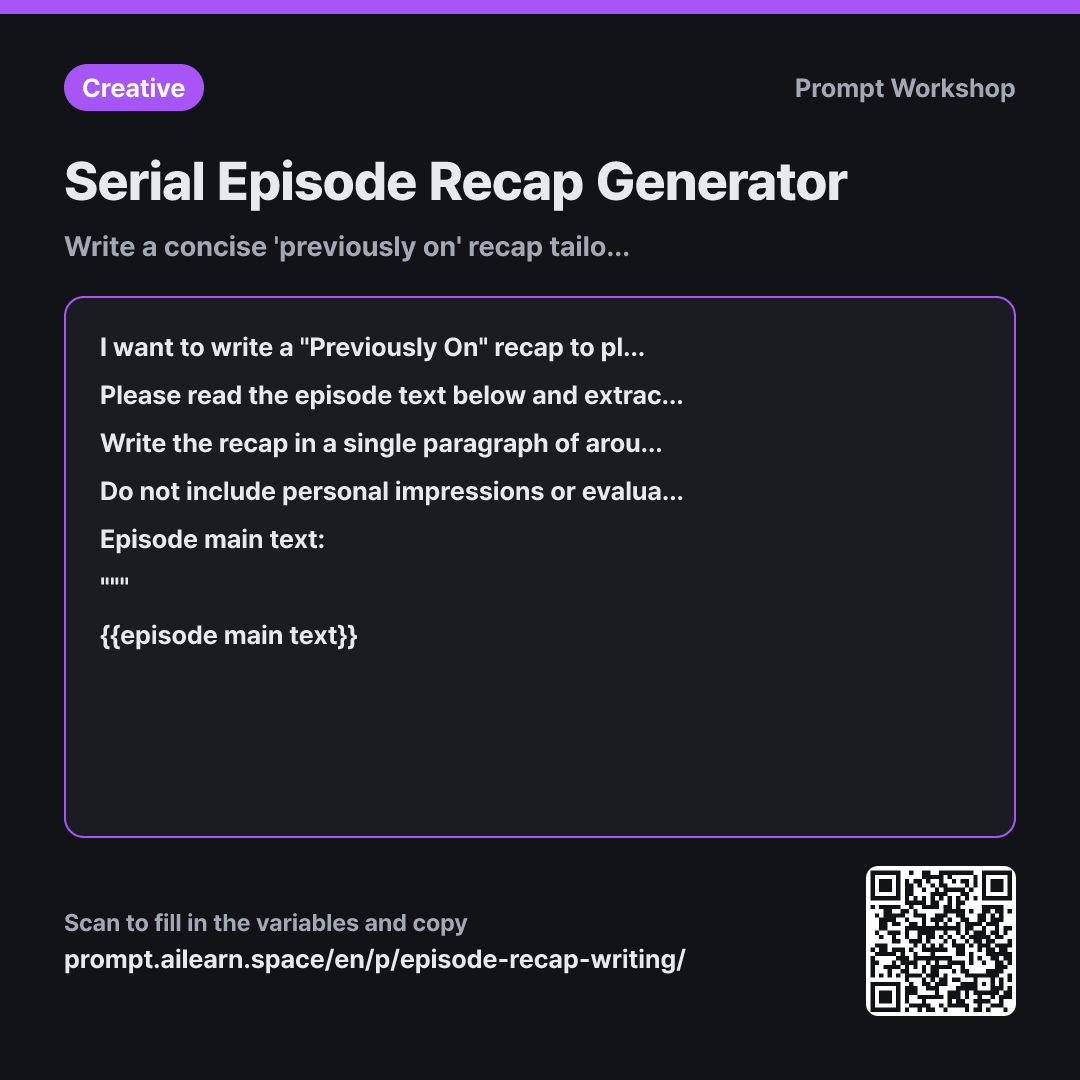
When asking an AI to summarize a serial episode, the most common issues are unsolicited commentary and accidental spoilers of twists that haven't been revealed yet. A generic prompt like "Summarize this" misses the target audience, leading the AI to produce a hybrid of a book review and a plot outline. This prompt prevents both problems through distinct sections.
The Context in the first paragraph clearly defines the reader. Specifying "readers who haven't read earlier chapters or read them long ago" prevents the AI from assuming prior knowledge, prompting it to add brief character introductions. The Task paragraph narrows the scope to "essential events required to understand the next episode," shifting the selection criteria from "important-looking scenes" to "what is necessary for the next chapter."
The Format paragraph specifies the length, chronological order, and an "omitted scenes" list. Setting a character count maintains a consistent recap length and tone across weekly updates. Requesting the omitted scenes lets you double-check what was left out and restore key plot points if needed—especially helpful for recurring serialization routines like web novels.
The Constraints paragraph establishes critical spoiler rules. AIs often reveal future twists prematurely in an effort to smooth out the narrative flow. Finally, wrapping the text in """ ensures that dialogue within the manuscript—such as a character saying "Don't tell anyone about this"—is treated purely as source material rather than an instruction.
Unfamiliar terms? See Aha AI: output-format, hallucination
Compared with a bad example
Summarize this episode
(Paste manuscript)
With this vague request, the AI evenly condenses the whole chapter. Background descriptions irrelevant to the next episode eat up half the word count, while the pivotal setup gets reduced to a single line. Worse, it often includes critical spoilers and subjective remarks like "The plot twist was thrilling," ruining the story for new readers.
Variations
One-Sentence Hook for the Next Episode
Please select the single event from the episode text below that sets up the premise for the next chapter, and write it in one sentence. Exclude any commentary or reviews, and do not spoil unrevealed secrets. Below the sentence, write a single line noting what could not be conveyed in this one-sentence summary.
""" {{episode main text}} """
Designed for tight spaces like chapter previews on serialized platforms. Requesting what was omitted helps you quickly expand the summary if one sentence feels insufficient.
Multi-Episode Story Arc Summary
Below is the text spanning multiple episodes of my serialized story. Please summarize the overall flow into a single cohesive narrative around {{summary character count}} without dividing it by episode. If an event is mentioned multiple times, state it only once. Where character relationships shift, describe it as "how Character A came to view Character B." On the final line, list up to 3 currently unresolved plot hooks.
""" {{episode main text}} """
Use this to review the overall narrative before writing a finale or after returning from a hiatus. It merges episodic boundaries and highlights shifting character dynamics along with lingering cliffhangers.
Model notes
If the episode text exceeds 5,000 characters, split it into parts and paste them sequentially, then follow up with: "Combine these summaries into one and reduce it to the specified character count."
When processing long manuscripts, earlier events can sometimes get overlooked. After receiving your summary, ask a follow-up question: "Please double-check if any key events from the first third of the text were omitted" to catch any missed details.
Related prompts
Last updated 2026-09-02 · Found a mistake? Let us know