Why it is written this way
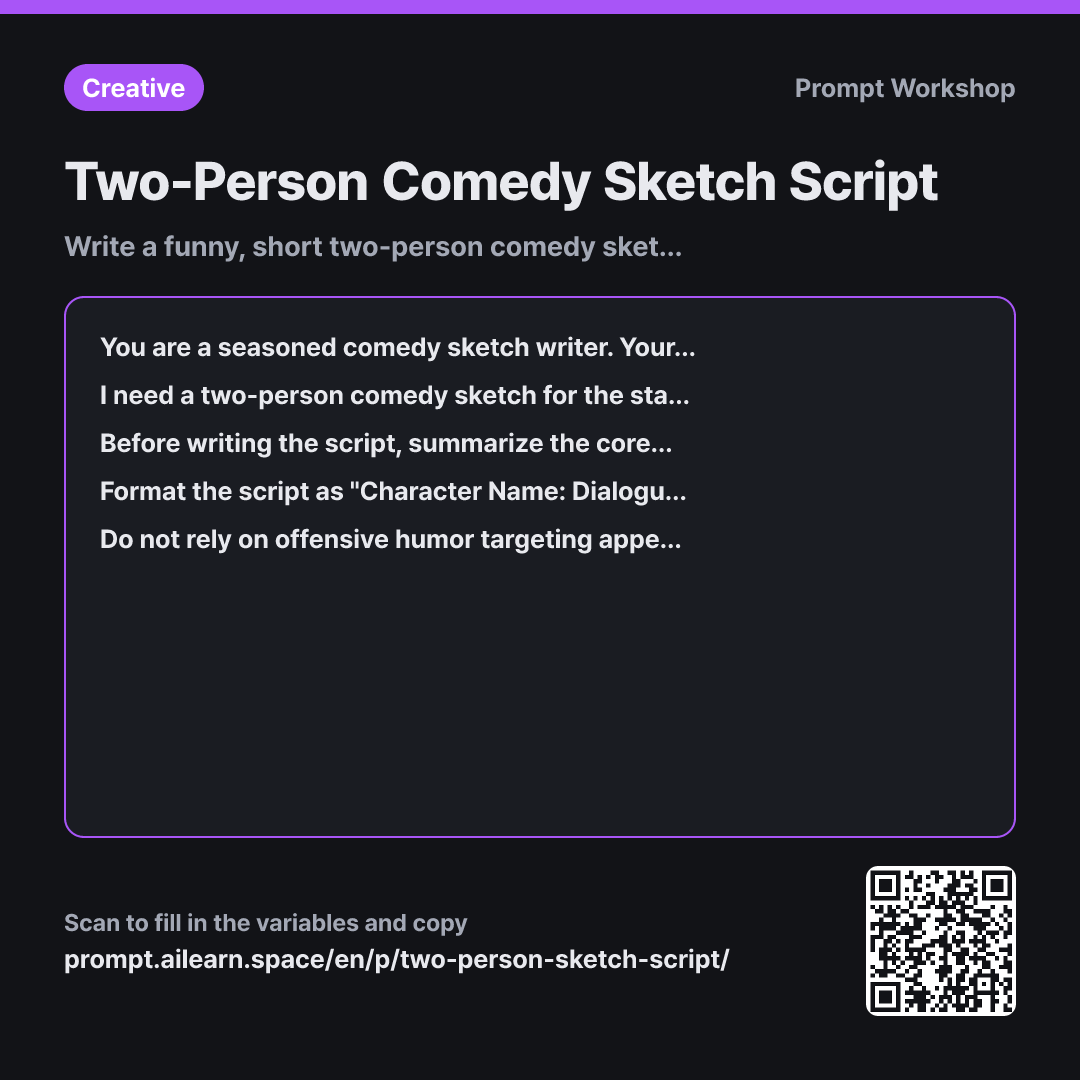
If you simply ask an AI to "write a funny comedy sketch," it defaults to superficial puns and back-and-forth banter where nothing actually progresses. On stage, while individual lines might sound mildly witty, the entire performance feels tedious because the humor relies solely on wordplay rather than situational tension.
The Role section does not just assign a profession; it embeds a specific comedy principle: "Laughter comes from characters operating under different assumptions." This foundational philosophy drives every following constraint. Without it, the AI immediately reverts to corny jokes regardless of subsequent instructions.
The Context details, such as the exact performance time and the "one chair, one handheld prop" limitation, determine whether the script is actually stage-ready. Without stage constraints, AI often generates scenes with multiple location shifts and four or more sudden characters. This precision is vital for school performances, auditions, or open mics with tight stage limits.
Requiring the AI to define the misunderstanding in one line beforehand and stating "do not introduce new twists midway" forms the core backbone of this prompt. When AI stories lose momentum, they tend to patch it by piling on extra settings, which instantly confuses the audience in a short sketch. The Constraints section serves two purposes: eliminating cheap, derogatory humor, and banning fleeting internet slang to ensure the sketch remains timeless.
Unfamiliar terms? See Aha AI: role-prompting, persona
Compared with a bad example
Write a funny 2-person comedy sketch for a school talent show.
Because no specific situation was given, the AI falls back on generic clichés—usually a late student arguing with a teacher—filled with shallow wordplay. Without a target runtime, the script might end in one minute or drag on for ten, and without marked comedic beats, actors have no guidance on where the timing and laughs should land during rehearsals.
Variations
When expanding the cast to 3+ actors
Write a 4-person comedy sketch based on: "{{current situation}}". The performance time is {{performance time}}. Two characters are the core parties involved in the misunderstanding, while the other two act as catalysts who amplify the confusion from their own mistaken perspectives. To ensure fair stage time, list each character's total line count at the end of the script. Limit stage props to a maximum of two chairs.
Useful when writing for group classes or theater ensembles. Specifying the line counts prevents one lead actor from dominating the entire sketch.
When polishing an existing draft
Below is my current {{performance time}} two-person sketch script. Do not rewrite the whole thing from scratch; instead, diagnose it based on three criteria: ① Spots where dialogue loops without advancing the situation, ② Lines where characters over-explain things the audience already figured out, and ③ Moments relying on dated slang or put-down humor. Point out these areas, then provide a revised version of only the single most sluggish section.
Use this when you have an initial draft that falls flat in rehearsals. Pinpointing the draggy sections first helps fix pacing while preserving your original comedic voice.
Model notes
Different AI models estimate script length and speaking pace differently. Read the generated script aloud with a stopwatch. If it is too long or short, give precise pruning feedback, such as: "This draft runs for 6 minutes. Keep the reveal point intact, but trim the setup to fit a 4-minute runtime."
Related prompts
Last updated 2026-09-02 · Found a mistake? Let us know