Why it is written this way
The most common pitfall in picture book prompts is ending up with a preachy lecture. If you ask for a "children's story that teaches friendship," the AI decides on the moral first and forcefully attaches plot events around it. The final page ends with lines like "Friends are precious!" and the child loses interest long before reaching it.
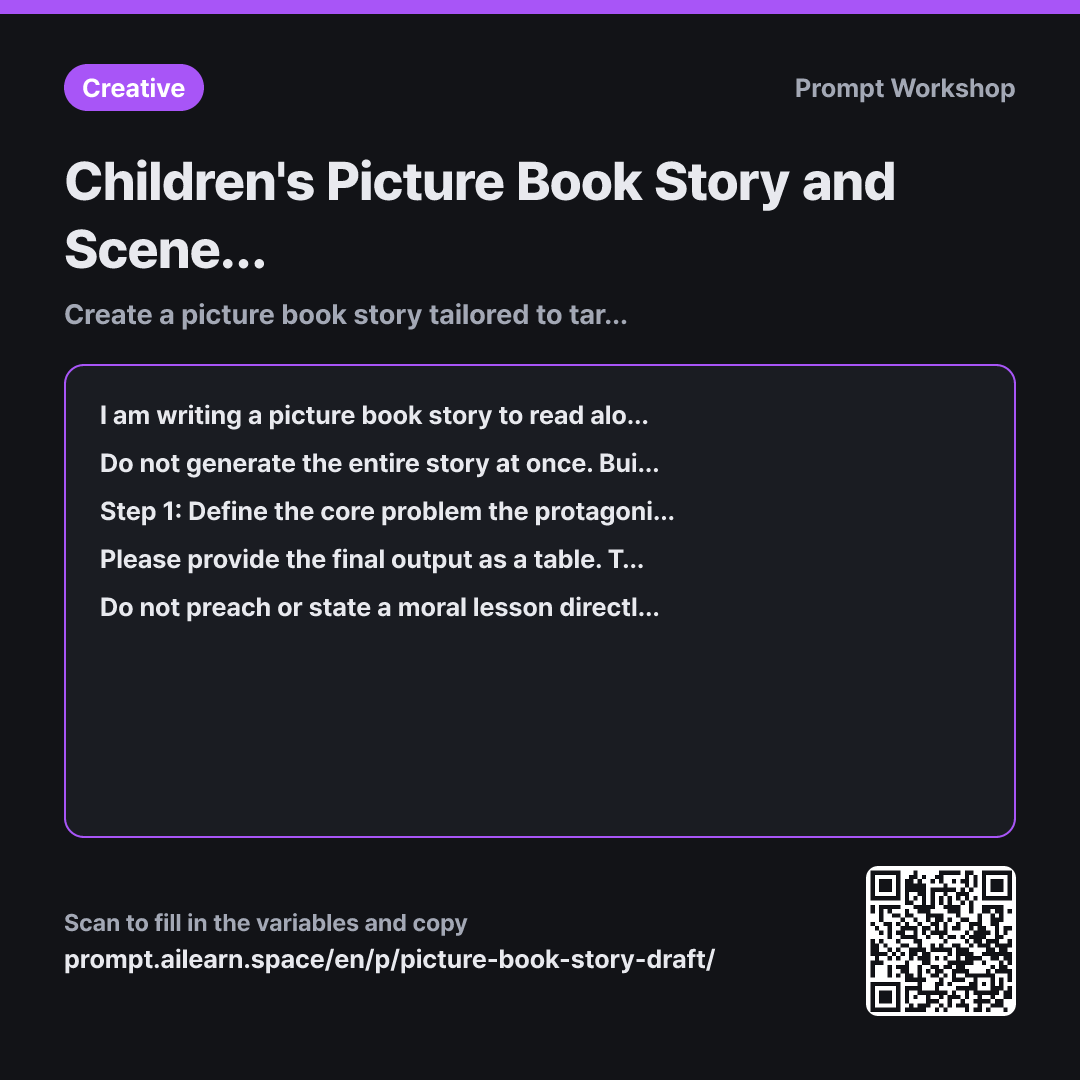
This prompt completely reorganizes the creation process to prevent that habit. The core strategy is breaking it down into Problem → Plot Arc → Scenes → Sentences rather than asking for everything at once. Pinning down the core conflict in one sentence keeps the story focused and eliminates sudden Deus Ex Machina resolutions.
The context section includes the age and the "read-aloud" setup because sentence cadence, rhythm, and length vary greatly depending on how the story is delivered. The step-by-step constraint requiring the AI to pause allows you to redirect the creative path easily. Adjusting a scene list in Step 3 is far cheaper than rewriting a finished manuscript.
The table in format pairs illustrations with text side by side. Explicitly writing the visual descriptions reveals whether any scene is purely relying on verbal explanation without engaging imagery. Finally, the constraint to "show through actions instead of preaching" provides a clear alternative to a mere prohibition, preventing the flat, bland results typical of generic AI story prompts.
Unfamiliar terms? See Aha AI: chain-of-thought, output-format
Compared with a bad example
Write a picture book story for a 5-year-old child. Make it about courage.
Asking like this produces an illustrated moral lecture rather than a real story. The character starts off scared and suddenly turns brave without a meaningful catalyst, ending with a cliche like "If you have courage, you can do anything!" Because the number of scenes is undefined, you won't know how many pages to illustrate, and uneven sentence lengths make reading aloud awkward.
Variations
Co-creating with a child's input
I am creating a story together with a {{target age}} child. The main character is {{main character protagonist}}. Do not write the whole story. Start by writing just the first three lines of the story, and then ask a question for the child: "What do you think happens next?" When I provide the child's response, incorporate it directly into the next three lines. Even if the child's answer is nonsensical or disjointed, do not correct it—find a creative way to make it fit into the narrative.
Use this when the collaborative process matters more than polished production. Without the explicit instruction not to correct the child, the AI often overwrites the child's ideas with generic tropes.
Fitting a predefined page/scene count
The print layout is fixed at {{number of scenes}}. Please draft a story featuring {{main character protagonist}} with the theme {{message to convey}}.
First, provide only a scene distribution table. Show which scenes introduce the problem, which scene marks the climax/turning point, and what will be depicted in the final two scenes. Once I review and approve the distribution table, we will write the actual text.
Designed for real-world publishing or production setups with fixed page counts. Lock in the scene pacing first to prevent story bloat later.
Model notes
Some models may attempt to write all steps at once despite the instructions. If this happens, explicitly state in your initial prompt: "Only complete Step 1 and stop." Proceeding one prompt per step ensures reliable output.
Related prompts
Last updated 2026-09-02 · Found a mistake? Let us know