Why it is written this way
When using AI for search ad copy, the most common frustration is getting well-written text that exceeds character limits in the ad platform, showing red error text. Copywriting for search ads is not about writing nice sentences; it is about fitting compelling messages inside rigid slot limits. Without explicit character boundaries, half of the generated output goes to waste.
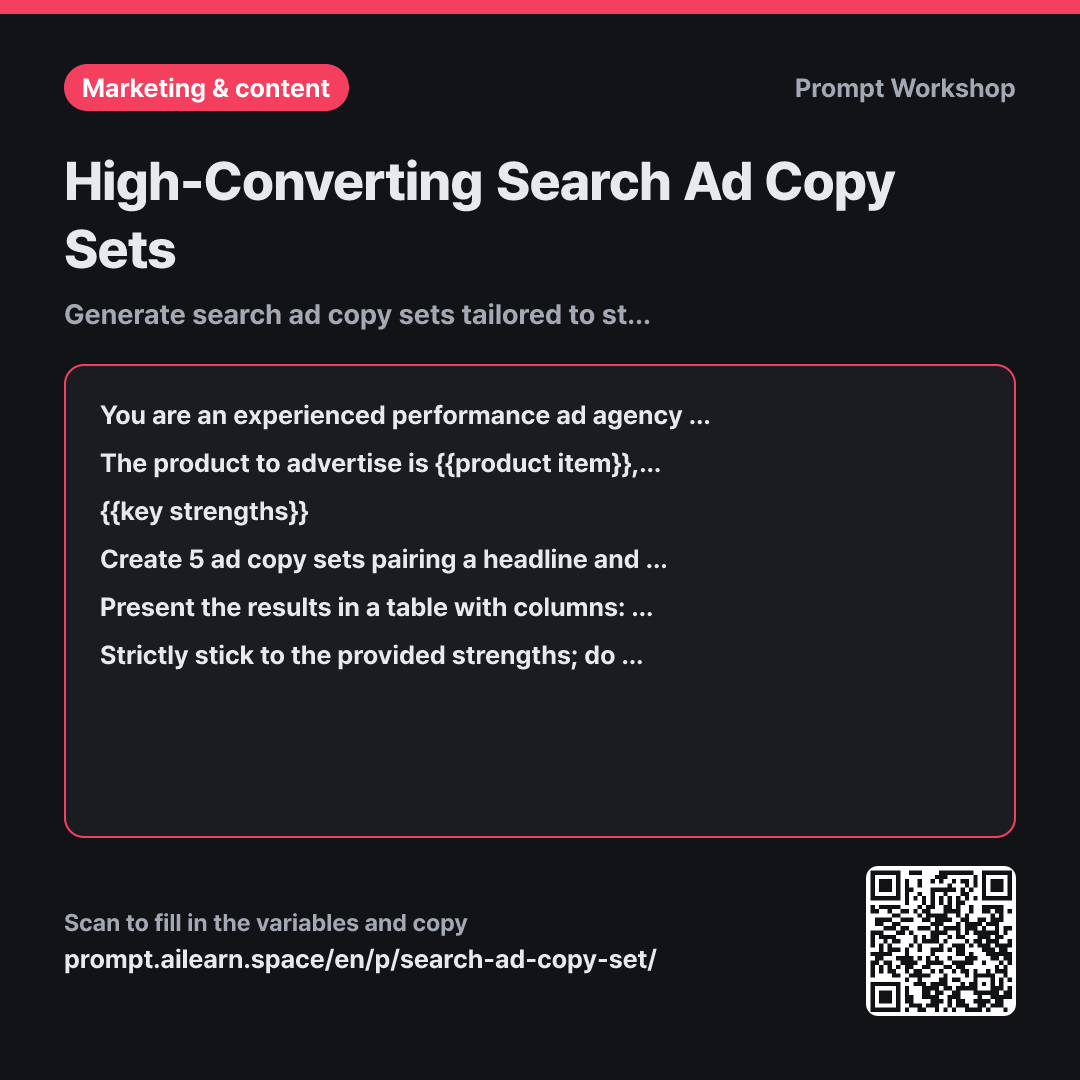
The first paragraph sets the Role as an agency copywriter. This single directive establishes that the searcher is already looking to buy, yielding direct, conversion-driven copy rather than generic brochure-style explanations.
The second paragraph provides Context combining target keywords and distinct strengths. Emphasizing that "users scan multiple ads side-by-side" is key: knowing competitor ads sit directly adjacent pushes AI to lead with unique value propositions instead of generic claims.
The Format paragraph locks down exact character limits. Providing 30 characters for headlines and 90 for descriptions aligns with standard Google Responsive Search Ads guidelines. Requesting separated headline and description lists beneath the table saves time when copying and pasting into multi-field ad setup tools. Finally, the Constraint paragraph prevents two major ad compliance hazards: making up non-existent numbers and promising landing page offers that do not exist.
Unfamiliar terms? See Aha AI: output-format, hallucination
Compared with a bad example
Give me 5 ad copies for our English tutoring service. For people searching online English lessons.
Without specifying character limits, headlines will be too long and descriptions will turn into multi-sentence paragraphs that cannot be pasted into ad managers. Without defined strengths, the AI produces generic filler like "Affordable prices" and "Systematic curriculum." Lacking landing page context, the ad copy will be misaligned with the actual offer.
Variations
Expanding Variations Across Multiple Keywords
I am creating search ad copy for {{product item}}. Based on the key strengths below, generate 3 tailored headlines for each keyword in {{search keywords}}. Each headline must be under 30 characters (including spaces) and naturally include parts of the search query. Present the output in a table with columns: "Keyword | Headline 1 | Headline 2 | Headline 3".
Key Strengths: {{key strengths}}
Different keywords reflect different user mindsets. Use this variant when you want tailored messaging grouped by search query instead of recycling the same copy.
Auditing and Refining Live Ad Copy
Below is the copy currently running for {{product item}}. The landing page is {{landing address}}. Review each ad variation in a table to check: (1) whether headlines exceed 30 characters or descriptions exceed 90 characters, (2) whether there are exaggerated claims requiring proof, and (3) whether it promises perks not verifiable on the landing page. For any flagged copy, provide a revised, compliant alternative.
Current Copy: {{key strengths}}
Use this to audit and optimize live ad assets instead of drafting from scratch, receiving both the issue diagnosis and the corrected copy in one step.
Model notes
AI models struggle with exact character counts. After receiving the table, ask: "Count the character length including spaces for each headline and description, and shorten any that exceed the limits."
LLMs cannot count exact character counts with 100% precision. Use character limits as strong constraints in your prompt, but always verify lengths before uploading to your ad platform.
Related prompts
Last updated 2026-09-02 · Found a mistake? Let us know