Why it is written this way
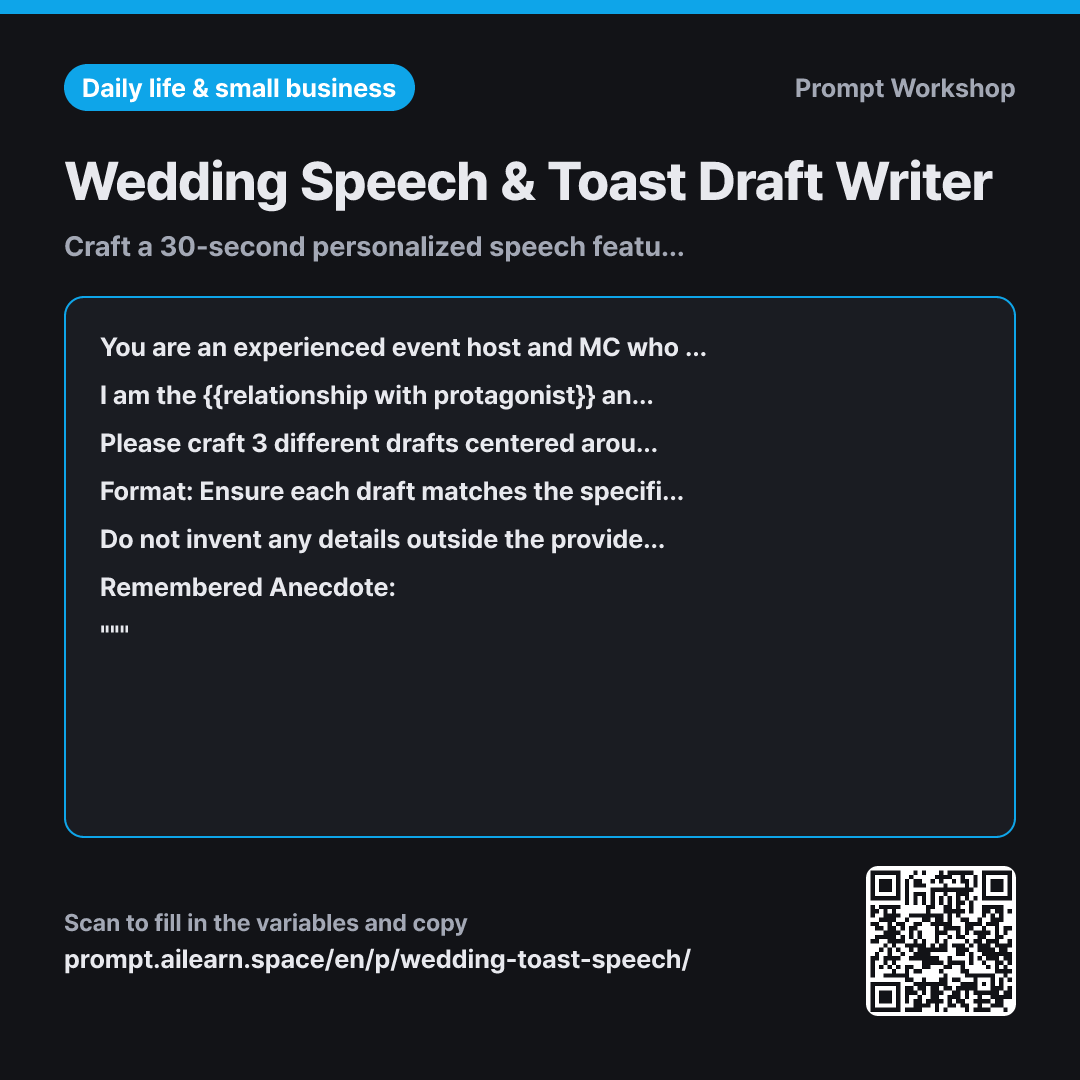
The most common failure in a wedding speech is not poor phrasing, but a lack of personal identity. Generic well-wishes result in a speech that anyone in the room could read, leaving the bride or groom feeling emotionally disconnected. This prompt places a concrete, real-life story at the center and builds everything else around it.
Assigning the Role of a professional MC fundamentally changes the prose style. Writing meant for speaking requires cutting long subordinate clauses and breaking sentences into lengths that allow the speaker to breathe comfortably at a microphone. The event setting and duration in the Context paragraph serve as anchors—what works for a formal ceremony differs drastically from an informal company toast.
The Constraints section serves as a crucial safeguard against common speech disasters. Without a strict rule against hallucination, AI tends to invent fictional moments like "from the very moment they first locked eyes." Explicitly banning risqué topics and hyper-local inside jokes prevents awkward silence and ensures the speech resonates with everyone in the room.
Requesting three distinct tones prevents premature finalization. Speech length can only be truly judged once spoken aloud, so choosing the best angle first and then polishing it is significantly more effective.
Once you receive your drafts, stand up and read them aloud with a timer. A 30-second read on a screen often turns into a 50-second speech at the mic. You will immediately catch stumbling words, breath shortages, or unnatural repetition of names. Fix those three spots, and your speech is ready.
Unfamiliar terms? See Aha AI: role-prompting, persona
Compared with a bad example
Write a 30-second wedding speech. It's for my college friend's wedding.
Without a specific story, AI defaults to generic greeting-card filler like "May their future always be filled with endless love and happiness." It reads fine on paper, but lacks emotional resonance. Furthermore, without spoken-pace constraints, the actual delivery often runs over a minute, throwing off the event schedule.
Variations
Polishing a Selected Draft
I will go with Draft #2 from the three options provided. The occasion is a {{nature of gathering}} and the target time is {{speaking time}}.
When read aloud, it runs slightly too long. Please trim the length while keeping the core content intact. Add a short note below detailing which sentences were removed and why, and flag any difficult pronunciations or overly long phrasing. Please do not shorten the anecdote itself.
If you simply say "make it shorter," AI usually cuts the personal story first. This prompt explicitly specifies what to protect and requests a breakdown of cuts.
Short Toast for Dinners & Receptions
Please write a concise toast for a {{nature of gathering}}. I am the {{relationship with protagonist}}. Target duration: {{speaking time}}.
Write exactly three sentences: 1) An opening greeting to welcome everyone, 2) A punchy takeaway drawn from the anecdote below, 3) A short call-and-response cheer or closing toast phrase. Keep the final toast phrase short (2–4 words) and avoid forced acronyms or outdated buzzwords.
Remembered Anecdote: """ {{remembered anecdote}} """
A short toast lives or dies by its closing cheer. This format locks down a 3-sentence structure and eliminates awkward slang.
Related prompts
Last updated 2026-09-02 · Found a mistake? Let us know