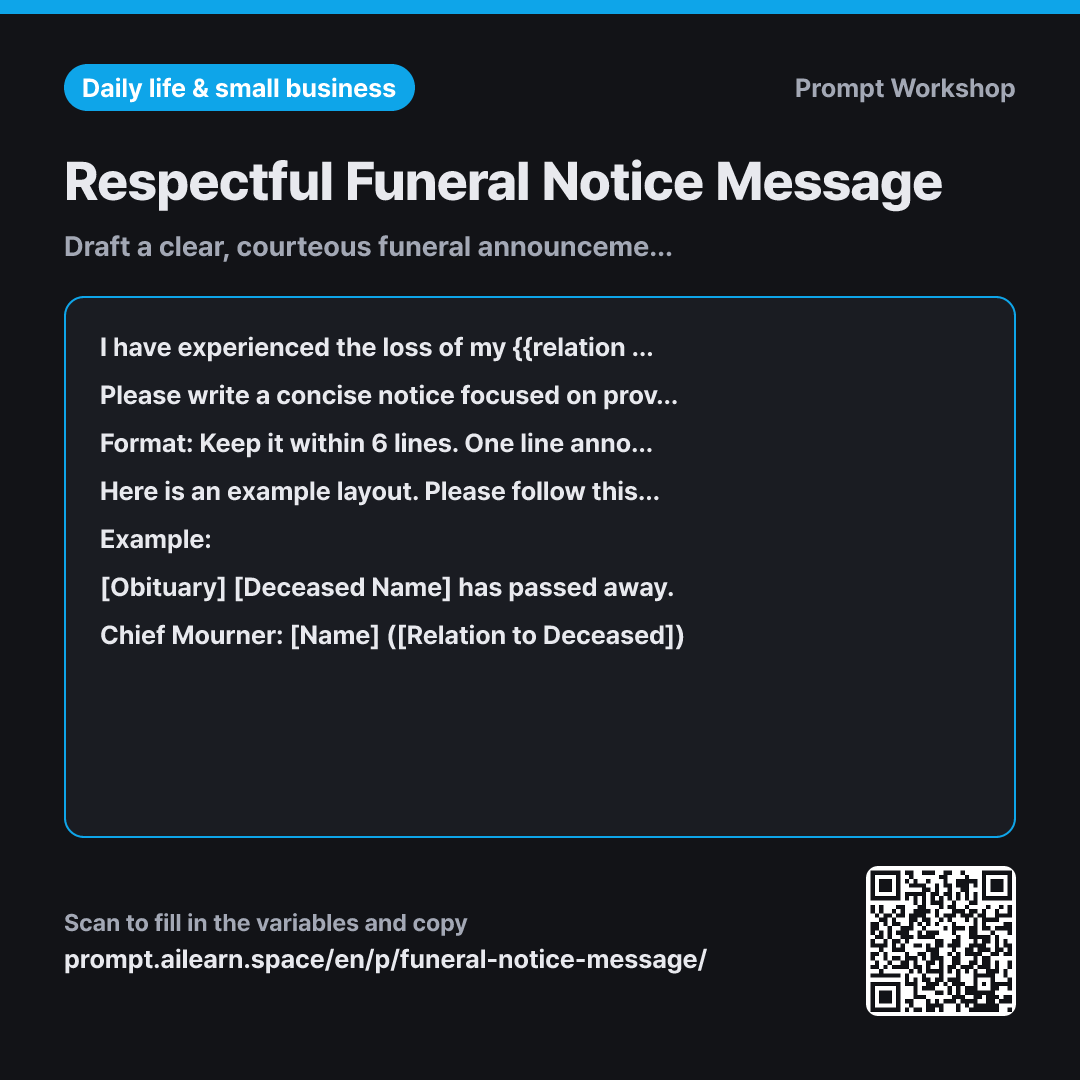
Why it is written this way
People searching for funeral message templates are usually overwhelmed and grieving. In this state, common mistakes happen: trying to convey deep emotions makes the message too long, and critical details like the chapel room or exact service time get omitted. Recipients feel hesitant to ask for clarification and end up making awkward phone calls. This prompt ensures etiquette not through sentence length, but through the clear ordering of information.
Stating "sent via SMS and messaging apps" in the context paragraph is the first safeguard. Without this, AI models tend to produce elaborate printed obituary formats or overly intimate personal letters. Establishing that multiple recipients will receive the same text keeps the tone dignified and concise.
The six-line constraint in the format section works hand-in-hand with the example block. Specifying only the line count often leads the AI to invent its own sequence, but providing an explicit Chief Mourner → Venue → Service Time → Contact layout ensures it follows standard conventions. Funeral announcements have established social formats where accurate, familiar layouts are far more effective than creative writing.
The constraints section prevents two critical issues. First, it stops hallucinations: if an AI invents a chapel room number or phone number and the message is sent out, attendees will end up at the wrong location. Second, it prevents excessive emotional phrasing. A funeral notice is intended to inform and assist those attending, and demanding emotional comfort puts recipients in an awkward position.
Before sending, simply verify four items aloud: funeral home name and room, service time, and contact information. If any brackets remain, that indicates missing information that needs to be filled. A funeral notice is the hardest type of message to issue a correction for.
Unfamiliar terms? See Aha AI: few-shot, output-format
Compared with a bad example
Write a funeral text message for my father
Without the venue and service time, the AI will either hallucinate plausible funeral home names and times or generate a completely generic "With heartfelt condolences" line with no practical details. In the former case, incorrect information spreads; in the latter, recipients have to call to find out where to go. Either way, it creates unnecessary confusion during an already difficult time.
Variations
For Company & Group Chats
I need to share a bereavement notice in our company group chat following the passing of my {{relation to deceased}}. The venue is {{mortuary information}}, and the funeral service is {{funeral time}}.
Since this is an announcement for colleagues, omit personal emotional expressions and place the line specifying department and name at the very top. Please provide two versions: one standard notice and one including a polite phrase indicating that attending or sending condolences is purely optional ("Your thoughts and prayers are more than enough"). Leave unprovided details in brackets like [ ].
Group chat announcements require team and name identification at the top so coworkers immediately know whose family member passed. Providing two options allows users to choose whether to relieve colleagues of social pressure to attend.
Post-Funeral Thank-You Note
The funeral for my {{relation to deceased}} has concluded. The service was held on {{funeral time}}, and I want to send a thank-you note to those who sent condolences and attended the service.
Please keep it within three sentences: the first sentence stating that the funeral was concluded smoothly, the second expressing gratitude, and the third offering warm regards for their well-being. Do not use phrases that invite a reply, and do not mention personal circumstances or medical history of the deceased.
Thank-you notes should not prompt a response, as that creates an awkward burden for the recipient to reply again. The prompt explicitly restricts reply-inducing phrases.
Related prompts
Last updated 2026-09-02 · Found a mistake? Let us know