Why it is written this way
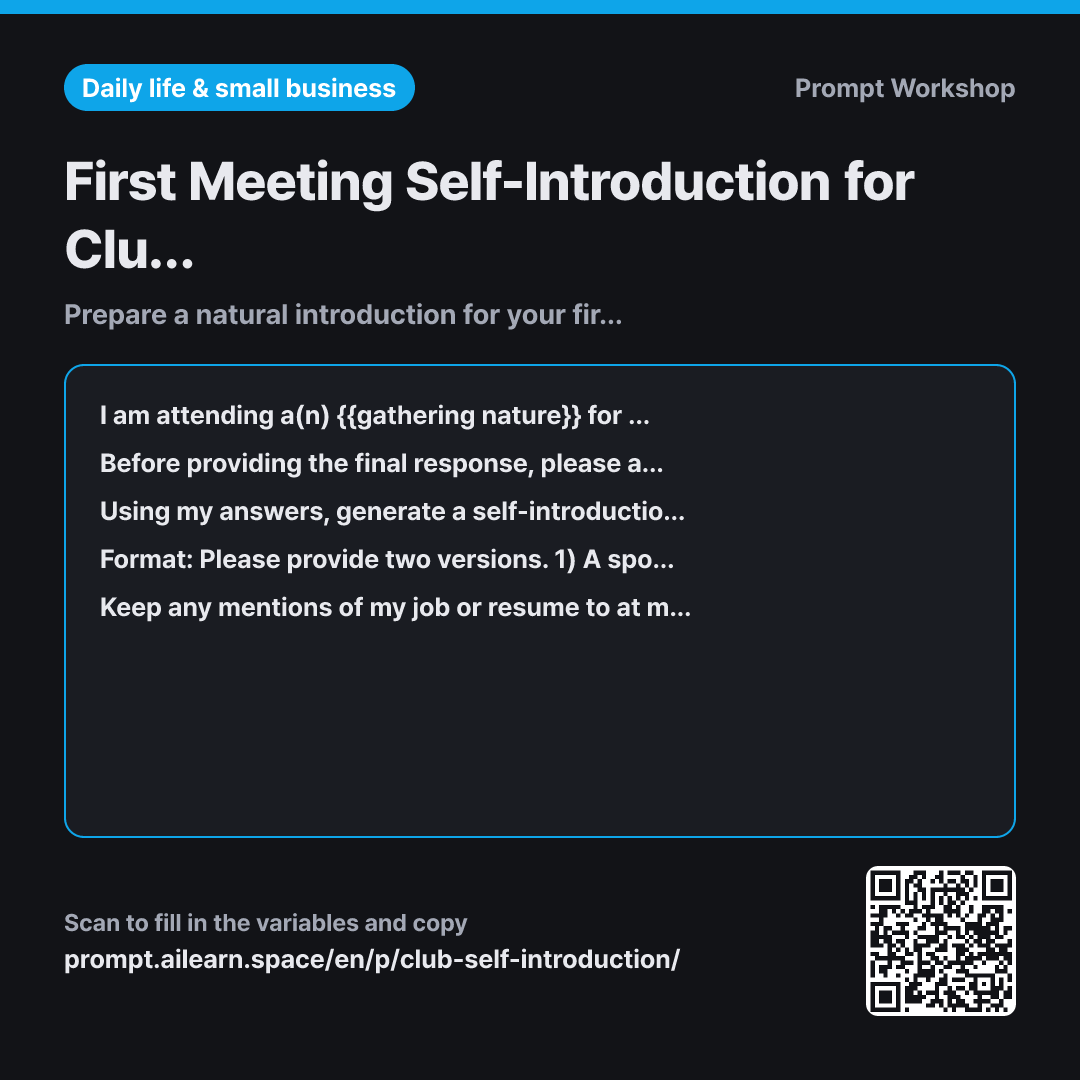
Copying generic self-introduction templates often makes you sound like you are in a job interview: name, age, job title, and a polite closing. While not wrong, it leaves listeners with nothing to latch onto, ending the conversation right there. What you need at a first meetup is not a resume summary, but a single hook that invites someone to strike up a conversation.
This is why the Context section asks for both the group's nature and your reason for joining. A running club requires a completely different tone and length compared to a book club. Saying "I kept slacking off when running alone" is instantly relatable to most members, providing an immediate icebreaker.
The Clarification step is the core of this prompt. Details like your experience level and how you want to present yourself are things only you know. Without asking, AI will default to bland assumptions. Answering two or three targeted questions also helps you organize your thoughts easily—it is often much easier to answer questions than to draft an introduction from scratch.
Splitting the Format into a spoken script and a group chat message addresses the fact that first introductions usually happen twice: once in person and once in the group chat. A spoken intro needs short pauses and rhythm, while a chat post needs to be concise and readable for members checking in later. The final constraints prevent career-dropping and humblebragging, which solves half the battle in making a good first impression.
Once you get the script, do not try to memorize the whole thing—just remember that final hook sentence. The opening comes naturally in the moment, but the conversation starter will slip your mind unless prepared. That final line is what sparks connections after the round of introductions.
Unfamiliar terms? See Aha AI: context-window, prompt
Compared with a bad example
Write me a short self-introduction for a club.
Without the group's nature or time limit, the AI produces a generic, one-size-fits-all introduction like "Hi, I'm [Name], excited to join and meet everyone!" which anyone could write without AI. It also tends to default to professional resume formats, making you sound unnecessarily formal in a casual hobby setting.
Variations
Joining an Established, Close-Knit Group
I am joining an existing {{gathering nature}} where most members already know each other well. My reason for joining is: {{reason for joining}}.
Please craft a self-introduction that feels natural and not intrusive to an established group. Include one modest line asking for tips or guidance without burdening existing members, and keep the whole speech within {{speaking time}}. Avoid forced jokes or trying too hard to break the ice.
When joining an existing circle, blending in smoothly matters more than standing out. Asking a simple question for advice naturally invites members to welcome you.
Online-Only Group Chat Introduction
I am posting my first introduction in the online group chat for a(n) {{gathering nature}}. My reason for joining is: {{reason for joining}}.
Write a 3-line introduction message for the chat. Line 1: greeting and preferred name. Line 2: why I joined. Line 3: an easy, engaging question that invites quick replies from members. Use at most one emoji and keep the total length around 120 characters excluding line breaks.
Text introductions easily get buried if no one replies. Ending with an engaging question prompts immediate interaction.
Related prompts
Last updated 2026-09-02 · Found a mistake? Let us know