Why it is written this way
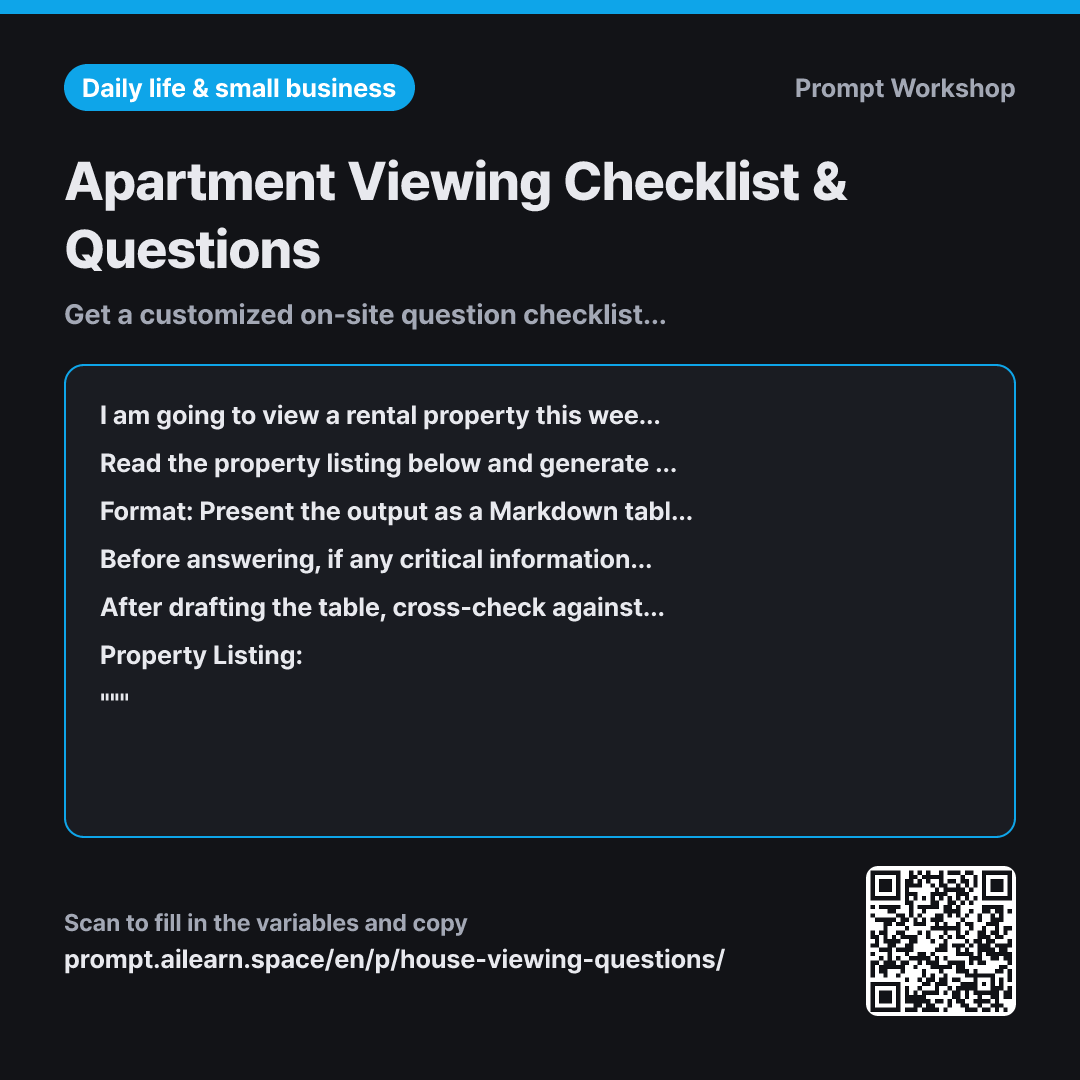
When you search for house-hunting questions online, you get flooded with generic 20-item checklists where half the answers are already in the listing and the other half do not apply to your situation. What you actually miss are the property-specific details. This prompt forces the AI to identify blind spots in the specific listing instead of regurgitating standard advice.
Setting the context via your living conditions and priorities shapes the focus of the checklist. If you work from home, daytime noise and natural light move up in priority, while parking questions get deprioritized if you don't own a car. It ensures the prompt reflects the reality that different tenants require entirely different checks for the same unit.
Structuring the format into a table with an 'Exact Question to Ask' column makes it instantly usable on-site. If an item simply says "check utility details," you still have to awkwardly formulate the phrasing in front of the agent. The 'Verification Method' column separates what to ask from what to inspect yourself—since you cannot simply ask an agent if there is mold; you have to look under the window sills.
Having the AI ask clarifying questions first prevents it from guessing when vital context is missing. Creating a list without knowing move-in timelines or budget constraints often leads to wasted effort. Finally, the review step filters out redundant queries already covered in the listing, eliminating the bloat common in generic rental checklists.
Once generated, keep the table open on your phone to check off items as you tour. The prompt deliberately avoids evaluating contract favorability; keep that evaluation separate and review any complex legal terms with a real estate professional later.
Unfamiliar terms? See Aha AI: context-window, output-format
Compared with a bad example
I'm going to look at an apartment. What should I ask? It's a studio.
Without the listing details, the AI simply outputs a generic web checklist. Half the generated questions will ask about utilities or appliances already stated in the listing, while missing specific questions relevant to the building's floor level, elevator access, or move-in timeline. Additionally, without verbatim question phrasing, you are left struggling to articulate questions on the spot.
Variations
Document & Paperwork Checklist Before Signing
I am preparing to sign a lease for the following listing: {{property listing}}. My living conditions are {{residence conditions}}.
Create a checklist strictly focused on documents and public records to verify before signing the lease. For each item, specify what document to check, where to obtain it, what specific details to cross-reference, and one concise question I can read verbatim to the agent. Limit to 8 items or fewer.
Do not provide legal advice or assess whether the terms are favorable. Focus solely on verifiable checklist items and questions, marking items that need formal review as 'Requires Professional Verification.'
On-site viewing questions and pre-signing document checks happen at different stages. This variant focuses entirely on verification without attempting legal interpretation.
Post-Tour Property Comparison
I just finished viewing the property below. My top priority is {{priority order}}, and my living conditions are {{residence conditions}}.
Summarize the top 3 pros and top 3 potential concerns for this property. Then, create a 5-item comparison table template based on my priorities so I can systematically evaluate future listings against this one. Leave fields blank if the listing lacks the information.
Property Listing: """ {{property listing}} """
Viewing multiple homes can make details blur together. Setting up a standardized comparison rubric based on your priorities makes the final decision much easier.
Related prompts
Last updated 2026-09-02 · Found a mistake? Let us know