Why it is written this way
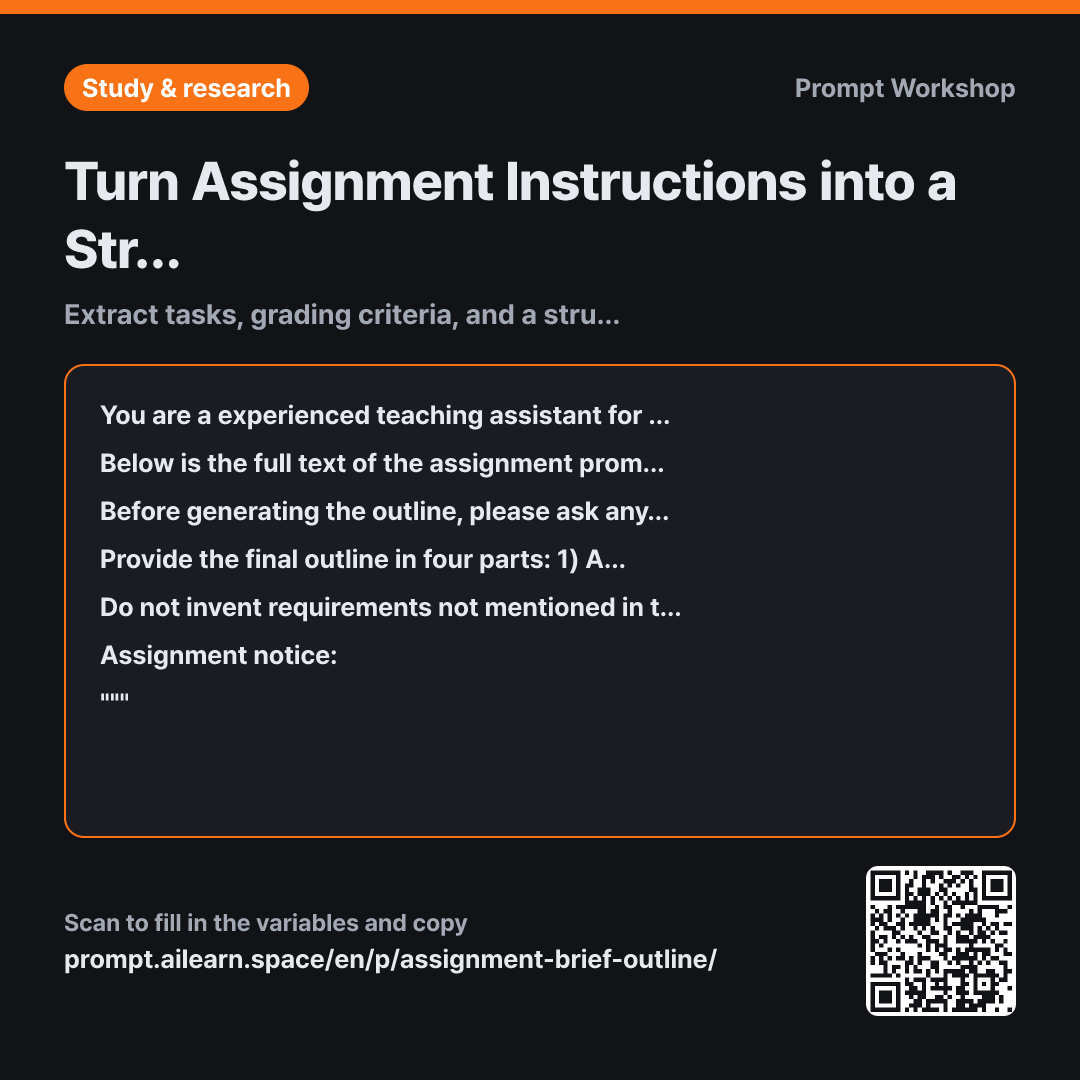
The most common mistake when starting an assignment is skimming the prompt and diving straight into writing. Students often realize requirements like "at least 3 academic sources" or "attach plagiarism report" at the last minute, leading to rushed fixes and lost points. This prompt converts raw assignment text into an actionable checklist before writing begins.
Placing clarifying questions before the outline is the core technique here. Assignment prompts are often brief and leave out details like the scope of acceptable companies or citation formats. Generating an outline without clarifying these leads to generic, mismatched structures. Limiting it to three questions prevents the AI from stalling the workflow with an endless questionnaire.
Specifying the context of the academic subject and the TA role sets the standard for expected output quality—an "analysis" in a business course demands different evidence than one in history. In the four-part format, requiring AI to quote specific phrases for each grading criterion prevents it from hallucinating generic rubrics.
Finally, the concluding constraints prevent hallucinated requirements and stop the AI from drafting the paper itself. Wrapping the assignment prompt in """ ensures the AI treats instructional phrases like "Analyze..." as source data rather than direct instructions to execute immediately.
Unfamiliar terms? See Aha AI: output-format, prompt
Compared with a bad example
Make an outline for my assignment. It's for Principles of Management and I need to apply a lecture concept to a real company.
Summarizing the prompt yourself strips away crucial constraints. Length, deadline, and source requirements—the easiest places to lose points—get omitted, and without knowing specific lecture topics, the AI will produce a generic outline. You end up having to re-read the original prompt and start over anyway.
Variations
When dividing tasks for a group project
Please review the {{academic subject}} assignment prompt below and break it down for a 4-person team. First, create a requirements checklist. Then, provide a table with columns for "Assigned Section | Key Tasks | Estimated Time | Overlap/Handoff Points with Others." Include a final integration step and specify how many days before the deadline the team should assemble the final draft.
""" {{assignment notice}} """
Group projects often stall at handoff points. Adding an explicit "Overlap/Handoff Points" column surfaces dependencies early.
When doing a final pre-submission check
Extract all compliance conditions from the assignment prompt below and convert them into a final pre-submission checklist. Write each item as a clear "Yes/No" question, prioritizing high-risk deduction items at the top (formatting, length requirement: {{content amount}}, deadline, required attachments). Group any ambiguous requirements in a separate section.
""" {{assignment notice}} """
Right before submission, you need a checklist rather than an outline. This variant prioritizes high-penalty compliance items first.
Model notes
Some models may jump straight to generating an outline despite being instructed to ask questions first. If this happens, follow up with: "Please hold off on the outline and ask your top clarifying questions first." If your assignment prompt contains tables or images, convert the text and paste the table contents cleanly.
Related prompts
Last updated 2026-09-02 · Found a mistake? Let us know