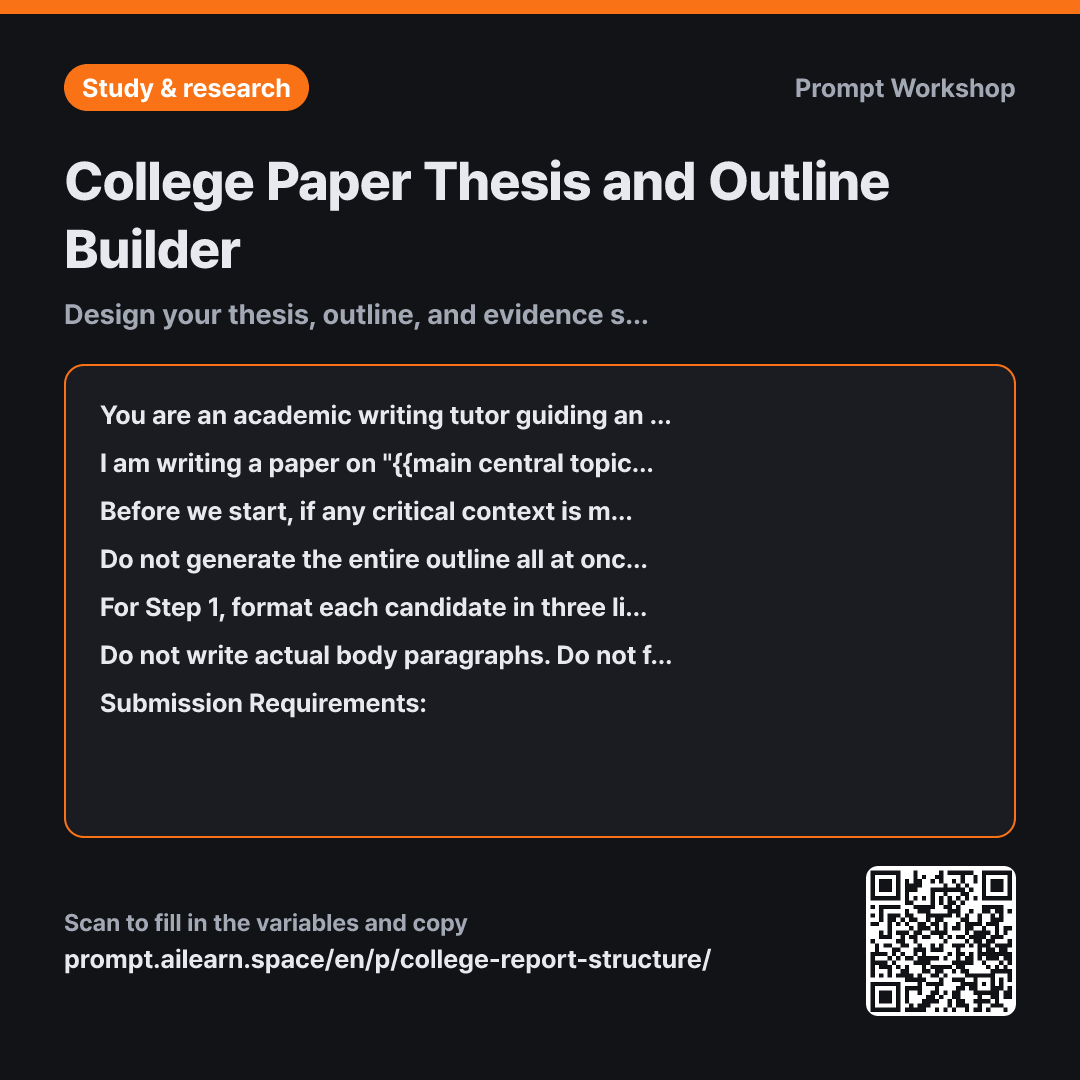
Why it is written this way
When asking how to write a college paper, many users immediately ask AI to draft full paragraphs. Beyond plagiarism concerns, relying on finished text leaves you with arguments that are not your own, making it impossible to defend your work against professors' questions. This prompt positions AI as a structural thinking partner rather than a ghostwriter, leaving the actual writing to you.
Dividing the workflow into three sequential stages is the core mechanism here. Requesting the thesis, outline, and evidence simultaneously forces AI to pick the most generic thesis automatically and build upon it. Forcing a stop after Step 1 gives you space to evaluate three directions and make your own choice. Including counterarguments for each candidate helps weed out weak angles, as a thesis without strong counterarguments usually lacks substance for a full paper.
Placing clarifying questions up front accounts for how theoretical frameworks or target timeframes completely shift an academic paper. Specifying formats per step prevents early tables in Step 1 or a single jumbled paragraph in Step 3.
Without explicit constraints, AI tends to hallucinate plausible-sounding paper titles, authors, and publication years. Citing these blindly can lead to severe academic integrity issues. Limiting the output to source types and search repositories keeps the process safe and genuinely faster. Wrapping the submission requirements in """ prevents assignment guidelines from being misconstrued as procedural commands.
Unfamiliar terms? See Aha AI: chain-of-thought, hallucination
Compared with a bad example
Write an 8-page paper on working-hour autonomy among food delivery platform workers. Start with the introduction.
The generated text may read smoothly, but the paragraphs will lack verifiable evidence. Citations often turn out to be completely fabricated, and the thesis will rely on textbook generalities that collapse under faculty scrutiny. In the end, diagnosing and rewriting such drafts takes significantly longer than writing from scratch.
Variations
Reviewing an Existing Outline Draft
You are an academic writing tutor guiding a student majoring in {{academic major field}}. Below is my draft outline and section summaries for a paper on "{{main central topic}}". Do not rewrite anything; only provide a diagnostic critique. Point out where the core thesis drifts across sections, which sections make unsupported claims, and which sections are over- or under-allocated relative to the target length ({{content amount}}). Conclude with the single most critical priority I should fix first.
""" {{submission requirement detail}} """
Structural flaws are much cheaper to fix at the outline stage. This variant keeps the AI strictly in a diagnostic role so you handle the actual revisions.
Anticipating Counterarguments Early
My working thesis for "{{main central topic}}" is listed after the guidelines below. Adopt the perspective of a {{academic major field}} researcher who strongly opposes this thesis, and present three rigorous counterarguments. For each counterargument, add a one-line suggestion on what type of empirical evidence could refute it. Do not rewrite my thesis.
""" {{submission requirement detail}} """
Examining objections early clarifies which body sections require the strongest empirical backing. This also doubles as preparation for Q&A sessions during presentations.
Model notes
When requesting all three steps simultaneously, models occasionally skip Step 1 and jump straight to the outline. Confirm you have received only the thesis candidates before giving the green light for Step 2.
When long assignment guidelines are attached, some models skip the stage-by-stage instructions and produce everything at once. Adding "Focus strictly on Step 1 for now" usually resolves this. Even if web search capabilities are enabled, only cite sources after opening and validating the original text yourself.
Related prompts
Last updated 2026-09-02 · Found a mistake? Let us know