Why it is written this way
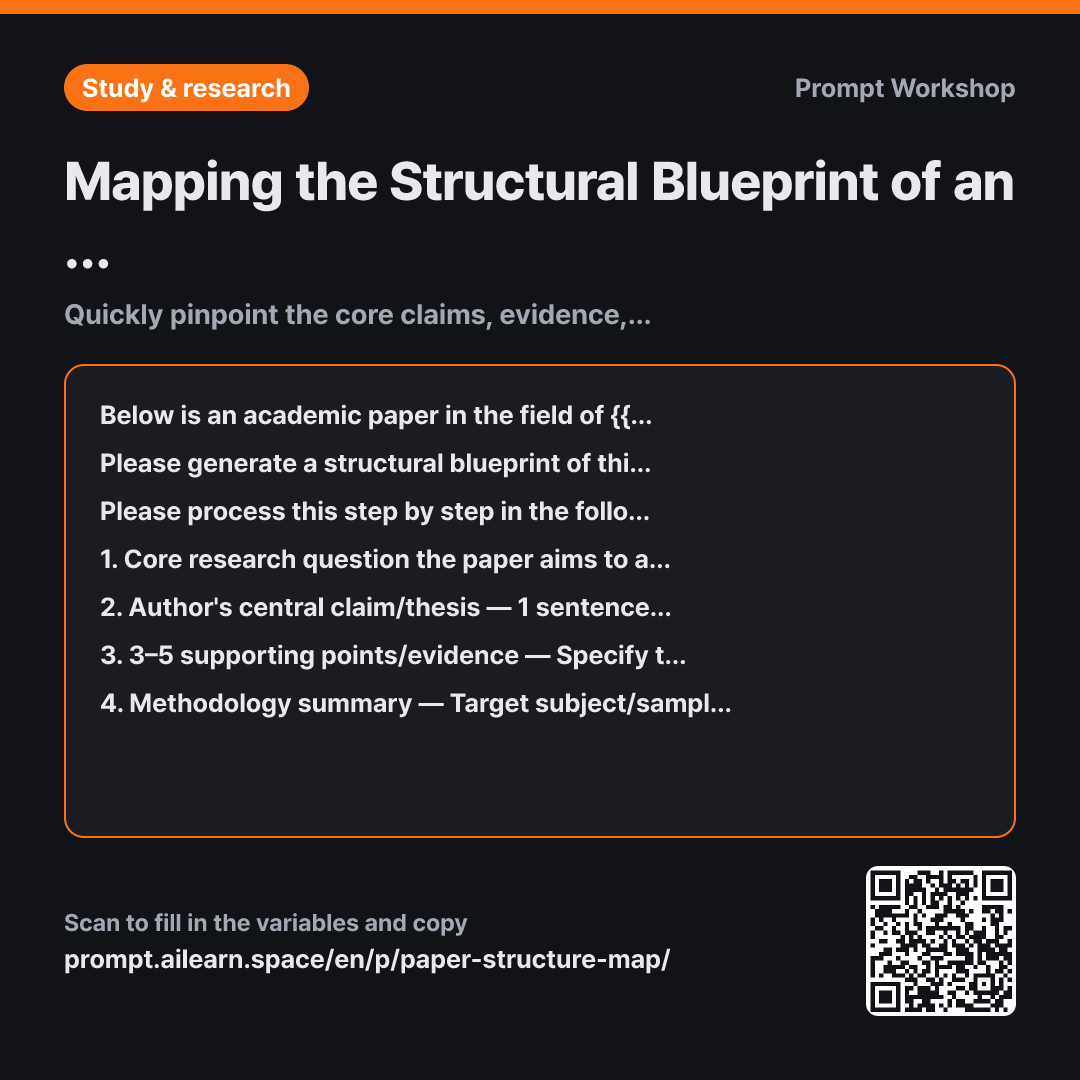
Reading an unfamiliar academic paper from the very first line often leads to getting lost in the theoretical background. You end up reading twenty paragraphs summarizing someone else's past research without understanding why the author is citing it. When using ChatGPT to accelerate reading, the first priority is not a summary, but a roadmap. Once you know what lives in which section, you can selectively deep-dive into only the necessary sections.
Breaking the task into five steps executed sequentially ensures that subsequent answers build upon earlier foundations. The central claim must be identified first before the AI can determine which sentences serve as supporting evidence. If prompted all at once, AI models tend to produce a sequential section-by-section summary, which is nothing more than a rephrased table of contents. Structuring the task in distinct phases turns each output into raw material for the next.
Explicitly prohibiting evaluation in the second paragraph is also intentional. If allowed to critique, the AI often skips structural mapping and offers vague commentary like "This is an interesting approach." Assessing methodological limitations can wait until the blueprint is drawn.
In the format instructions, requiring section names in parentheses is the most practical rule. When every point in the blueprint is tethered to its location, you can jump straight to the source text and instantly verify whether the AI interpreted the passage accurately. In the constraints, requiring "Not found in text" acts as a safeguard against hallucinated filler. Wrapping the paper body in """ prevents figure captions or footnote instructions inside the paper from being misread as user prompts.
Unfamiliar terms? See Aha AI: context-window, prompt-injection
Compared with a bad example
Summarize this paper.
(paste paper)
This produces a generic, chronological compression from introduction to conclusion. While shorter, the author's novel claims are blended indistinguishably with literature review citations in the same tone, leaving the reader clueless about the paper's actual contribution. It does not indicate where to look in the source text, forcing you to reread from scratch anyway. Crucial numbers or sample sizes are often silently omitted without any indication in the summary.
Variations
Standardized Comparison Across Multiple Papers
Please summarize the following {{target field}} paper strictly using the six fields below. I will be comparing multiple papers using this exact template, so do not alter the field names or their order.
Research Question / Target Sample & Size / Methodology / Key Findings (including exact metrics) / Author Limitations / Novel Contribution. Keep each field to a maximum of two sentences. If information is missing from the text, write "None stated."
Paper Text: """ {{paper body text}} """
When building a literature comparison matrix, fixing the fields beforehand is essential. Inconsistent formatting across papers makes it impossible to merge into a single comparative table later.
One-Page Archival Brief
Please convert the following {{target field}} paper into a single-page reference brief for future retrieval.
At the top, include the citation metadata (Authors, Year, Title — only if present in text), followed by the paper in one sentence, 3 highly citable key quotes with their respective section headers, and finally 2 suggested follow-up topics to read next. Do not invent bibliographic details not explicitly provided.
Paper Text: """ {{paper body text}} """
Running this prompt immediately after generating the structural blueprint creates a permanent reference note for your research archive. The restriction against inventing missing metadata is critical.
Model notes
For models that natively support PDF uploads, attach the file directly first before sending the prompt. If the text is very long, pasting just the Introduction, Methodology, and Results sections is sufficient to generate an accurate blueprint.
Related prompts
Last updated 2026-09-02 · Found a mistake? Let us know