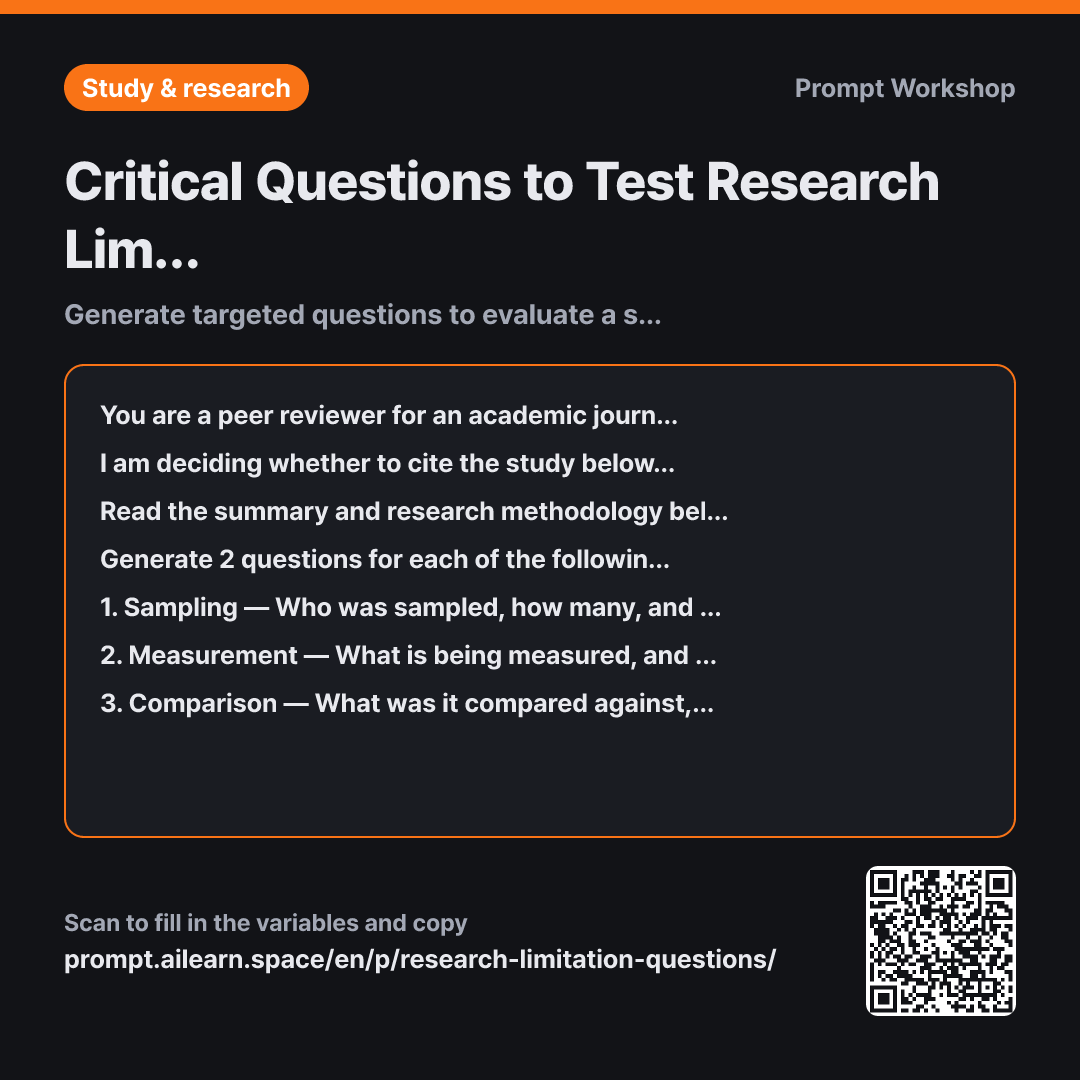
Why it is written this way
When you paste a research paper and ask an AI "What do you think of this study?", it usually defaults to praise. It offers a three-line summary of its significance and brushes off limitations with vague remarks like "caution is needed when generalizing." In critical academic reading, you do not need generic praise; you need sharp, specific questions to investigate when reopening the source material. This prompt avoids handing judgment over to the AI and focuses strictly on retrieving diagnostic questions.
Specifying the Role as a peer reviewer who "cares more about the process than the conclusion" prevents the AI from defaulting to standard peer review formats that attempt to balance strengths and weaknesses. Directing its focus to methodology forces scrutiny on sampling and measurement.
Setting the 5 categories in the Format establishes strict review criteria. Asking for "limitations" without criteria results in generic remarks applicable to any paper. Splitting the review across sampling, measurement, comparison, interpretation, and conditions generates inquiries tailored exclusively to the study at hand. The High/Medium/Low impact rating helps prioritize where to look first when time is limited.
Strict Constraints avoid two common pitfalls: banning evaluative terms prevents questions from morphing into premature conclusions, while tagging missing info as "Not specified in text — needs verification" stops the AI from inventing unmentioned methodology flaws. The final self-check instruction ensures the AI covers all 5 categories even when provided with brief text. Separating the text blocks using """ delimiters prevents the AI from confusing abstract claims with methodological details.
Unfamiliar terms? See Aha AI: role-prompting, hallucination
Compared with a bad example
Tell me the limitations of this paper.
(Paste paper)
This prompt yields generic statements applicable to almost every paper, such as "the sample size is small," "generalizability is limited," or "further research is required." It misses concrete issues, such as whether a self-report proxy distorted the measurement or whether the post-test timing affected results. Copying those generic points produces superficial critiques without genuine engagement.
Variations
Reviewing Your Own Research Proposal
Below is the proposal for a study I plan to conduct in {{target field}}. I want to identify the questions a journal reviewer would likely raise.
Extract questions across 5 categories: Sampling, Measurement, Comparison, Interpretation, and Conditions. For each question, label it as either "Answerable with current proposal / Not answerable with current proposal." For any question marked "Not answerable," provide a one-line note on which section of the proposal must be revised to address it.
Paper Abstract Summary: """ {{paper abstract summary}} """
Research Method: """ {{research method}} """
Applies the same critical framework to your own research plan rather than an existing paper. Questions marked as unanswerable point directly to areas needing revision.
Fact-Checking Studies Cited in News Articles
Below is the summary of a study in {{target field}} cited in a news article, along with the methodology described in the report.
Generate 5 questions to verify whether the news article's claims overextend what the study actually demonstrated. Focus specifically on target group shifts, exaggerated phrasing of effect sizes, and omitted boundary conditions. Do not make a verdict on whether the article is right or wrong.
Paper Abstract Summary: """ {{paper abstract summary}} """
Research Method: """ {{research method}} """
News articles frequently strip away research conditions. This variant generates questions to help you cross-reference what was omitted against the original source.
Model notes
If you want answers to the questions, save the generated question list first, then query them one by one (e.g., "Check only question #3 against the provided text").
Related prompts
Last updated 2026-09-02 · Found a mistake? Let us know