Why it is written this way
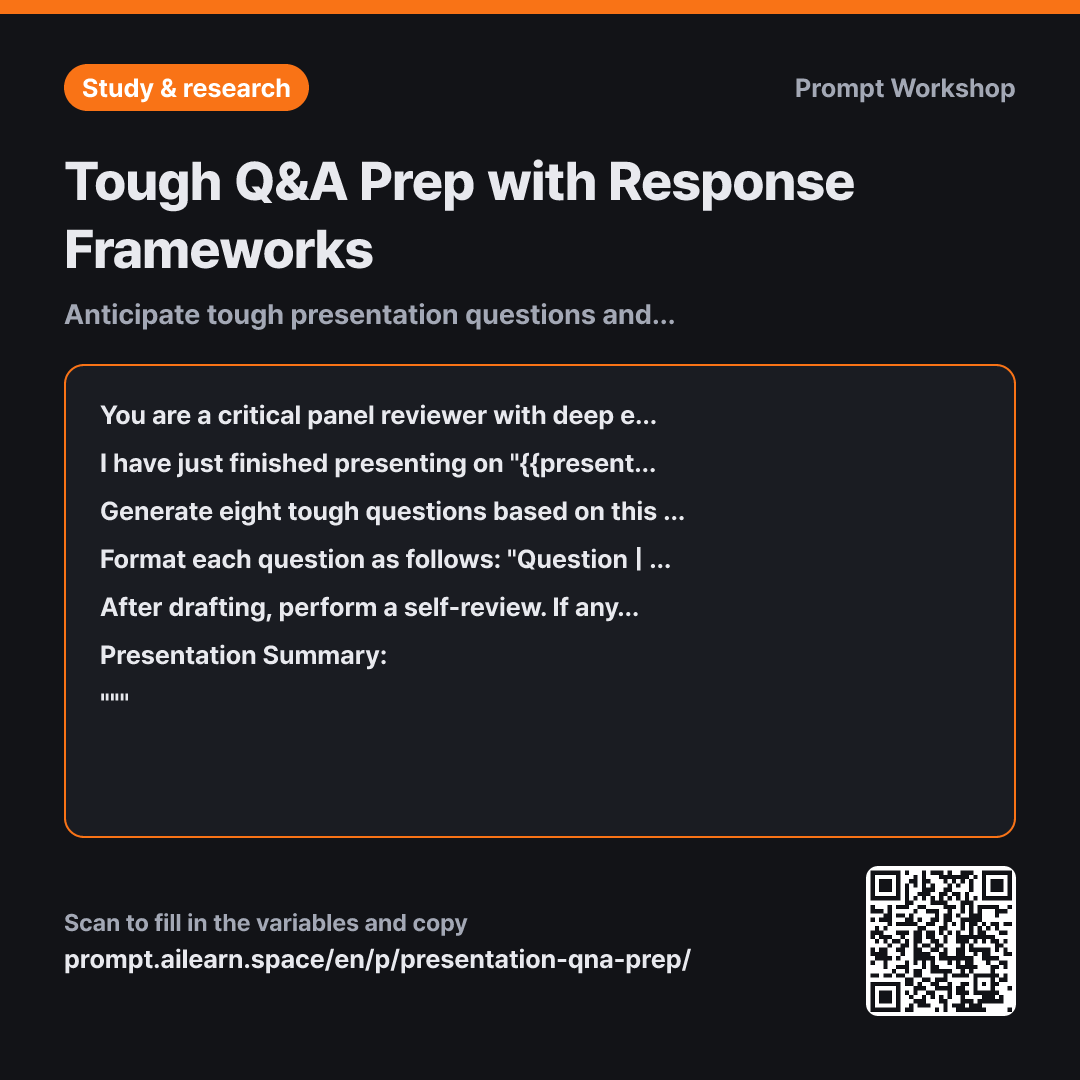
When asking an AI for potential Q&A questions, it often defaults to softballs like "Why did you choose this topic?" Preparing only for easy questions leaves you defenseless in high-stakes presentations. AI tends to be overly accommodating, which inherently softens its questioning.
Explicitly setting the Role as an uncompromising reviewer who is "not here to encourage" shifts the AI's perspective. Naming four specific attack angles in the prompt—sources, sample sizes, causality, and missing counterexamples—guides the AI to probe actual methodological vulnerabilities rather than generating generic curiosities.
Structuring the Format into a three-part answer (Acknowledge → Evidence → Concession) prevents long-winded, defensive rambling, which is the primary reason presenters struggle during Q&A. Providing a ready-to-use "fallback line" ensures you handle unknown answers professionally rather than making awkward guesses.
Finally, the self-Constraint review in the last paragraph filters out redundant or weak questions, ensuring that only the sharpest, most challenging inquiries make the final list.
Unfamiliar terms? See Aha AI: role-prompting, persona
Compared with a bad example
Give me some questions people might ask after my presentation.
(Pastes presentation summary)
This results in basic clarification prompts like "Could you explain your main point again?" It completely misses major vulnerabilities—such as relying on a sample size of only three interviews—leaving you unprepared for real pushback.
Variations
Interactive Q&A Roleplay Practice
You are an expert review panelist. You have just listened to my presentation on "{{presentation topic}}". Ask me one tough question at a time. After I answer, ask a sharp follow-up question that targets any loopholes in my response. After three back-and-forth exchanges, give me a two-line feedback summary on strengths and areas for improvement, then move to the next question.
""" {{presentation summary}} """
Great for practicing spoken responses in a realistic conversational format rather than just reading a static list.
Preparing for a Non-Expert Audience
I am presenting on "{{presentation topic}}" to a non-expert, general audience. Generate eight practical questions this audience is likely to ask. Focus on practical implications like "Why does this matter to me?" and "What are the next steps?" rather than academic methodology. Write the 3-line response framework in plain, jargon-free language.
""" {{presentation summary}} """
When the audience changes, the nature of difficult questions changes from methodological rigor to practical relevance and execution.
Related prompts
Last updated 2026-09-02 · Found a mistake? Let us know