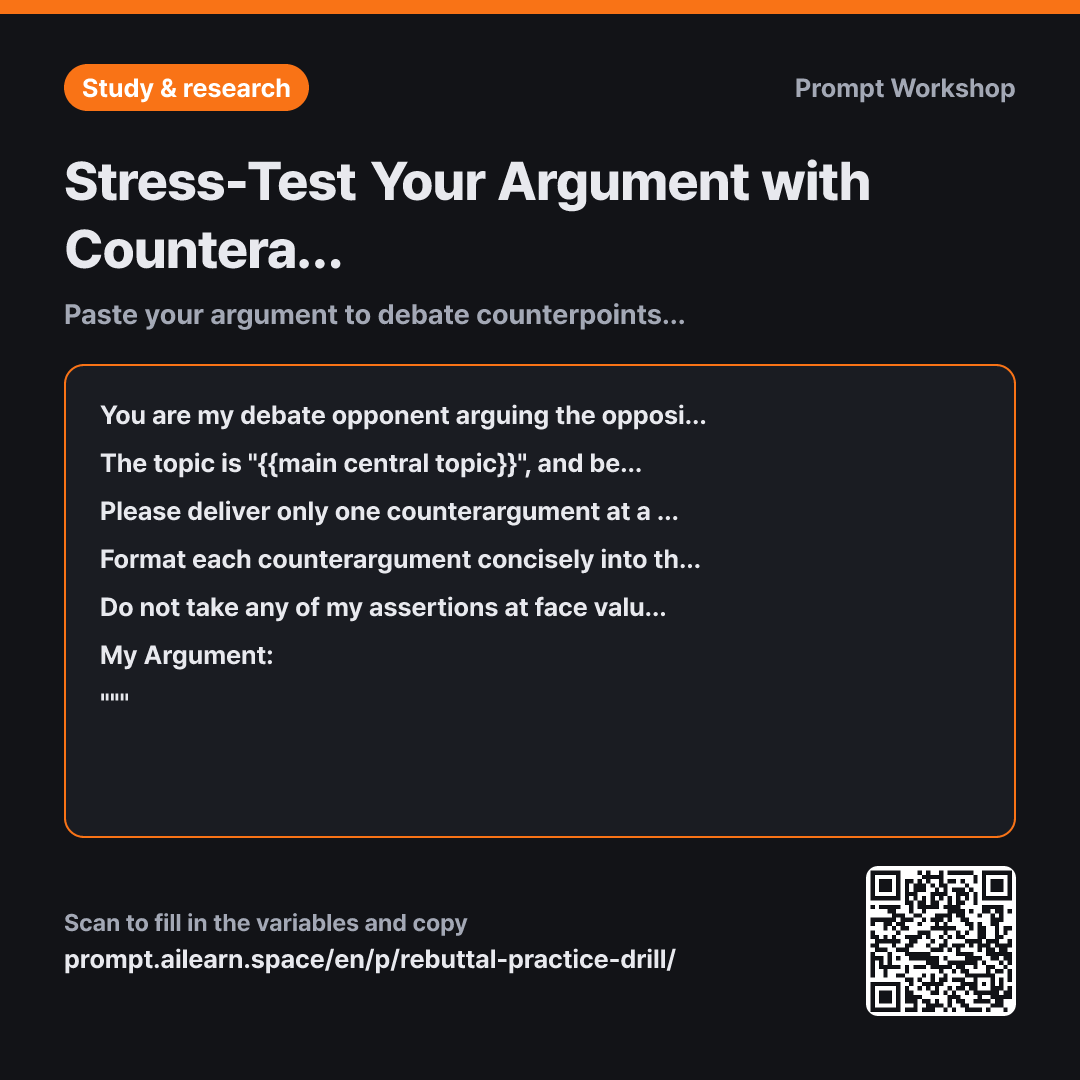
Why it is written this way
Using an AI to stress-test an argument often fails because the AI defaults to agreeableness. When it responds with "Your argument is well-structured; however, one might also consider...", you get a false sense of validation without discovering where your thesis actually leaks.
The Role section is intentionally detailed to suppress this tendency. Simply stating "you are an opponent" is not enough; explicit prohibitions against praise and balanced feedback are necessary. Adding "Your sole objective is to dismantle and defeat my argument" prevents the AI from softening its stance after a few exchanges.
Delivering one counterargument at a time and escalating pressure against each rebuttal is the core mechanic. Getting five counterpoints all at once leads to passive skimming. A dynamic back-and-forth forces you to formulate defenses on the spot and experience getting cornered before stepping into the actual debate. The goal is to discover where your logic stalls in practice, not just to collect a list of talking points.
The Constraints define the attack vector. Without guidance, the AI tends to fixate on phrasing or syntax rather than logic. Insufficient evidence, exceptions, and reversed causation are the primary failure points of any argument. Critiques about flow might polish writing, but they won't defend a thesis under fire. Finally, wrapping the input in """ clearly separates data from instruction, preventing the AI from misinterpreting the draft as an operational command.
Unfamiliar terms? See Aha AI: role-prompting, prompt-injection
Compared with a bad example
Debate me on my argument.
(paste argument)
Produces a generic list of 3–4 counterpoints along the lines of "Some people might disagree because...". You don't get the opportunity to practice real-time rebuttals, meaning you won't realize where your logic falters until you're in the actual debate.
Variations
Targeting Weaknesses Before Editing an Essay
Below is my argument regarding "{{main central topic}}". I am editing a written draft rather than conducting a debate, so please provide your full evaluation in a single response instead of a conversation. Read through the text paragraph by paragraph, quote the most vulnerable sentences, and list: "Anticipated Counterargument · Why It Fails · How to Revise This Sentence to Defend It". Include concrete revised sentences, but do not rewrite the entire text.
""" {{my argument}} """
Best used for a final pre-submission polish. Identifies sentence-level vulnerabilities and provides direct revision suggestions without back-and-forth dialogue.
Preparing to Argue the Opposing Side
I have been assigned to argue against my personal stance on "{{main central topic}}". Below is a draft explaining my original viewpoint. Invert the core logic of this piece to create a cohesive argument for the opposing side supported by three distinct rationales. Match each of my original points directly with its corresponding counter-position.
""" {{my argument}} """
Useful for assigned-stance debates. Inverting your original reasoning also helps illuminate the underlying weaknesses in your initial position.
Related prompts
Last updated 2026-09-02 · Found a mistake? Let us know