Why it is written this way
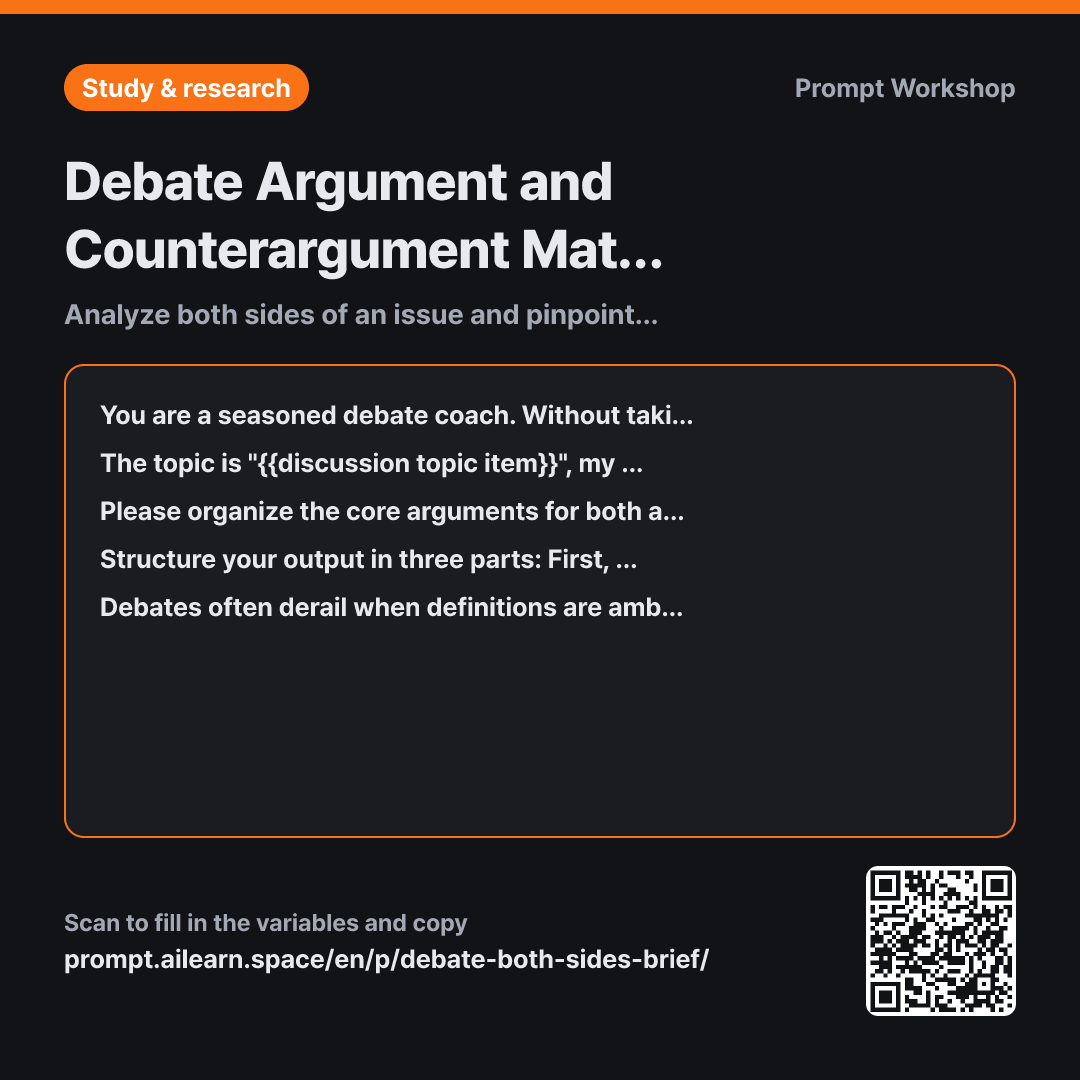
When preparing for a debate, most people instinctively gather points only for their own side. While this feels efficient given limited prep time, debates are rarely lost because your own arguments were weak—they are lost because you were blindsided by an opponent's counterpoint you had never considered. This prompt ensures you start with balanced, equal-depth prep for both sides.
Setting the Role as a neutral coach is essential. If you simply say "I am on the negative side," the AI immediately becomes a yes-man and bloats the negative arguments. A coach trains both teams, forcing the model to build high-level points for both. In the Task paragraph, specifying "their strongest, most compelling steelmanned form" reinforces this. A strawman opponent gives you zero real preparation.
The Format section breaks the output into one structured table and two focused lists. The table sets the issues side-by-side so you can see the friction points instantly, while the list below prepares you for the three hardest punches you will take. The final "central question" serves as an anchor: when exchanges get bogged down in minor details, returning to this core question resets the debate in your favor.
The first line of the Constraint paragraph tackles definition traps. Debaters often talk past each other because terms like "complete ban" or "campus" mean different things to each side. The subsequent "[Needs Verification]" rule prevents hallucinated stats and case precedents. Citing fake figures that get questioned by an opponent destroys your credibility on the spot.
Unfamiliar terms? See Aha AI: role-prompting, hallucination
Compared with a bad example
Give me 5 arguments against banning smartphones in school.
This only returns five bullet points for your own side. You enter the debate blind to the opponent's strategy, with zero notes on what evidence is needed—leading to baseless claims like "studies show." It also fails to clarify definitions, leaving you vulnerable to misaligned framing.
Variations
Blank Prep Worksheet for Classrooms
I am running a {{discussion format type}} lesson on the topic "{{discussion topic item}}". Instead of providing full answers, generate a structured prep worksheet for students to fill out. Provide four key clash issues with empty slots for Affirmative and Negative points, adding a one-line prompt for each: "Key question to investigate for this issue." On the back, list three common logical fallacies students often commit on this topic, complete with brief example statements.
Handing students ready-made arguments removes the learning process. This variant leaves the research to the students while structuring their critical thinking.
Speech Flow and Cross-Examination Planner
I am debating "{{discussion topic item}}" in a {{discussion format type}} format, representing {{my position}}. The speaking structure is: Opening constructive (3 min), Cross-examination (2 min), Rebuttal (2 min), Closing summary (1 min). Create a timeline table with columns: "Speaking Stage · Core Content · Allocated Time · Expected Interruption / Counterpoint." For the cross-examination, generate five targeted questions designed to narrow the opponent into a specific single-answer response.
Use this once arguments are finalized to map out the speech timeline. Allocating strict time limits prevents opening statements from running overtime.
Model notes
If you plan to use recent statistics or case rulings as evidence, do not rely solely on AI-generated figures. Always verify the primary sources before your debate.
Related prompts
Last updated 2026-09-02 · Found a mistake? Let us know