Why it is written this way
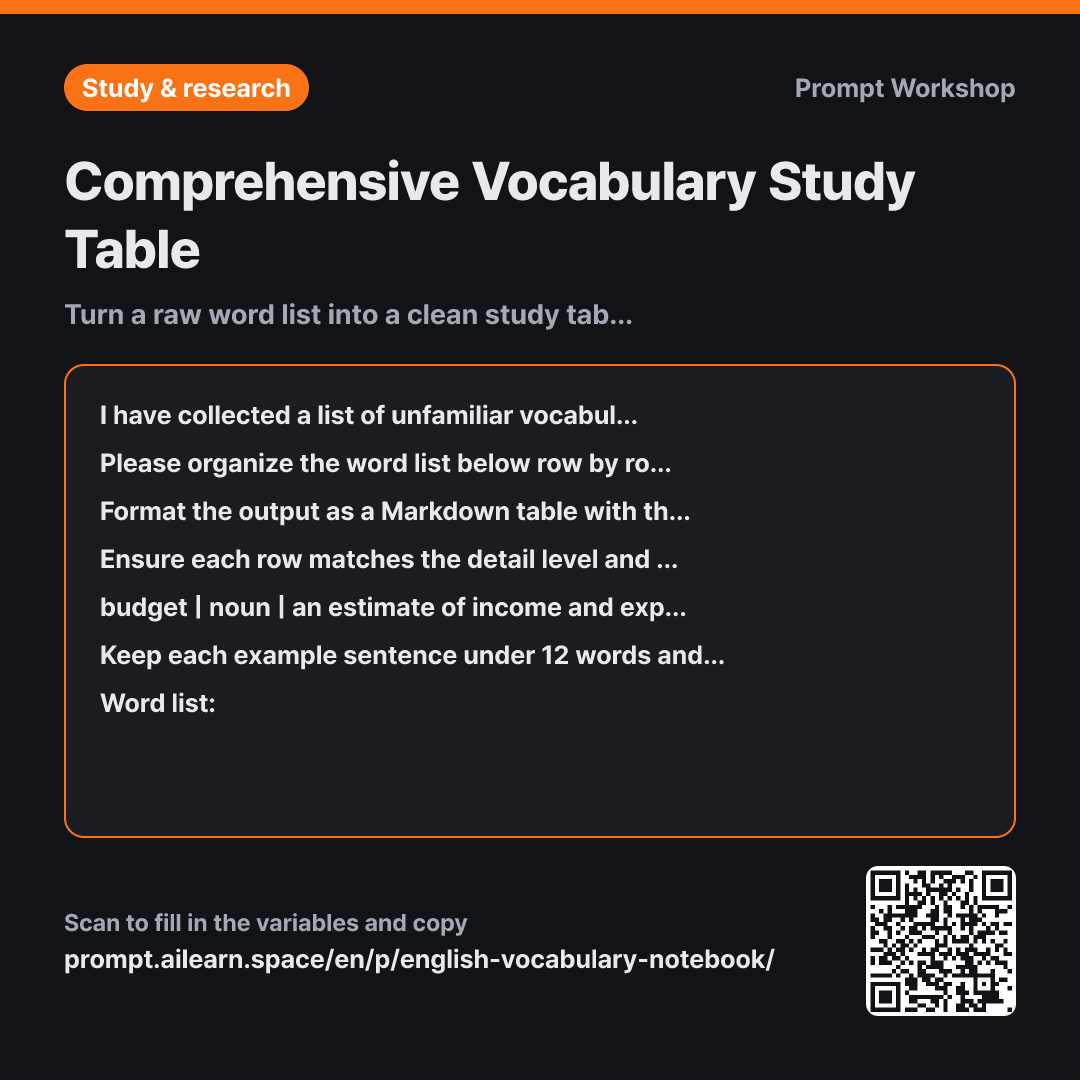
When asking AI to create vocabulary lists, the most common failure is getting a dry dictionary dump. It tends to spit out five definitions per word with no examples or overly stiff textbook sentences that don't teach practical usage. This prompt sets strict structural columns to extract only actionable learning information.
Setting explicit column names under Format prevents the AI from skipping practical details. Having dedicated slots for part of speech and translations forces natural example sentences, while the "Confusing Word & Difference" column proactively targets common exam traps.
Including a single-row Example is the key element here. Plain text instructions often result in inconsistent sentence lengths and varying detail. Providing a concrete sample guarantees consistent density across all rows.
The Constraints—such as "under 12 words" and "single most common definition"—keep example sentences concise and focused. Explicitly forbidding extra words stops the AI from inflating your study load with unrequested "related vocabulary." Wrapping the input in """ delimiters prevents notes inside the list from being parsed as instructions.
Unfamiliar terms? See Aha AI: few-shot, output-format
Compared with a bad example
Tell me the meanings of these words:
sustain, allocate, redundant, marginal, comply
This returns a bare list of dictionary definitions without context. You won't know which meaning is most common or how to spot the word inside real sentences. It also misses crucial paired distinctions (like 'redundant' vs. 'unnecessary'), forcing you to look them up again.
Variations
Quick Review Mode Before an Exam
Please organize the following word list into a simple 3-column table: "Word | Definition | Short Example Sentence". Provide only one definition per word and keep example sentences under 8 words. Do not include extra explanations or etymologies.
""" {{word list}} """
Removes confused words and translation columns. Ideal for rapid review the night before a test on words you've already learned once.
Fill-in-the-Blank Self-Test
Please create a fill-in-the-blank practice quiz using the word list below. Write one natural English sentence for each word, replacing the target word with a blank ( ). Present all 10 quiz questions first, and place the answer key with translations separately at the very bottom.
""" {{word list}} """
Placing all answers at the bottom prevents accidental spoilers while skimming through the quiz.
Model notes
If your list exceeds 30 words, the quality of example sentences toward the end may degrade. Process in batches of 15 words and merge them afterward.
Some models may break table formatting if example sentences contain line breaks. If the table layout gets distorted, ask: "Please reformat this as an itemized bulleted list per word instead of a table." If you plan to import the vocabulary into Excel or flashcard apps (like Anki), add: "Also provide the table as CSV text below."
Related prompts
Last updated 2026-09-02 · Found a mistake? Let us know