Why it is written this way
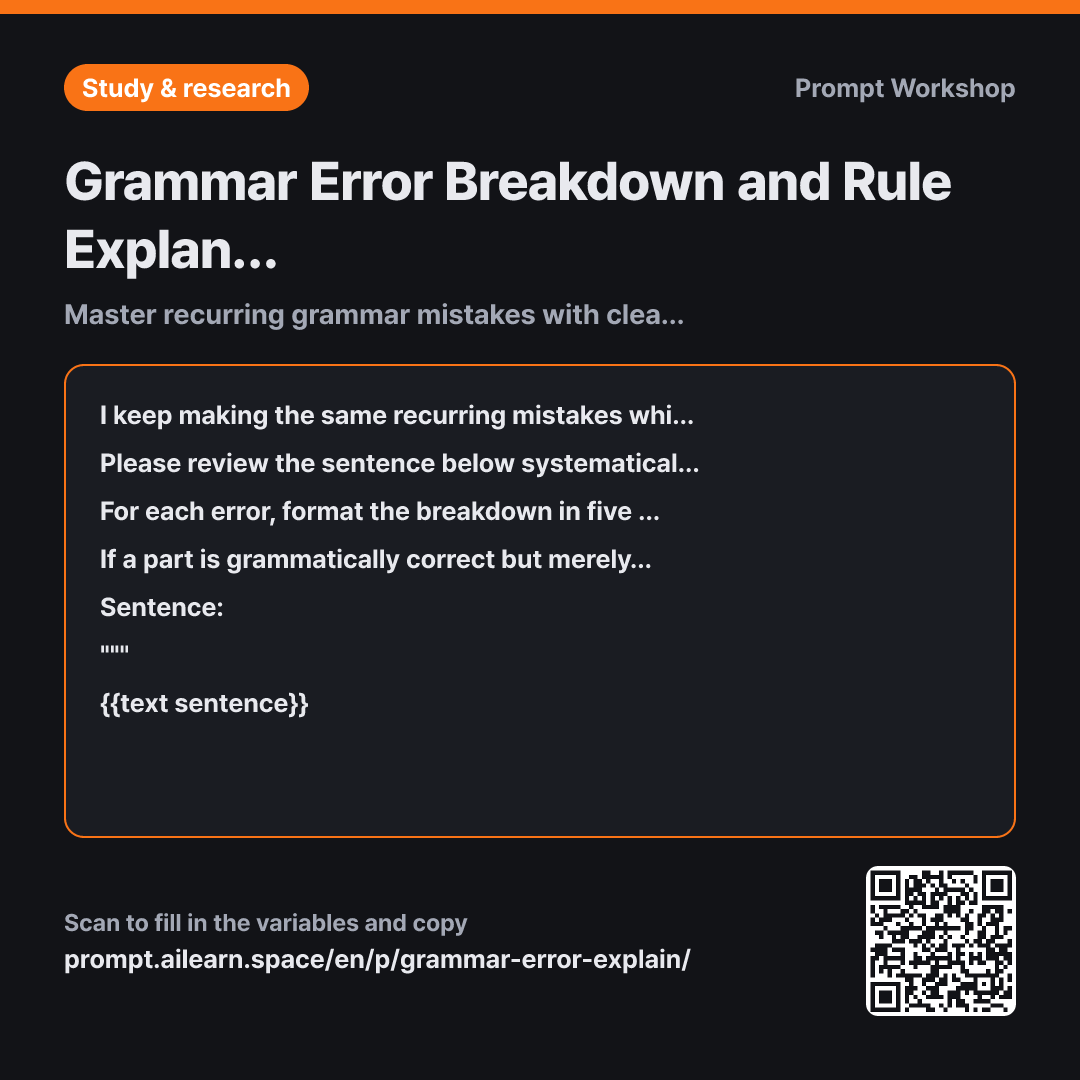
When you ask a generic grammar question, AI usually gives you just one corrected sentence. That solves the immediate problem, but because you never internalize the underlying rule, you make the exact same mistake again the following week. This happens constantly with concepts that differ fundamentally between languages, such as articles and tense usage. This prompt ensures you receive the foundational rules and contrasting example sentences, not just a simple fix.
The second paragraph divides the analysis into clear steps. Separating error identification from rule labeling eliminates vague explanations like "this just sounds more natural" and forces the AI to provide concrete linguistic justification. Asking for a correct sentence paired with a common mistake is essential because we remember rules best when we clearly see the boundary line of error.
The five-line format keeps explanation lengths balanced. Left to answer freely, an AI will often write a long explanation for the first mistake and gloss over subsequent ones in a single line. The concluding summary list of rule names creates an effective, customized review checklist when checking multiple sentences.
Enclosing the sentence in """ prevents the input text from getting mixed up with prompt instructions. If your sentence contains imperative phrases like "Explain this," an AI might mistakenly interpret it as a user command without delimiters. The instruction to write "Uncertain" if not completely sure is also crucial—without it, the model may fabricate plausible-sounding rule names, and the more convincing a hallucinated explanation sounds, the easier it is to memorize the wrong concept.
Unfamiliar terms? See Aha AI: output-format, hallucination
Compared with a bad example
Is this sentence correct? I have visited my grandmother last weekend, and she was very happy to seeing me.
The AI will simply respond with "It is incorrect. Here is the correction: ..." and a single revised sentence. You won't learn why the present perfect tense cannot co-occur with specific past time adverbs, nor why "happy to" requires a base verb. Without explicit rule names, you cannot look up the corresponding chapters in a grammar textbook.
Variations
When Checking Multiple Sentences at Once
Below is a list of {{target language}} sentences I wrote. Please organize each sentence into a table with the columns: "No. | Original | Corrected Sentence | Rule Name". Below the table, list any rules that appeared more than once, sorted by frequency of error. Provide the detailed explanation only once per rule.
""" {{text sentence}} """
Repeating the same explanation for every sentence makes the output unnecessarily long. Surfacing recurring rules helps you prioritize which grammar topics to study first.
When Testing Your Own Understanding First
Identify the errors in the sentence below, but do not reveal the answers right away. Only tell me how many errors there are and approximately near which word each error is located. Once I attempt to correct them myself, evaluate my answers and explain only the mistakes I missed along with their rule names.
""" {{text sentence}} """
You retain knowledge much longer when you try to spot and fix the errors yourself before seeing the answer. A single instruction hiding the solution beforehand creates an active quiz.
Model notes
Grammar terminology can vary slightly across different AI models. If an unfamiliar term appears, ask "Is this rule known by any other names?" to match it with standard textbook terms. If two different models disagree on a correction for the same sentence, verify the rule in an authoritative grammar guide, as one of the models may have hallucinated the rule name.
Related prompts
Last updated 2026-09-02 · Found a mistake? Let us know