Why it is written this way
When asking AI for writing corrections, it usually returns a single, polished piece. While it looks great, you have no way of knowing what was changed or why, leading you to make the exact same mistakes in your next piece. Moreover, the overly advanced vocabulary often makes it hard to speak or use naturally in interviews or exams.
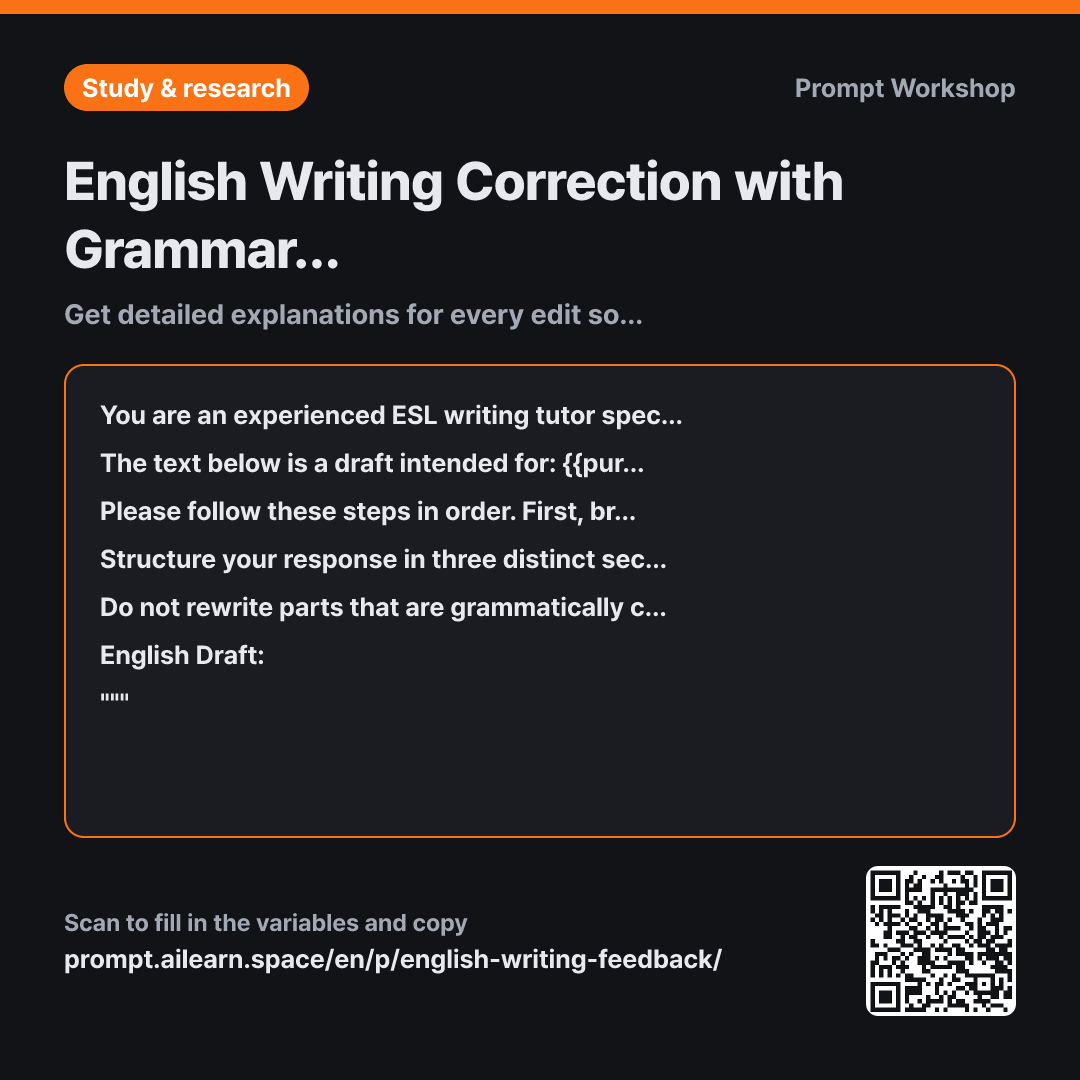
Setting the Role as an experienced ESL tutor targets the typical blind spots non-native speakers have—such as articles, pluralization, and tense consistency. The Context provided by the purpose of writing determines the depth and tone of the revision, prioritizing formality for applications or logical transitions for academic essays.
The third paragraph breaks the workflow into Steps. Reviewing sentence by sentence ensures the revision preserves the original intent rather than rewriting entire paragraphs from scratch. The "Grammar Rule Name" column in the Format is the core of this prompt; naming the rules helps you recognize mistakes later, and the top-3 summary serves as a personalized proofreading checklist.
Setting clear Constraints prevents the AI from over-polishing based on mere style preferences, which often leaves the original draft unrecognizable. Enclosing the draft in """ delimiters guarantees that phrases like "Please explain" inside the user's text are treated strictly as content to edit, not instructions for the AI.
Unfamiliar terms? See Aha AI: output-format, prompt
Compared with a bad example
Make this sound natural in English.
I want to apply this program because I am interested in marketing...
You will get a much more sophisticated piece of English, but without any notes explaining what was changed and why. You would have to compare both versions side by side manually. The elevated vocabulary also makes it difficult to explain those exact phrases if asked in an interview.
Variations
When you want feedback on mistakes before rewriting
Below is my English draft written for: {{purpose of writing}}. Do not rewrite or fix it yet. Instead, point out up to 3 grammar errors, up to 3 awkward expressions, and up to 3 logical inconsistencies. Explain what needs improvement and how I should approach fixing them. I will write the revision myself first.
""" {{english draft}} """
Actively rewriting the text yourself helps internalize the grammar rules. This approach forces you to think through the feedback before seeing the final answer.
When evaluating writing against exam rubric criteria
Please evaluate the English writing below based on criteria suitable for: {{purpose of writing}}. Break down the review into four areas: Task Achievement, Coherence & Structure, Lexical Resource, and Grammatical Accuracy. For each area, highlight one strength and one weakness, then provide the single highest-impact revision I can make at my current skill level. Do not assign numerical scores or grades.
""" {{english draft}} """
Numerical scores vary wildly across models. It is much more practical to receive specific strengths, weaknesses, and a concrete next step.
Model notes
When requesting both a detailed table and the full final text in a single turn, the output may occasionally get cut off. If that happens, request the table first, and follow up with "Now generate the full final text based on the table."
Related prompts
Last updated 2026-09-02 · Found a mistake? Let us know