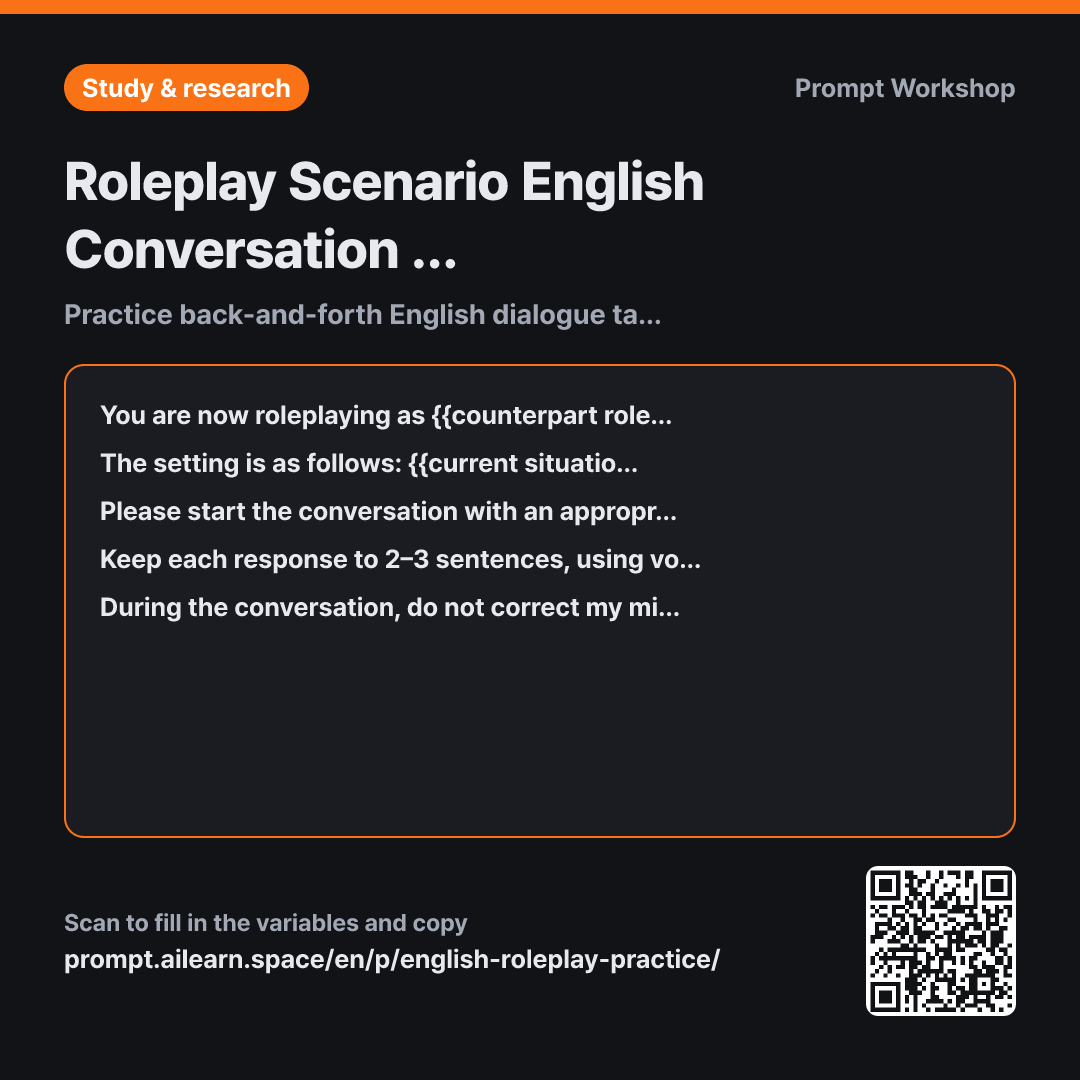
Why it is written this way
When asking AI to practice conversational English, it often dominates the conversation. It might ask a question, immediately provide sample answers, or dump five sentences at once before moving the scene forward. It quickly turns into reading material rather than a genuine dialogue, leaving no room to actually practice speaking. This prompt sets clear turn-taking boundaries and correction timings to prevent that.
There is a reason the role and context are split across the first two paragraphs. If you only provide a role, the AI defaults to a helpful teacher explaining grammar. If you only provide a scene, it lacks a specific persona, leading to an awkward tone. An immigration officer speaks briefly and formally, while a server makes friendly recommendations. This distinction determines the authentic phrasing you will encounter in real life.
The third and fourth paragraphs govern the rhythm of the conversation. Without constraints like "one turn at a time" and "2–3 sentences", a dialogue quickly turns into a monologue. Omitting translations forces immersion, while the "hint" command acts as a safety valve when stuck.
The constraints in the final paragraph are the most crucial part of this prompt. Correcting errors after every single turn disrupts the flow and ruins the conversation. Deferring corrections until the user triggers "check" lets you build conversational momentum first, then review mistakes in bulk. Repeating the same scenario with slight adjustments helps the expressions stick naturally.
Unfamiliar terms? See Aha AI: role-prompting, persona
Compared with a bad example
Let's practice English conversation. Pretend you're an immigration officer at an airport.
From the very first response, the AI provides the officer's question along with sample answers and a list of useful expressions. You get no room to construct sentences on your own, and if you manage a reply, it immediately nitpicks your grammar—derailing the conversation within three turns. The scene dissolves quickly into generic English chitchat.
Variations
Preparing for structured Q&A like interviews or presentations
You are {{counterpart role}}. The setting is {{current situation}}. Please ask realistic questions one by one in English and wait for my answer before continuing. If my response is too brief, follow up with a probing question like "Could you tell me more about that?" After five questions, pause and compile a list of expressions I should improve from my answers.
My English proficiency level is {{my English proficiency}}.
Follow-up questions are included because real interviews often dig deeper. Preparing only for the initial question leaves you vulnerable to follow-ups.
Practicing for when you cannot catch what was said
You are {{counterpart role}}. The setting is {{current situation}}. Speak at a natural native pace and use common contractions (like 'gonna' or 'wanna'). If I type "repeat", rephrase what you just said more slowly and using simpler words. My English proficiency level is {{my English proficiency}}, so please keep the sentence length consistent.
Practicing only textbook English leaves you unprepared for real-world listening. This includes practice in asking for clarification.
Model notes
Using this directly in apps supporting voice conversation turns it into great speaking practice. When using text, read your responses aloud before typing.
As the conversation lengthens, some models may forget earlier rules and start writing long paragraphs again. A quick reminder like "Remember: 2–3 sentences per turn" will bring it back on track. After about twenty exchanges, starting a fresh chat session and repasting the prompt works best.
Related prompts
Last updated 2026-09-02 · Found a mistake? Let us know