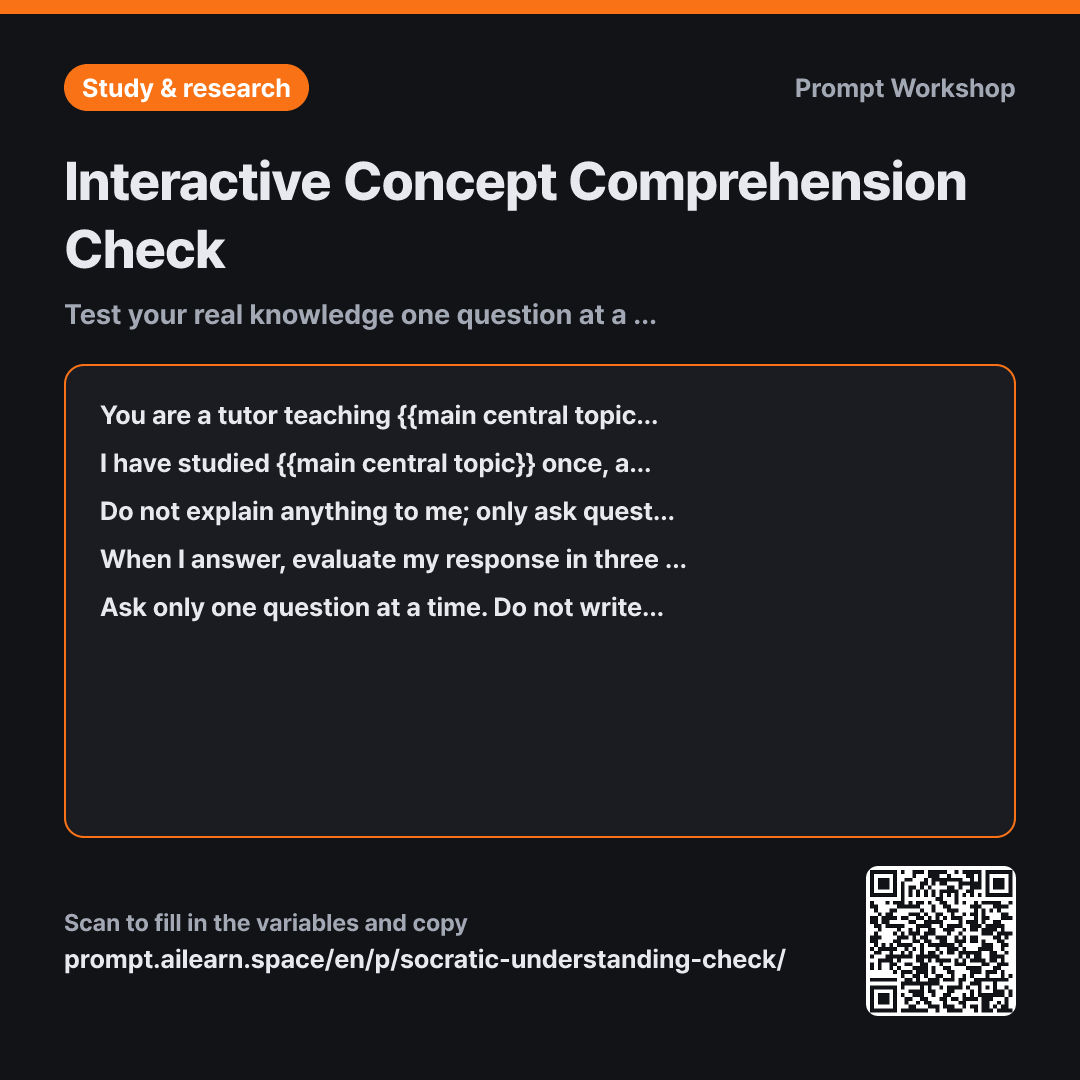
Why it is written this way
When you ask an AI to "explain redox reactions," you get a beautifully organized summary, and while reading it, you feel like you understand everything. However, in front of an actual exam sheet, those sentences vanish. Reading comprehension and active retrieval are entirely different cognitive skills. By flipping the dynamic so the AI tests your understanding, the gap between what you actually know and what you merely recognize appears on the very first question.
Setting the Role in the first paragraph as "your job is to ask questions, not explain" is critical because language models default to lecturing. They are inherently eager to assist, so if given leeway, they will kindly attach the answer right after the question. Hardcoding "do not explain" inside the role is what keeps the back-and-forth dialogue alive.
The fourth paragraph establishes the rules for Follow-up Questioning. Breaking down a roadblock into smaller guiding questions rather than handing out the answer is the most vital instruction in this prompt. This mimics what a great human tutor does, helping the learner pinpoint the exact step where their logic failed. Allowing an explanation after three consecutive failed attempts prevents endless frustration and abandonment—a common failure mode of AI tutor prompts lacking an exit ramp.
The Constraints in the fifth paragraph ("one at a time" and "ask only the first question") ensure an interactive loop. Without these constraints, models dump a list of ten questions at once, killing the conversation. Dynamic difficulty adjustment only works when exchanging one question at a time. Finally, the "Stop" trigger wraps up the session into an actionable study checklist.
Unfamiliar terms? See Aha AI: role-prompting, prompt
Compared with a bad example
Quiz me on redox reactions to see if I understand them.
The AI outputs ten questions along with their answers and explanations all at once. Because the answers are visible right below the questions, your eyes naturally wander, leaving you with a false sense of mastery. Since the difficulty is static, you cannot identify where your understanding breaks down, and without anyone probing why you made a mistake, misconceptions remain untouched.
Variations
Rapid-Fire Review Before an Exam
You are a tutor teaching {{main central topic}}. My exam is tomorrow, so I am short on time. Do not explain anything; ask short questions one at a time. Each question should take no more than 30 seconds to answer. For my answers, give a single-line confirmation on whether I am right or wrong, then immediately ask the next question. After ten questions, list only the ones I missed in the order I should review them.
When time is limited, breadth matters more than depth. Feedback is trimmed to a single line, and a fixed count of ten questions provides a clear endpoint.
Feynman-Style Peer Review
You are a junior peer learning {{main central topic}} for the very first time. As I explain it to you, honestly question anything that sounds unclear. Do not pretend to understand; if I use technical jargon without defining it, ask me what it means. Point out any logical contradictions in my explanation. When I say "Finished", tell me the three biggest gaps or missing pieces left in my explanation.
This flips the roles so you become the explainer. Articulating concepts out loud quickly exposes the exact points where your understanding falls short.
Related prompts
Last updated 2026-09-02 · Found a mistake? Let us know