Why it is written this way
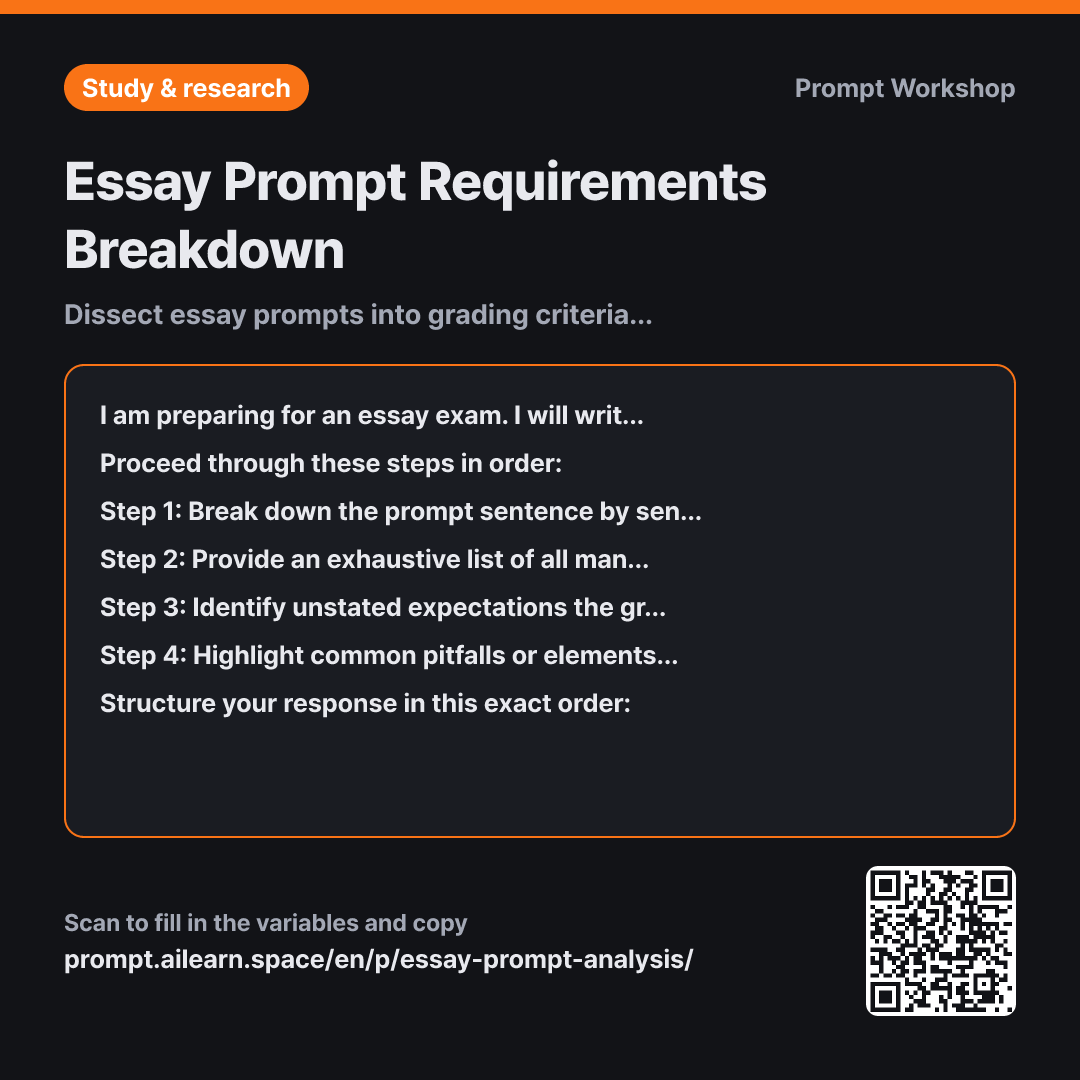
A common mistake when analyzing an essay prompt with AI is pasting the prompt and asking it to generate a full response. That creates a ghostwritten draft you cannot use on test day, leaving you with no real practice. Most point deductions happen not from poor writing style, but from failing to answer all parts of a multi-part question (e.g., answering only two out of three requested tasks). This prompt isolates the requirements rather than giving away the answers.
The second paragraph breaks the process into four distinct steps to catch different types of errors. In Step 1, separating sentences makes it obvious that "compare", "explain", and "propose" are separate instructions that require distinct sections. Step 3 identifies implicit grading criteria while requiring specific rationales, preventing the model from giving generic, unhelpful writing advice.
The third paragraph dictates the format, organizing the output like a scoring rubric. Having a clear checklist of mandatory elements allows you to cross-check your completed draft item by item. It pairs directly with the core task of analytical deconstruction. Calculating word count allocation in the final paragraph prevents over-allocating space to the first question at the expense of subsequent tasks.
Labeling inferred points with "(Inferred)" and wrapping the source text in """ delimiters serve a protective purpose. Because essay questions contain imperative verbs like "explain" and "propose", models often mistake them for instructions meant for the AI and start writing the essay. Framing the prompt strictly as input data ensures the AI stops at analysis.
Unfamiliar terms? See Aha AI: output-format, prompt
Compared with a bad example
Write an essay for this prompt. 1,200 words.
Compare the perspectives on community presented in Texts A and B...
Without access to the actual texts, the AI invents arguments for Texts A and B. While the resulting 1,200-word draft may sound plausible, it is factually detached from the actual reading materials and worthless for scoring. You also miss out on understanding the structure and specific sub-tasks required by the question.
Variations
Checking if a Draft Meets All Requirements
Below, I have pasted both the essay prompt and my completed draft. Do not rewrite or edit my draft. Instead, extract the required tasks from the prompt as a checklist and evaluate whether my draft addresses each one, using only the labels "Fulfilled / Partially Fulfilled / Missing". For any item marked "Partially Fulfilled" or "Missing", quote the relevant excerpt from my draft (or state if completely absent). If I only have 5 minutes left to revise, tell me the single most critical fix in one sentence.
Prompt and Draft: """ {{essay prompt}} """
Forces the model to cross-examine rather than grade or rewrite. Asking for revisions obscures your original voice and prevents you from spotting your own gaps.
Mastering Question Patterns and Structures
Please analyze only the structural pattern of the following essay prompt. Identify the prompt type (e.g., comparative, application, data interpretation), cite the specific phrasing that indicates this type, and outline the standard structural template typically used to answer such prompts. Focus exclusively on structural mechanics, not the topical content.
Essay Prompt: """ {{essay prompt}} """
Ideal for reviewing past exam questions in bulk. Familiarity with prompt types speeds up question comprehension significantly on exam day.
Related prompts
Last updated 2026-09-02 · Found a mistake? Let us know