Why it is written this way
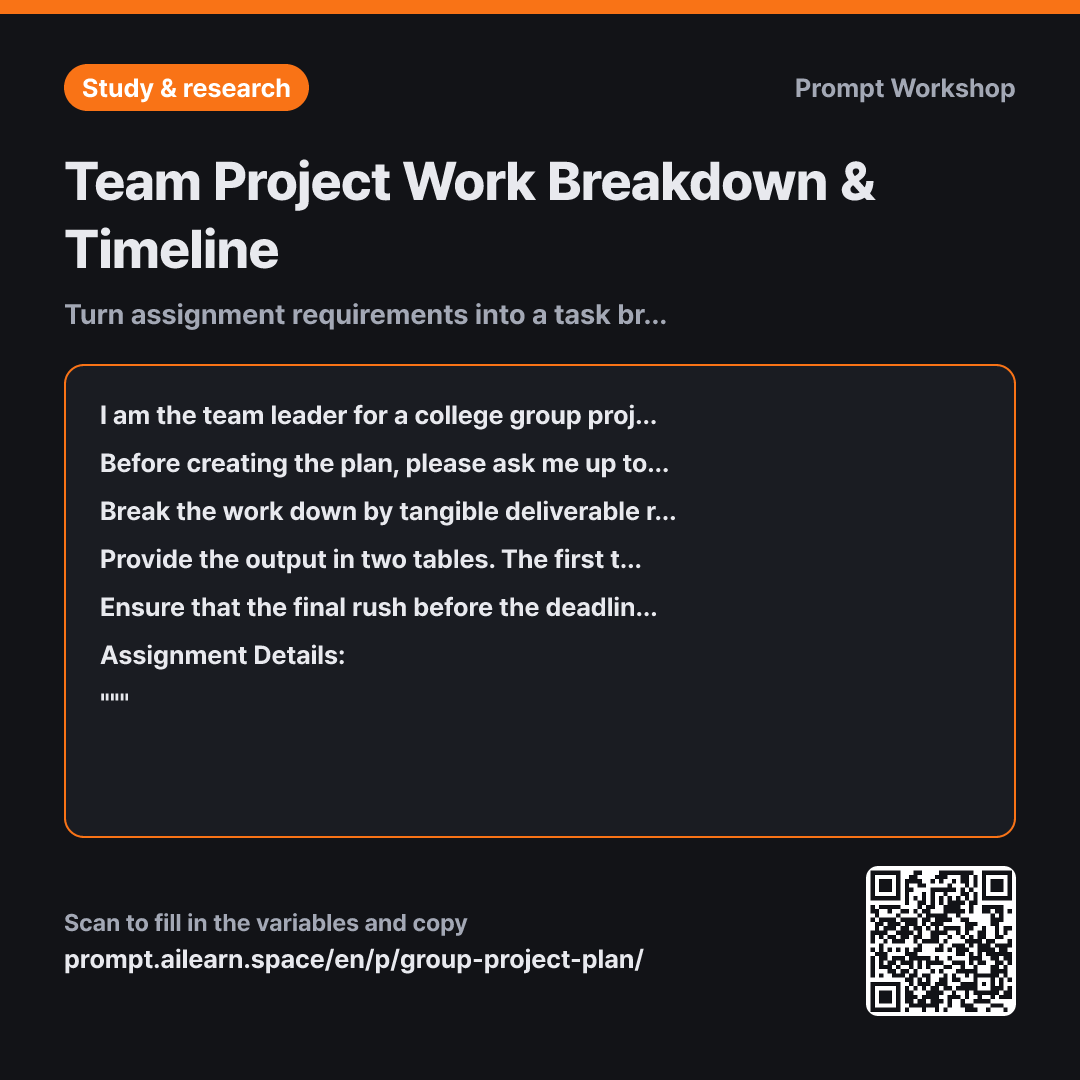
Group project breakdowns usually fail in predictable ways: in the first meeting, tasks are split into broad buckets like "I'll research, you make the slides, and you present," only to discover three days before the deadline that the slides and research do not match. When tasks are divided by person rather than deliverable, nobody owns the handoffs. This prompt focuses on deliverables first and assigns people second.
The Context in the first paragraph specifies team size and deadline upfront because these two factors dictate the entire architecture of the plan. Three people versus six people require completely different task granularity, and two weeks versus six weeks changes the workflow sequence. Asking clarifying Questions first prevents blind assumptions, as key variables like prior slide-deck experience or existing interview access drastically affect the schedule.
The Task paragraph introduces the "definition of done," which is the core of this plan. "Survey research" is ambiguous, but "a spreadsheet containing 50 valid responses" has an undeniable endpoint. Clear completion criteria eliminate vague status updates like "I'm almost done."
The Format specifies two distinct tables because task allocation and timeline tracking answer different questions. The distribution table shows who owns what artifact, while the weekly timeline shows what must finish each week. Finally, enforcing a dedicated rehearsal buffer guarantees the team has built-in time to merge work, which in practice takes the longest time.
Unfamiliar terms? See Aha AI: output-format, context
Compared with a bad example
I have a 4-person group project. Make a role breakdown and schedule for a local business revitalization presentation.
This will produce a superficial table assigning Member A to research, Member B to analysis, Member C to PPT, and Member D to presentation. Without explicit "definitions of done," members won't know their expected output scope, and without an integration day, the team will only sync the night before the presentation. It also fails to align effort with the grading rubric.
Variations
When falling behind mid-project
We are a team of {{number of people}} working on a group project, and we are running out of time before {{due date}}. The assignment details are below. Instead of redesigning the plan from scratch, de-scope our work into an emergency plan that can realistically be finished within the remaining time. Prioritize components with the highest grading weights, and include a table showing what we are cutting/reducing alongside the potential point loss. Conclude with a single-line action item for each member to start today.
Assignment Details: """ {{assignment details}} """
When time is scarce, you need a consensus on what to cut rather than an unrealistic master plan. Showing the estimated point loss helps team members agree on trade-offs.
Preventing free-riding
Our team of {{number of people}} needs to divide the assignment below. Structure the breakdown so that each member's individual contribution is clearly identifiable in the final deliverables. For each deliverable, specify how attribution will be recorded (e.g., dedicated document sections, separate files), and provide a list of 5 brief weekly peer check-in items. Do not generate a formal peer evaluation rubric.
Assignment Details: """ {{assignment details}} """
Contribution disputes usually arise from a lack of audit trails. This prompt focuses on visible task attribution rather than adversarial evaluation forms.
Related prompts
Last updated 2026-09-02 · Found a mistake? Let us know