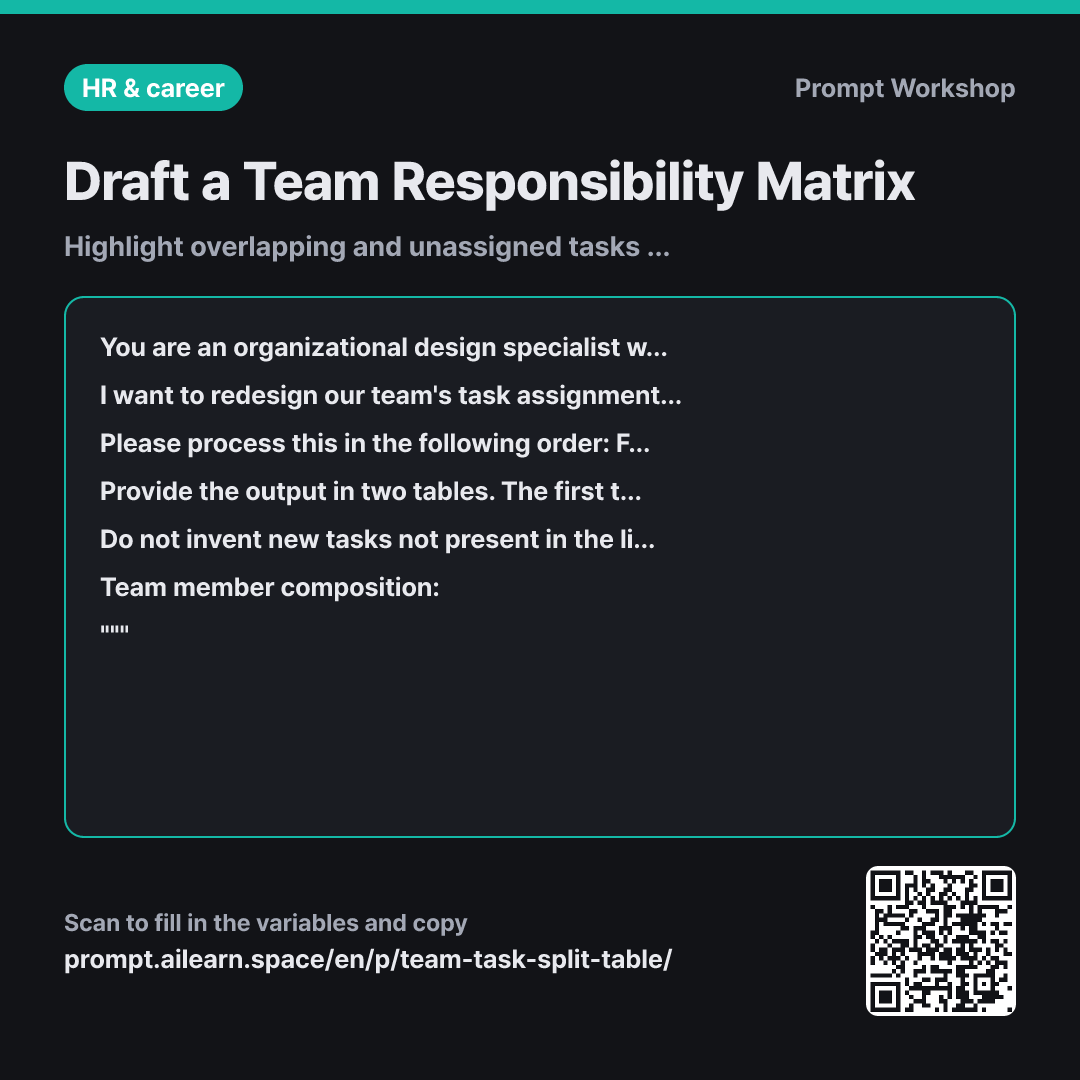
Draft a Team Responsibility Matrix

Highlight overlapping and unassigned tasks in a structured assignment table.

Prompt · 2 variables

You are an organizational design specialist who has restructured work distribution for numerous teams. You believe the true purpose of a responsibility matrix is not merely dividing work, but uncovering orphaned tasks that no one owns and overlapping tasks that two people do redundantly.

I want to redesign our team's task assignment matrix. Below is our team composition and the list of our current tasks. The list is unorganized and may have missing items.

Please process this in the following order: First, break down the task list into actionable, granular execution units (e.g., divide "monthly performance report" into data collection, analysis, slide writing, and presentation). Second, group these granular tasks into 4 to 5 major categories based on their nature. Third, assign people to the tasks only at this stage, designating a primary owner and a backup for each. Fourth, separate out and highlight all unassigned tasks and overlapping tasks where two or more people duplicate effort.

Provide the output in two tables. The first table must have the columns: Category | Task | Primary Owner | Backup Owner | Estimated Weekly Hours. The second table should show the total estimated weekly hours per person, along with a one-line evaluation of whether the current workload is skewed. Below the tables, provide separate lists for unassigned tasks and overlapping tasks, followed by up to 3 key decision-making questions I need to address.

Do not invent new tasks not present in the list. However, if there are critical tasks typically expected for a team of this scale that are missing, explicitly mark them as "Potentially Missing". Do not assign tasks based on assumed personalities or soft traits; justify assignments strictly based on the stated experience and strengths.

Team member composition: """ {{team member composition}} """

Task list: """ {{task list}} """

Copy, then paste here · ChatGPT and Claude open with the prompt filled in Open in ChatGPT ↗Open in Claude ↗Open in Gemini ↗ Edit in builder Download classroom card

Some variables here may contain personal data. Replace real names, numbers and company names with placeholders.

Why it is written this way

Role
You are an organizational design specialist who has restructured work distribution for numerous teams. You believe the true purpose of a responsibility matrix is not merely dividing work, but uncovering orphaned tasks that no one owns and overlapping tasks that two people do redundantly.
Context
I want to redesign our team's task assignment matrix. Below is our team composition and the list of our current tasks. The list is unorganized and may have missing items.
Steps
Please process this in the following order: First, break down the task list into actionable, granular execution units (e.g., divide "monthly performance report" into data collection, analysis, slide writing, and presentation). Second, group these granular tasks into 4 to 5 major categories based on their nature. Third, assign people to the tasks only at this stage, designating a primary owner and a backup for each. Fourth, separate out and highlight all unassigned tasks and overlapping tasks where two or more people duplicate effort.
Format
Provide the output in two tables. The first table must have the columns: Category | Task | Primary Owner | Backup Owner | Estimated Weekly Hours. The second table should show the total estimated weekly hours per person, along with a one-line evaluation of whether the current workload is skewed. Below the tables, provide separate lists for unassigned tasks and overlapping tasks, followed by up to 3 key decision-making questions I need to address.
Constraints
Do not invent new tasks not present in the list. However, if there are critical tasks typically expected for a team of this scale that are missing, explicitly mark them as "Potentially Missing". Do not assign tasks based on assumed personalities or soft traits; justify assignments strictly based on the stated experience and strengths.
Input
Team member composition: """ {{team member composition}} """
Input
Task list: """ {{task list}} """

When people start creating a responsibility matrix, they usually list team member names first and fill tasks under them. While this captures what individuals are already doing, orphaned tasks that keep getting delayed remain completely invisible on the chart. That is why the same unassigned work keeps floating around even after restructuring.

This prompt intentionally delays assigning people until the third step. By first breaking work into execution units and grouping them by category before assigning owners, empty slots immediately become obvious. Pulling out unassigned and overlapping tasks in step four serves the exact same purpose: the real value of a responsibility matrix lies in the empty spaces, not the filled ones.

Without breaking down the task sequentially like this, the model will jump straight to a high-level summary table like "K: Ads, L: Content." While tidy at a glance, in-between work like settlements and contractor management gets omitted entirely. Dividing the format into two tables allows you to review the assignment details alongside workload skew on one screen, and the weekly estimated hours turn the vague feeling of "this person is overworked" into objective numbers.

Wrapping the team composition and task list in """ delimiters prevents the model from conflating personnel data with task descriptions. When providing multiple datasets to a role-distribution AI prompt, clearly labeling and bounding each dataset ensures clean parsing.

Finally, explicitly forbidding assignment by personality traits prevents the matrix from turning into a subjective evaluation. Justifications like "they are detail-oriented, so assign them settlements" lack objective basis and are difficult to debate constructively. Instead, allowing a "Potentially Missing" tag keeps standard but omitted responsibilities as questions to confirm rather than fabricated assignments.

Unfamiliar terms? See Aha AI: output-format, prompt-injection

Compared with a bad example

Common bad example

Make a team task allocation table for our team.

(Pastes team members and tasks)

This merely generates a table repeating what each person is already doing next to their name. It offers no new insight, and unowned tasks like invoice settlement or inquiry handling are missed once again. Heavy workload imbalances also stay hidden and end up being formalized as-is.

Variations

Restructuring When a Team Member Leaves

Restructuring When a Team Member Leaves

One person in the team composition below is leaving in two months. Please create two alternative plans to redistribute that person's responsibilities among the remaining team members. For each plan, detail how the total weekly hours per person will change, which tasks will face higher operational risk, and what tasks should be candidates for outsourcing or sunsetting. Compare the pros and cons of both plans in a table.

""" {{team member composition}} """

Evenly dividing an empty seat overburdens everyone slightly. This prompt provides options to selectively drop or outsource work.

Resolving Overlapping Tasks Only

Resolving Overlapping Tasks Only

From the task list below, identify only the tasks where two or more people are currently involved. For each task, write a clear boundary sentence defining where one person's scope ends and another's begins, and assign a single final decision-maker. Highlight ambiguous boundary areas prone to friction, and write questions to ask the team to clarify those points.

""" {{task list}} """

For overlapping tasks, drawing explicit boundaries is faster than dividing the work. Assigning a single decision-maker resolves most friction.

Model notes

Team member names will appear directly in the output. Use initials or aliases (e.g., "Associate A") when pasting.

Related prompts

Last updated 2026-09-02 · Found a mistake? Let us know