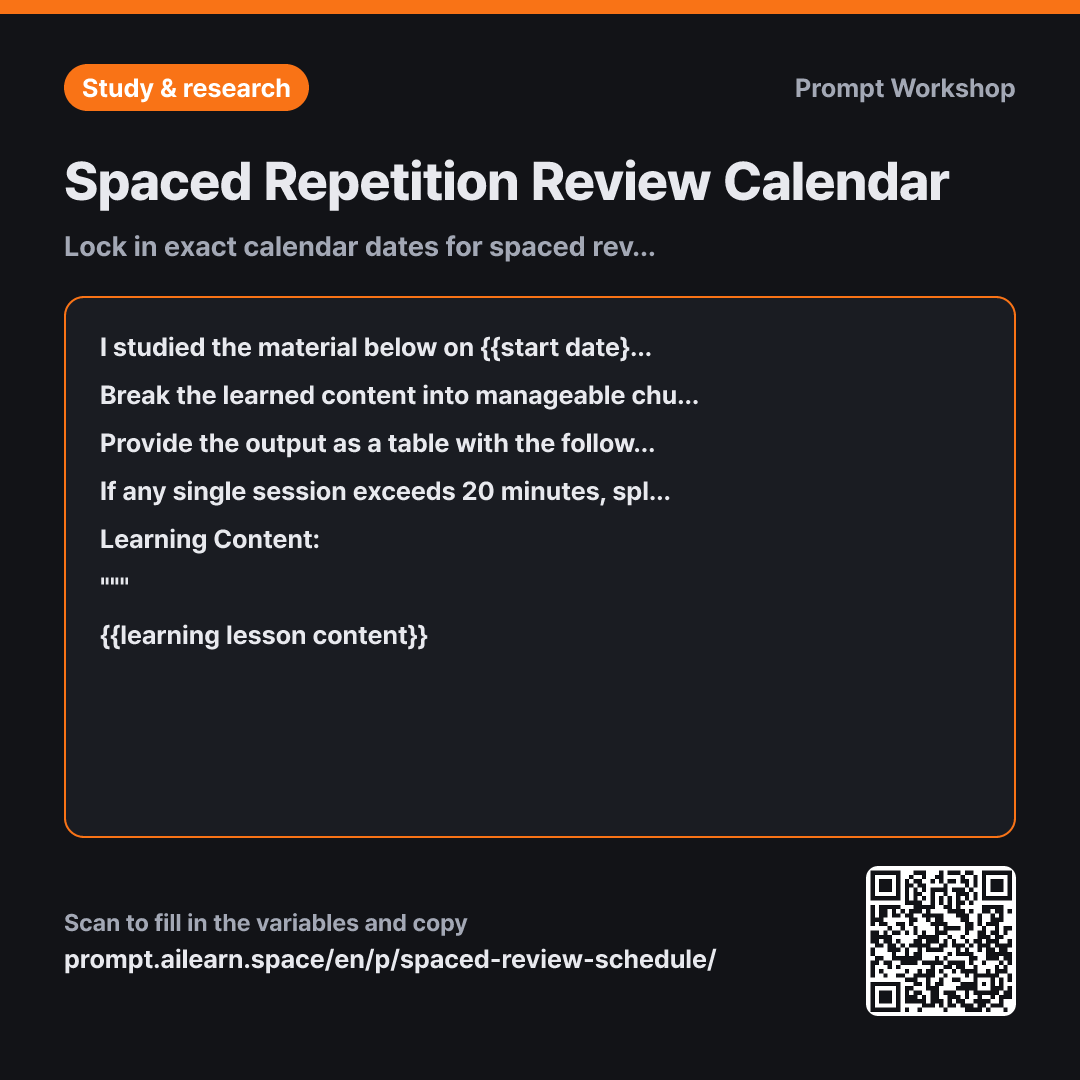
Why it is written this way
When you ask ChatGPT for a study review plan, you usually get generic advice like "Review once the next day, then again in a week." While technically accurate, it rarely gets followed because you cannot directly copy it into your calendar. Without exact dates, review becomes "sometime later," and later never happens. The goal of this prompt is not advice, but a concrete table stamped with real calendar dates.
In the second Task paragraph, specifying the exact intervals—1, 3, 7, 16, and 35 days—prevents the model from generating arbitrary, inconsistent cycles each time. While the forgetting curve concept is widely known, different sources cite different intervals. Locking in the numbers ensures consistency across weeks, and requiring day-of-the-week calculations helps you spot scheduling conflicts immediately.
In the third Format paragraph, separating "Content Scope" and "Review Method" ensures that the cognitive task changes as time passes. Passively skimming the same notes five times only creates the illusion of mastery. Specifying this distinction forces later sessions to focus on active recall and testing.
In the fourth Constraints paragraph, strict boundaries prevent the plan from becoming unmanageable. Without a time cap, the AI might generate two-hour daily commitments, and without strict topic boundaries, it might hallucinate unstudied material. Banning vague labels like "reading" guarantees that you can sit down and take immediate action.
Unfamiliar terms? See Aha AI: output-format, prompt
Compared with a bad example
Make me a review plan. I studied biology homeostasis today.
This results in generic study tips and vague recommendations like "Review in 1 day, 3 days, and 7 days." Because it gives relative intervals rather than calendar dates, you have to count the days manually. Furthermore, without a designated review method or daily time limit, you will likely just re-read everything from the beginning on day one and quickly burn out.
Variations
When an Exam Date Is Fixed
I studied the material below on {{start date}}, and my exam is scheduled for [Exam Date]. Please distribute spaced review sessions across the remaining timeframe. Gradually increase the intervals so that the final review session concludes two days before the exam, leaving only a brief high-level skim for the day before. Present this as a table with the columns: Session Number, Date (Day of the Week), Content Scope, and Review Method. If the remaining days are insufficient for all sessions, reduce the number of sessions and explain in a single line below the table which session was omitted and why.
Learning Content: """ {{learning lesson content}} """
When working with a fixed exam deadline, the end date takes precedence over theoretical intervals. Requiring the AI to explain omitted sessions ensures you enter the exam aware of any trade-offs made.
When Catching Up on Overdue Reviews
I studied the material below on {{start date}}, but I missed [Number] days of scheduled review. Instead of creating a plan from scratch, adjust the schedule so I can catch up starting today. Do not cram all missed sessions into a single day; split them across two days, prioritizing the material I have not reviewed for the longest time. Provide the table with the columns: Session Number, Date (Day of the Week), Content Scope, Review Method, and Estimated Time.
Learning Content: """ {{learning lesson content}} """
Starting entirely over after falling behind often leads to repeated failure. Splitting overdue items into manageable chunks provides a realistic path back on track.
Related prompts
Last updated 2026-09-02 · Found a mistake? Let us know