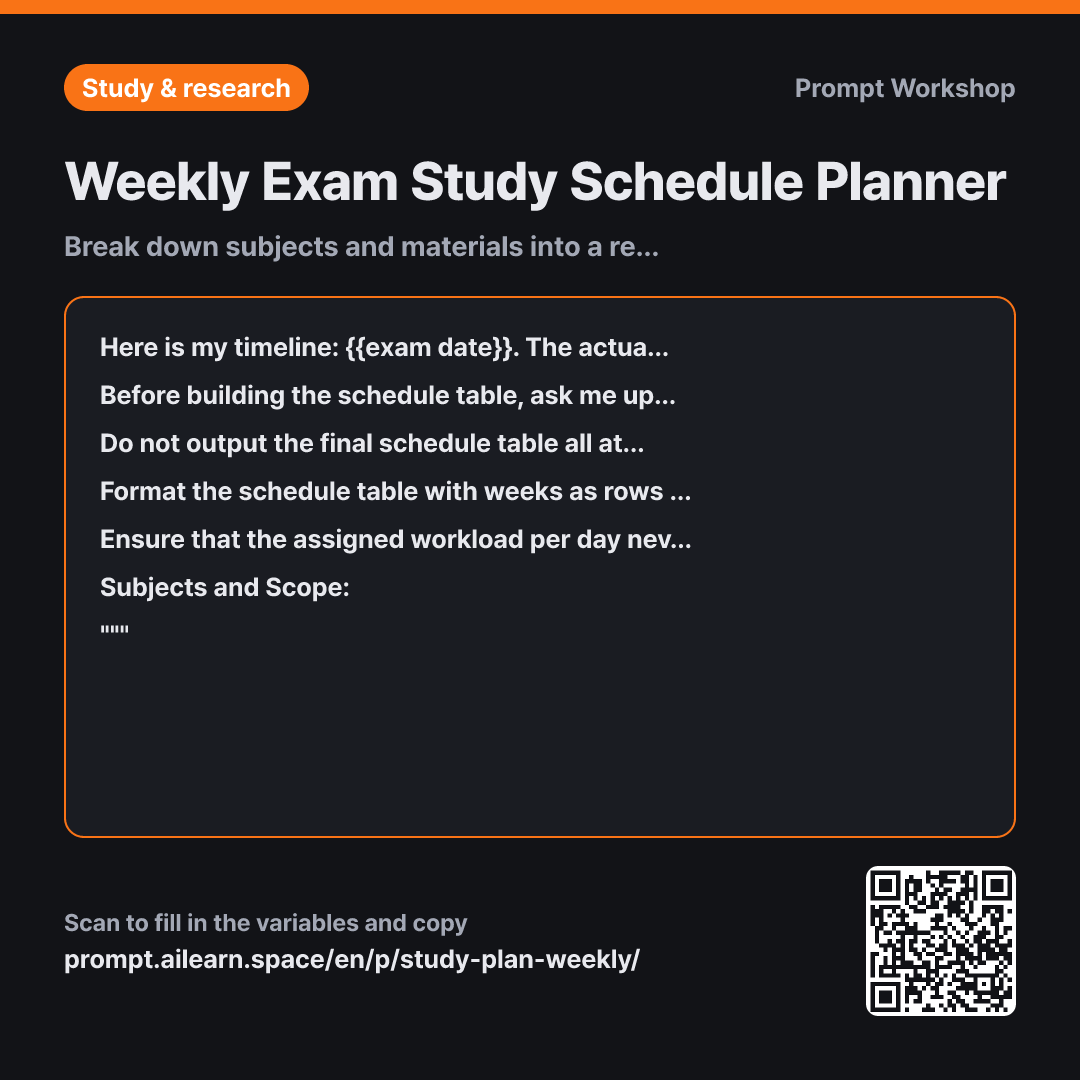
Why it is written this way
When asking AI for a study schedule, it often spits out an unrealistic 8-hour-per-day plan. You might manage to stick to it for the first three days, but as soon as you fall behind once, the whole plan collapses—and creating a new one feels so daunting that you end up abandoning planning altogether. An unachievable plan is worse than having no plan. This prompt forces the AI to calculate your realistic available hours before building any schedule.
Splitting the task into two steps is the core mechanism here. Comparing the total available hours against the scope in Phase 1 reveals whether the workload actually fits before any table is generated. Deciding what to cut or deprioritize upfront is vastly better than receiving an impossible schedule and feeling guilty every single day.
Putting clarifying questions first ensures that high-impact variables—like weak units or completely blocked days—are accounted for. Without these questions, you get a generic, flat schedule that spreads equal time across all topics. The "Review / Spaced Repetition" column in the format works hand-in-hand with the spaced review rule in the constraints. Simply glancing over a topic once means you will remember nothing on exam day.
The weekly buffer day and final-week review rule give you breathing room to recover when life happens. Enclosing the scope in """ ensures that syllabus text or textbook tables of contents are not misinterpreted as system instructions.
Unfamiliar terms? See Aha AI: chain-of-thought, output-format
Compared with a bad example
I have an exam on Nov 14. Make me a study schedule. Subjects are Business, Stats, and English.
Without knowing daily time constraints, the AI makes generous assumptions—typically outputting a brutal 4-hour weekday and 8-hour weekend routine with equal time distributed blindly across subjects. There is no built-in spaced repetition, forcing you to re-read all three subjects from scratch during the final week.
Variations
When you fall behind and need to recalibrate
I created a plan with the scope below, but I am now one week behind schedule. Please recalculate the remaining schedule based on {{exam date}}. Do not rebuild it from scratch; remove what I have already completed and redistribute only the remaining workload. If time is too tight, first suggest which chapters can be downgraded to a "quick skim." My daily availability remains {{daily study time}}.
""" {{subject and scope}} """
Rebuilding the entire plan from scratch after falling behind often leads to another failure. Pruning what is already done and rescheduling only the remainder produces a plan you can actually stick to.
When determining daily action items step-by-step
From the scope below, determine only today's study workload based on one day's allocation of {{daily study time}}. Break the tasks into 25-minute study blocks, and for each block, specify "What to study · Target end point · Completion criteria (how to verify it's done)". Reserve the final block for reviewing yesterday's material.
""" {{subject and scope}} """
A weekly overview doesn't tell you exactly which book to open right now. Running this variant in the morning lets you sit down and start working immediately.
Model notes
Some models struggle with exact date arithmetic. In Phase 1, confirm the count by asking, "Count how many days remain first," before generating the schedule. Since some models may not know the exact current date, it is safest to state today's date alongside the exam date. Once the schedule is generated, follow it for just the first week and calibrate for week two.
Related prompts
Last updated 2026-09-02 · Found a mistake? Let us know