Why it is written this way
When asking an AI to organize reading notes, the biggest risk is that it fills in parts of the book you never actually read. Given just a book title, AI models tend to pull standard summaries and famous quotes from online memory. The resulting output reflects what the internet thinks about the book rather than what you actually absorbed.
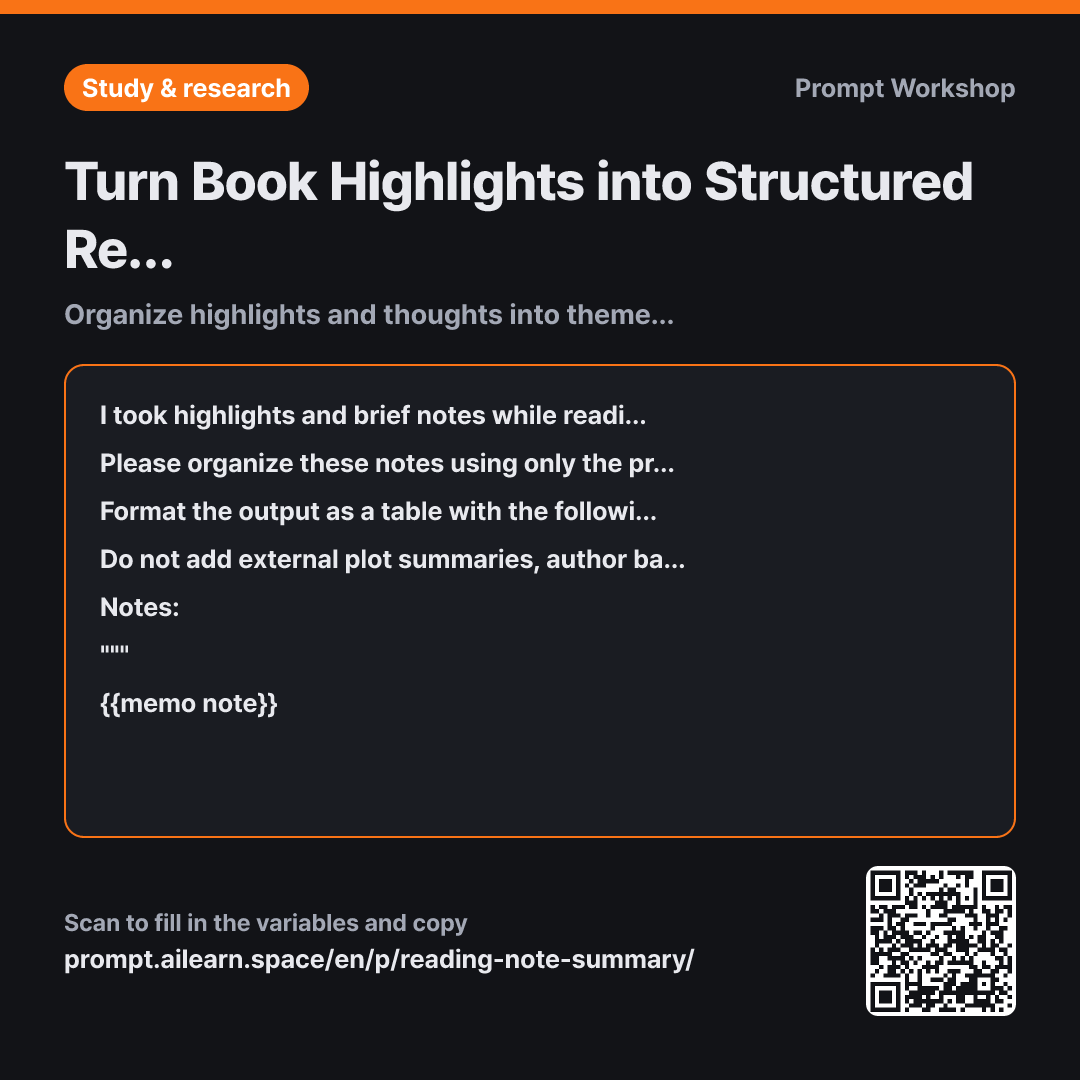
This is why the Task in the second paragraph explicitly restricts the source: "using only the provided text as your raw material." Locking down the input keeps every insight anchored strictly in your own reading. Splitting quotes from personal thoughts in the same paragraph is equally crucial; months later, it becomes difficult to recall which lines belonged to the author and which were your own, leading to misattributions in future writing or research.
In the Format instructions, the "Reason to Revisit" column makes your notes practically actionable. Highlights without context lose their relevance over time. Adding "unanswered questions" beneath the table provides natural starting points for your next reading selection.
Most Constraints are clear negative constraints paired with safe alternatives. Ambiguous notes are flagged as "Needs Clarification" rather than deleted or guessed, and phrasing is polished without altering original intent. Wrapping the raw notes in """ prevents incidental remarks (like "look this up later") from being misread as prompt commands.
Unfamiliar terms? See Aha AI: hallucination, output-format
Compared with a bad example
I read Atomic Habits, please write my reading notes. I liked the 2-minute rule and the identity part.
When given only a book title, the AI generates generic table-of-contents summaries and overused quotes. Even if it generates page numbers, they are often hallucinated, and the personal reasons why you highlighted those passages are lost entirely. You end up with a generic web summary rather than a personal reading log.
Variations
Outlining a Book Review or Essay
Below are the notes and highlights I took while reading {{published book title}}. Using only these notes, create a structured outline for a comprehensive book review. Establish a central thesis based on my recurring interests, and arrange specific notes as supporting evidence across paragraphs. Do not write full prose drafts; provide only the key argument and designated quotes for each section.
""" {{memo note}} """
Letting the AI write the entire essay draft removes your voice. Keep the AI limited to outlining and evidence placement, then write the actual prose yourself.
Synthesizing Multiple Books on One Theme
Below are reading notes collected across multiple books on a shared topic. Organize them thematically rather than by book. Format the output as a table with the columns: "Theme | Supporting View & Note | Contradicting View & Note | My Takeaway". Attribute each note clearly to its respective book title, and do not introduce external information.
""" {{memo note}} """
Points where books disagree provide the deepest insights. This structure places differing perspectives side by side for direct comparison.
Model notes
Placing long quotes directly inside markdown tables can sometimes cause display truncation. If quotes exceed a few lines, instruct the model: "Move long quotes to a bulleted list beneath the table." For extensive notes, process them chapter by chapter first, then finish with: "Consolidate all previous tables into a single thematic overview."
Related prompts
Last updated 2026-09-02 · Found a mistake? Let us know