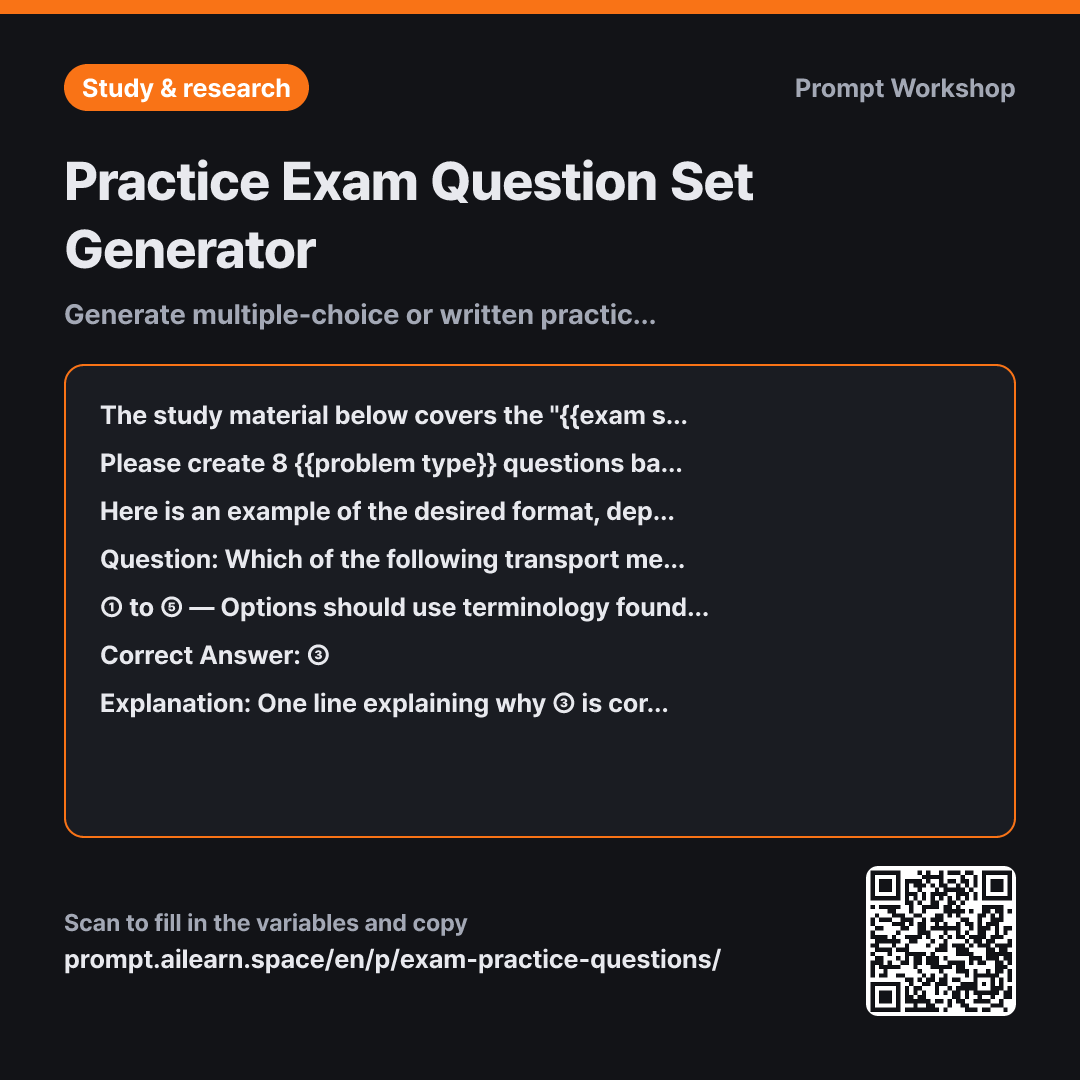
Why it is written this way
If you simply ask an AI to generate exam questions, it typically picks random nouns from the text and spits out shallow questions like "What is osmosis?" While this tests basic memorization, it misses the conceptual nuances tested on real exams. Explaining exact exam depth in words is difficult, but providing a reference example communicates standard expectations instantly.
The Example paragraph achieves this. By showing a complete sample with the question, answer, explanation, and "Common Pitfalls," the AI captures the required depth, tone, and layout. Demanding plausible distractors directly inside the example ensures that incorrect options aren't obviously wrong, preventing the student from guessing the right answer effortlessly.
The Format paragraph specifies a 3-3-2 difficulty distribution (Easy, Medium, Hard) to ensure a balanced question set. Grouping answers at the very bottom prevents accidental spoilers while taking the test.
The Constraints paragraph preserves question reliability. Quizzing outside the provided material wastes study time, as do ambiguous questions with contested answers. Restricting the AI from claiming these are "real past exam questions" prevents halluncinated provenance and skewed study expectations. Enclosing study material in """ ensures any student notes like "Prof said this is on the exam!" are not parsed as AI instructions.
Unfamiliar terms? See Aha AI: few-shot, hallucination
Compared with a bad example
Make an exam quiz based on this.
(paste textbook summary)
Produces a handful of trivial definition questions at an evenly low difficulty. In multiple-choice questions, the distractors are often absurdly obvious, allowing anyone to guess correctly without real understanding. Explanations usually appear right under each question, spoiling the answer before you attempt it.
Variations
Targeting Weak Concepts from Incorrect Answers
I will provide the question numbers I answered incorrectly from the {{academic subject}} "{{exam scope}}" practice set created earlier.
First, identify the core concept tested across these missed questions. Then, generate 5 new {{problem type}} questions approaching that same concept from different angles. Do not reuse sentences from earlier, and include a one-line "What you need to know to answer correctly" note under each question.
A targeted variation for drilling missed concepts instead of repeating the entire quiz. Use this in the same chat thread so the AI can reference the previous questions.
Grading Written Free-Response Answers
Please create 3 free-response written questions for {{academic subject}} based on the study material below. For each question, establish a grading rubric breaking down point allocations based on specific keywords or concepts included.
Present only the questions first and wait for my response. Once I submit my answers, grade them according to your rubric and indicate which sections of the study material I should review for any deducted points. Do not reveal the model answers beforehand.
Study Material: """ {{learning study material}} """
Free-response questions require clear rubrics to be effective practice. Withholding the model answers forces you to write out responses on your own first.
Model notes
After completing the questions, follow up with: "Give me 5 more questions testing the same concepts as the ones I missed in questions #3 and #7" to focus strictly on your weak areas.
Related prompts
Last updated 2026-09-02 · Found a mistake? Let us know