Why it is written this way
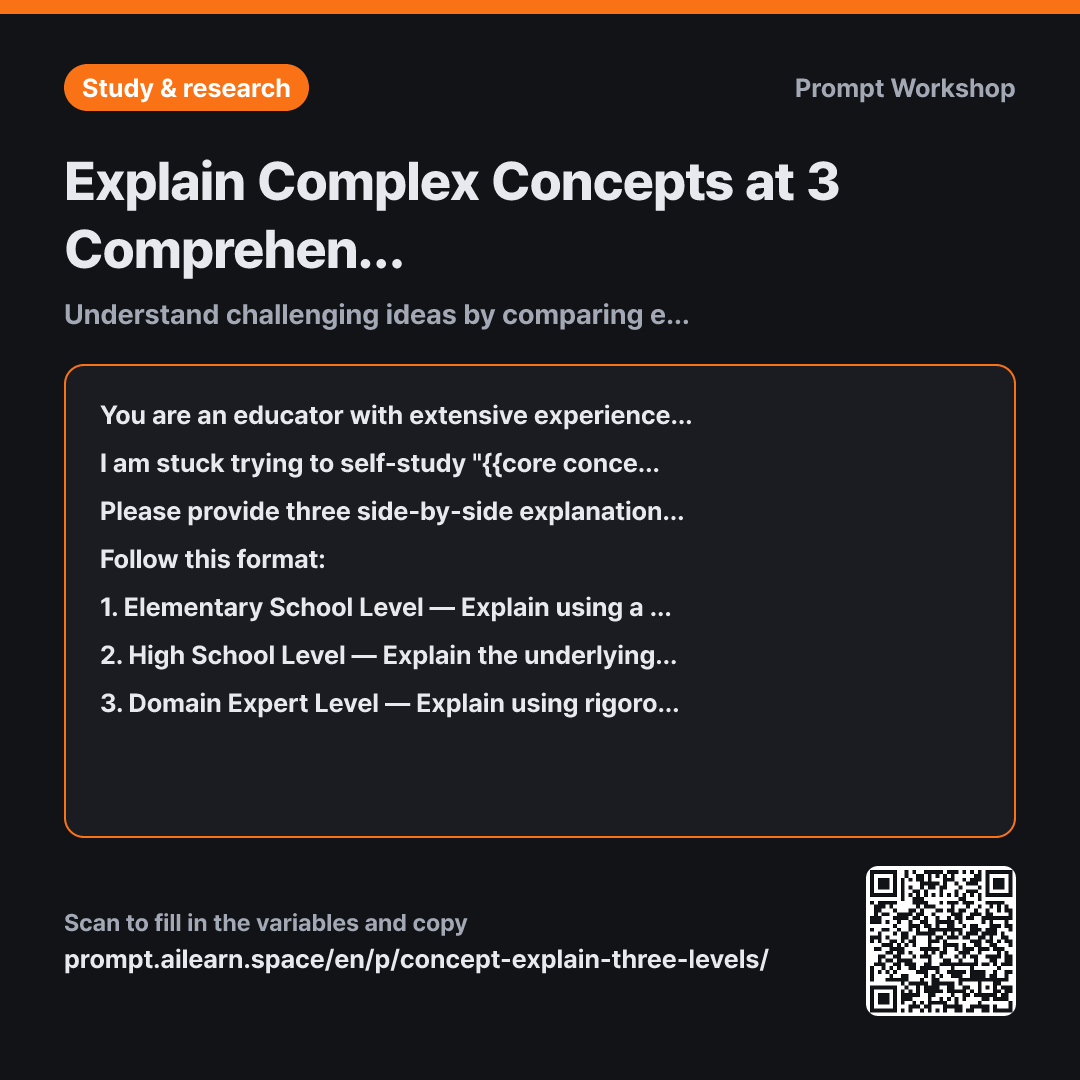
When you receive an explanation at only one difficulty level, it is hard to pinpoint where you got stuck. Simple explanations make you feel like you understand until you try to apply the knowledge and fail, while complex explanations leave you unsure of which specific term or premise derailed you. This is why requesting a concept breakdown across three tiers is so effective: reading parallel tiers reveals the exact sentence where your comprehension ends.
In the role section, specifying both ends of the spectrum—"to both elementary school students and first-year graduate researchers"—is critical. If you only name one demographic, the AI tends to write all three versions in a uniform tone. Anchoring both extremes forces a genuine conceptual gap between the tiers.
The format section assigns explicit sentence counts and unique content requirements to each level. If you only adjust length, the model simply pads or trims the same sentences. Asking for "underlying mechanisms" in tier two and "boundary conditions and exceptions" in tier three ensures that advancing tiers introduce real logical constraints rather than just verbosity. The "What Was Added at Each Level" breakdown creates a reference map so you can see the exact layer where your knowledge fell short.
The constraints prevent common pitfalls of simplified explanations. Analogies help intuition but can leave lasting misconceptions; requiring the AI to state the analogy's limitation allows you to discard the mental crutch when reading the formal definition. Finally, demanding that unsettled topics not be framed as settled facts prevents the model's tendency to sound overly definitive when simplifying.
Unfamiliar terms? See Aha AI: role-prompting, hallucination
Compared with a bad example
Explain opportunity cost simply.
This produces a brief summary with a single analogy. It feels clear while reading, but lacks the conditions and exceptions needed to solve real problems. It also blurs the line between the formal definition and the metaphor, making it easy to memorize an analogy as literal fact.
Variations
When you want to understand via familiar analogies
Please explain "{{core concept}}" using comparisons to things I already understand well.
First, provide 3 candidate analogies from daily life or other well-known fields that share a similar structural logic with this concept. For each, add a one-line note on where the analogy holds and where it breaks down. Then, select the best-fitting analogy among them and use it to explain the entire concept.
Instead of letting the AI pick an arbitrary metaphor, having it list multiple candidates lets you choose the one that best aligns with your background knowledge.
When explanations still leave you stuck
I am trying to understand "{{core concept}}", but I keep getting stuck. Before explaining further, identify up to 5 prerequisite concepts that I must master first, ordered from foundational to advanced.
For each prerequisite, include a one-line note identifying "where you will get stuck if you don't know this," along with a Yes/No diagnostic question so I can test my understanding and pinpoint where to start review.
If a concept remains confusing no matter how simply it is explained, the issue usually lies in a missing prerequisite. This variant maps out the foundational ladder instead of re-explaining the target concept.
Related prompts
Last updated 2026-09-02 · Found a mistake? Let us know