Why it is written this way
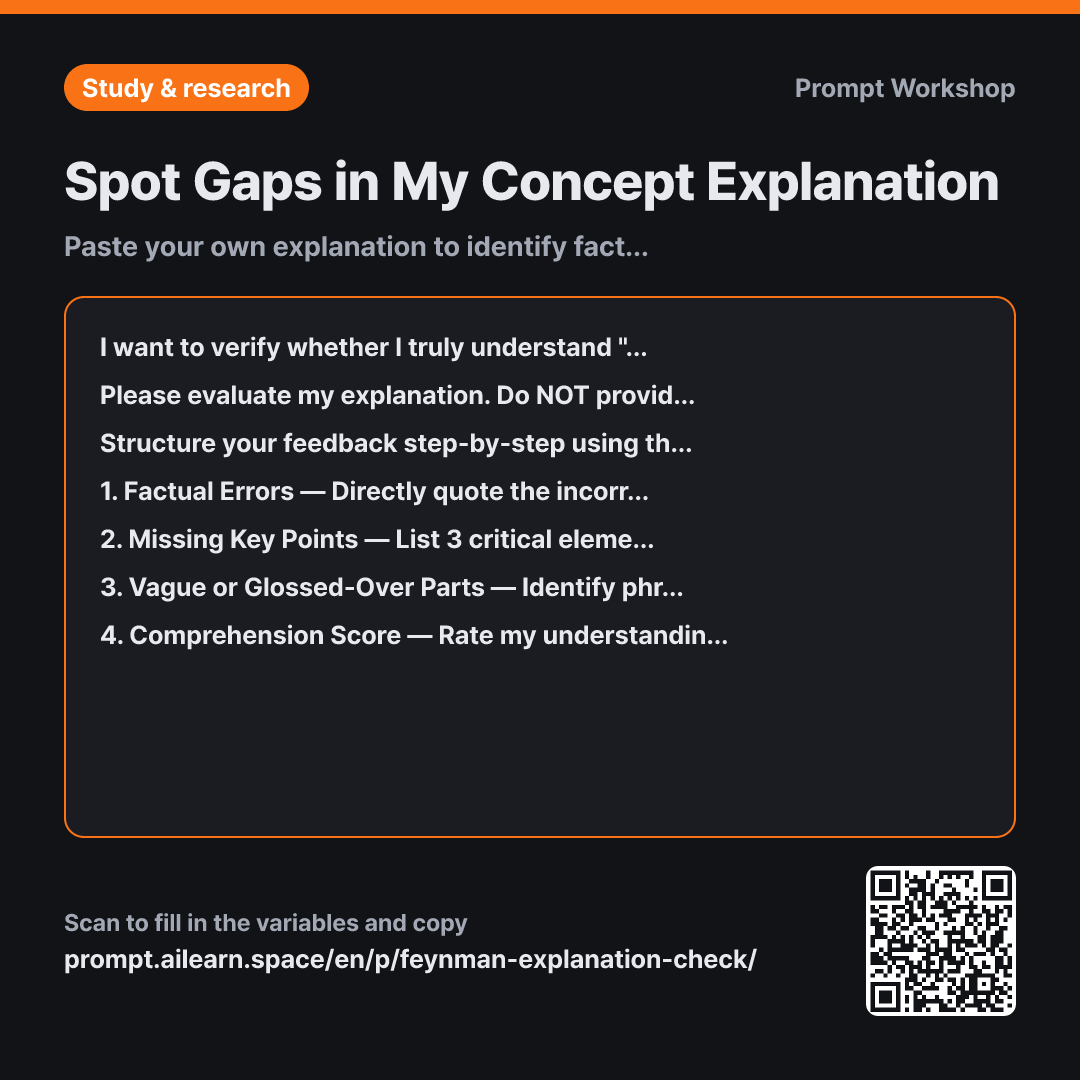
Reading an explanation multiple times creates the illusion of competence. That illusion shatters the moment you face a blank test sheet. The core of using the Feynman Technique with ChatGPT is flipping the dynamic: instead of asking the AI for an explanation, you provide your own explanation and have the AI grade it. The AI functions here as an evaluator, not a teacher.
The sentence in the second paragraph, "Do NOT provide a rewritten or polished version," is the most important constraint in this prompt. Without it, the AI will provide a brief critique and immediately output a beautifully written, complete explanation. The moment you read that, you slip back into passive recognition, and the active retrieval practice is lost.
Dividing the critique into steps ensures different types of misunderstandings are handled distinctly. Factual mistakes, omitted concepts, and glossed-over hand-waving require different remedies. Step 3 is especially valuable for comprehension checks: it catches filler connectors like "and with that energy," which people often write without actually knowing what the mechanism is. Step 5 provides guiding questions instead of direct answers, pointing out exactly what needs to be filled in during the next attempt.
The constraints section prevents the evaluation from turning into basic copyediting. If the AI starts fixing grammar and style, conceptual gaps get buried under cosmetic revisions. Instructing it not to invent quotes prevents hallucinated critique. Wrapping the text in """ delimiters prevents any personal notes or question marks inside your text from being misread as new system instructions.
Unfamiliar terms? See Aha AI: chain-of-thought, hallucination
Compared with a bad example
Did I understand this correctly?
(Paste my explanation here)
The AI will usually start with polite praise like "You've got a solid grasp!" and follow up with a perfectly rewritten explanation. Your errors and omissions blend seamlessly into the polished text, making it difficult to pinpoint exactly where your understanding fell short. You end up merely reading someone else's good explanation, and you will stumble in the exact same spot next time you try to explain it.
Variations
Reviewing a Rewritten Attempt
I have rewritten my explanation of "{{core concept}}" after addressing the previous feedback.
Please check exclusively whether the prior feedback points were properly resolved. For each previous critique, label it as Resolved, Partially Resolved, or Unchanged, and add a single line explaining what is still missing for any incomplete points. If any new factual errors were introduced, list them separately at the end.
Rewritten Explanation: """ {{my explanation}} """
Re-scoring the whole text on a second pass can obscure the original issues. Checking only the status of previous critiques makes remaining gaps immediately clear.
Testing Pedagogical Clarity
Below is an explanation of "{{core concept}}" written as if I were teaching it to a beginner or junior colleague.
Read this from the perspective of someone hearing about this topic for the first time. Identify 5 chronological points in the text where a beginner would stop to ask "Why?" or "What does that mean?". For each point, write a single line explaining what prerequisite context should have been introduced earlier to prevent confusion. Do not write the answers for me.
My Explanation: """ {{my explanation}} """
This variant evaluates the logical sequence rather than just factual accuracy. Even if the facts are right, a scrambled explanation fails to communicate effectively.
Model notes
If you paste your revised explanation into the same conversation thread, the AI will compare it with the initial feedback and highlight specific improvements.
Related prompts
Last updated 2026-09-02 · Found a mistake? Let us know